
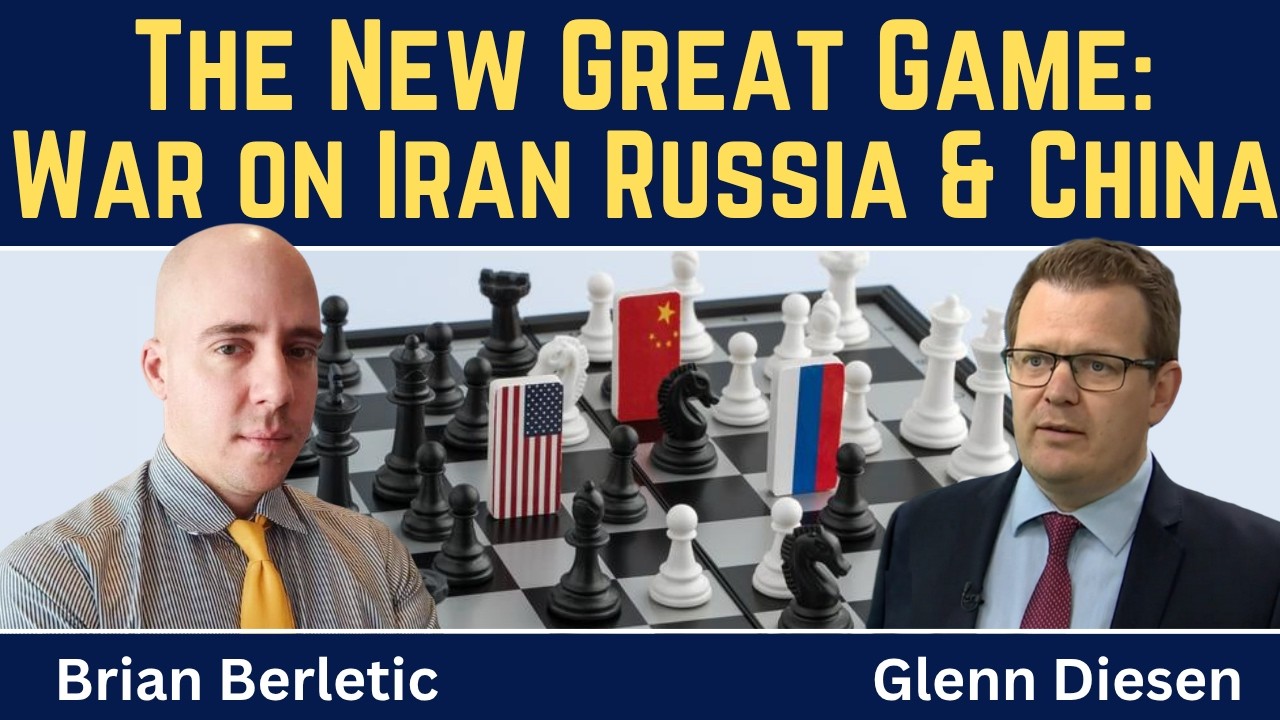
While Western media outlets mostly treat the conflicts with Russia, Iran, and China separately, geopolitical analyst Brian Berletic argues that all these crises are part of a single long-term strategy. In an extensive interview, the former US Marine and operator of the channel The New Atlas describes the current geopolitical conflict as a modern version of the “Great Game”—a global power struggle over trade routes, energy, spheres of influence, and the future of the world order.
His central thesis:
The USA is no longer primarily trying to maintain peace or stability — but to sabotage the rise of competing power centers before American hegemony finally collapses.

“The real goal is China”
Berletic makes it clear right at the beginning:
Iran, Russia and China are not separate conflicts — but parts of a single geopolitical picture.
In his view, the entire US strategy is ultimately directed against China.
Russia should be weakened:
- through sanctions
- NATO expansion,
- Attacks on energy infrastructure,
- and the war in Ukraine.
Iran, in turn, will:
- military,
- economically
- and geopolitical
pressure was put on China to destabilize its energy supply.
Because:
China is massively dependent on energy imports from the Middle East.
Berletic argues that
the conflicts in Eurasia are therefore no accident —
but part of a comprehensive attempt to slow China’s long-term rise.
Diplomacy as a tool of escalation
Berletic is particularly critical of American diplomacy.
The US would not hold talks to resolve conflicts —
but to buy time, build narratives and prepare for further escalation.
He refers to:
- on Ukraine,
- on Iran
- and in Taiwan.
Western politicians repeatedly speak publicly of “negotiations,”
while at the same time:
- Weapons delivered
- military alliances expanded,
- Sanctions tightened
- and conflicts would deepen.
Berletic describes this as a strategy of “double play”:
diplomacy on the outside —
escalation in the background.
“The USA doesn’t want balance – they want dominance.”
A key point of the interview:
The United States would not accept a multipolar world.
Berletic explains:
Washington is not striving for a balance of power —
but rather global dominance (“primacy”).
He refers to:
- US strategy papers,
- RAND studies,
- Think tank analyses
- and official government documents,
in which the securing of American dominance is repeatedly and openly discussed.
According to Berletic, the real fear of the USA is
that Eurasia will grow together economically.
Above all:
- China,
- Russia,
- Iran,
- Central Asia
- and parts of Europe
They could jointly form an economic area that escapes American control.
Control of trade routes
Berletic’s analysis of global sea routes is particularly alarming.
He argues:
The US is systematically trying to:
- Energy flows,
- Trade routes,
- Straits
- and maritime hubs
to keep under control.
He mentions the following:
- the Strait of Hormuz
- the Strait of Malacca,
- the Indian Ocean,
- the South China Sea
- and even the Baltic Sea.
According to Berletic, a global maritime printing strategy is currently being established:
- against Russian energy
- against Iranian exports,
- and indirectly against China.
“The USA is deliberately creating instability”
Berletic goes even further:
Washington is no longer necessarily trying to stabilize the world —
but rather to destabilize it in a controlled manner.
In his view, the logic is:
If the US can no longer catch up with China economically,
then one must:
- destroy supply chains,
- Trade routes are endangered,
- Energy prices are destabilizing
- and create global uncertainty.
The goal is
to slow down China’s rise —
even if this damages the global economy.
Berletic puts it drastically:
The USA is prepared
to “set everything on fire”
if it means prolonging its dominance.
The new energy warfare
A large part of the interview revolves around energy.
Berletic describes
how Europe has already been affected by:
- Sanctions,
- Pipeline crises,
- LNG dependency
- and the destruction of Nord Stream
has been strategically more closely tied to the USA.
Now the same strategy is being applied to Asia.
He refers to:
- the crisis in Hormus
- Attacks on shipping,
- Pressure on Indonesia,
- military presence around Malacca
- and the attempt to make Asian countries more dependent on US energy exports.
Taiwan as the “Asian Ukraine”
Berletic’s statements regarding Taiwan are particularly explosive.
He does not believe
that Washington was ever seriously interested in a peaceful solution.
Rather, Taiwan is being systematically:
- militarily upgraded,
- politically instrumentalized
- and used as leverage against China.
He effectively refers to Taiwan as
a potential “Asian Ukraine”.
Together with:
- Japan,
- South Korea
- and the Philippines
Taiwan should be integrated into a regional anti-China front.
The global “dirty war”
Berletic repeatedly refers to an already ongoing “Dirty War” against China.
By that he means:
- Sabotage,
- Economic war
- political influence operations,
- Support for armed groups,
- Attacks on Belt and Road Initiative infrastructure projects,
- as well as destabilization along Chinese trade routes.
He cites examples from:
- Myanmar
- Pakistan,
- Afghanistan
- and Central Asia.
He said that Chinese infrastructure projects in particular were being deliberately put under pressure.
Washington’s real fear
Berletic describes the biggest American concern as follows:
China could become permanently stronger than the USA —
and create a multipolar order in which Washington can no longer dominate.
That’s precisely why they try to:
- To weaken Russia,
- to isolate Iran
- To control trade routes
- to militarize alliances
- and to keep Eurasia divided.
“How much more damage will the USA cause?”
However, the darkest element of the interview is Berletic’s conclusion.
He believes that
the American empire is already in a phase of structural decline.
The crucial question is no longer
whether US dominance will end —
but rather:
how much damage will be done in the process.
Berletic explicitly warns against
underestimating Washington’s willingness to escalate.
He refers to:
- on discussions about nuclear weapons,
- on the massive militarization of Asia,
- on the increasing confrontation with Russia,
- and the willingness to accept global economic crises.
The actual conclusion
Between the lines, Berletic describes a world in transition:
- from American-dominated unipolarism,
- towards a multipolar order.
But this transition is not peaceful.
In his estimation, Washington is trying to:
- to delay the change,
- To weaken rivals,
- to control trade routes,
- to keep Eurasia divided
- and to play geopolitical rivals off against each other.
The conflict against Iran,
the escalation against Russia, and the encirclement of China
Therefore, these are not separate crises —
but rather fronts of the same global power struggle.