
Citi’s Robotics & Physical AI Leadership Conference wrapped up on Tuesday. The annual Citi Research event brings together robotics founders, investors, operators, and industry executives to assess the state of “physical AI.”
Analyst Heath Terry summarized the key takeaways Wednesday morning, painting a picture of the robotics industry moving from proof of concept to commercial deployment, while warning that scaling robots remains challenging.
“Labor shortages, reshoring, and favorable regulatory tailwinds are accelerating enterprise demand, while data scarcity, talent constraints, battery limitations, and high deployment costs remain key friction points,” Terry explained to clients.
Citi said the winners in physical AI will likely be firms that own proprietary real-world data, solve specific labor bottlenecks and use Robotics-as-a-Service models to reduce upfront costs for customers.
Terry highlighted automation-exposed industrial names including Rockwell Automation, Emerson Electric, Honeywell, Symbotic, Ralliant and Belden as potential beneficiaries.
Humanoids are attracting significant investor interest. Last month, we detailed how readers can invest ahead of a major ramp in humanoid production expected in the coming quarters. Read the report.
Via Deutsche Bank:

Over the last two years, about $20 billion has been invested in physical AI, with applications spanning warehouses, logistics, trucking, construction, aviation, and defense.
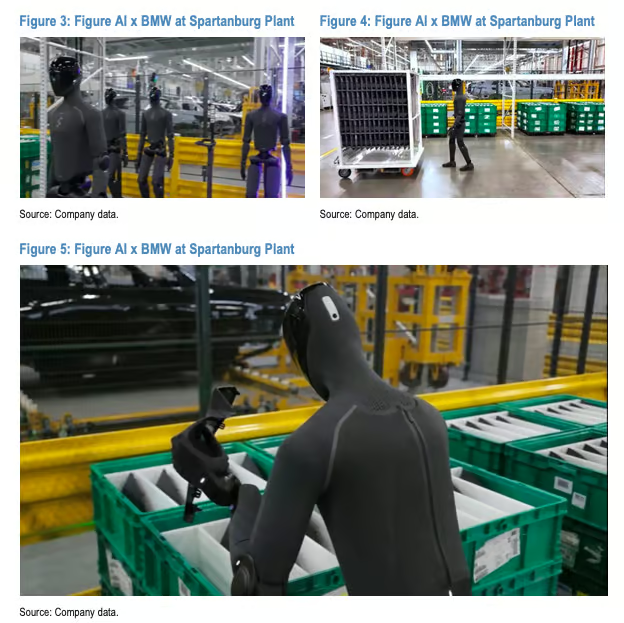
Last week, carmaker BMW revealed that a new upgraded humanoid is walking its factory floors at the Spartanburg plant in South Carolina.
Here are Citi’s top takeaways from the physical AI conference:
Key AI Takeaways
Physical AI is transitioning from proof-of-concept to commercial deployment, but the path to scale is more operationally intensive than the digital AI analogy suggests. Unlike large language models, where a base model carries a lot of the value, physical AI places the premium on proprietary, task-specific data collected in real-world environments, purpose-built hardware, and safety certification.
Across sessions, participants consistently identified data scarcity as the binding constraint, with Instawork noting that even tens of millions of hours of data being collected in 2026 likely represents only basis points, not percentage points, of what is ultimately needed to achieve high-level robotic performance. Power, battery longevity, and chip architecture are also emerging as critical bottlenecks, with panelists noting that existing semiconductor platforms were designed for datacenter workloads, not real-time edge inference on mobile platforms.
The most commercially advanced companies, whether in humanoids, warehouse AMRs, autonomous trucking, or construction, shared a common profile: they started with a specific, high-pain labor problem, adopted a Robotics-as-a-Service model to lower customer adoption barriers, and prioritized safety and reliability above model sophistication.g significant investment enthusiasm, but near-term ROI is being driven by purpose-built AMRs and specialized systems from companies like Locus Robotics and Dexterity. The conference reinforced our view that physical AI is a decade- long buildout, with durable value accruing to companies that own the data flywheel, solve real deployment problems, and meet the highest safety standards.
Key Industrials Takeaways
After attending Citi’s Robotics & Physical AI Leadership Conference, we came away convinced that automation, robotics, and physical AI continue to make gradual progress toward broader commercialization, creating what we view as a durable long-term growth tailwind for our automation-exposed industrial companies. Our preferred ways to gain exposure to industrial automation are through Buy-rated ROK, EMR, and HON (pure-play automation providers), SYM (warehouse automation), RAL (sensors and T&M), and BDC (industrial networking), as we view these companies as well positioned to benefit from increasing investments in automation (including equipment, software, and AI). Key drivers of automation adoption remain a constrained labor market as well as accelerating domestic manufacturing activity and capacity expansions, with automation supportive of higher throughput, increased uptime, and improved operational efficiency/accuracy that appears supportive of healthy ROIs.
While logistics, warehousing, and autos appear to be important end markets driving automation adoption (higher volume, repetitive tasks), several panelists highlighted AI’s potential to unlock new skills/capabilities for robotics and automation, which could, over time, expand addressable markets for automation solutions (new end markets and new use cases), which we view as a broad positive. Advances in AI/LLMs along with growing availability of data (real-world as well as simulated) are leading to more refined technology through, for instance more integrated hardware and software and more active usage driving increasingly capable deployments (as AI-enabled systems grow “smarter”), which we think could further support accelerating automation adoption over time. In some instances, access to high-quality data remains a bottleneck (where companies are combining simulations with limited real-world data), but we also view this as an opportunity and competitive moat for our companies, given their large installed base and ability to leverage/mine data to further drive autonomy and operational efficiency.
Select companies also highlighted robotics-as-a-service (RaaS) business models that potentially lower the barriers to adoption for small and medium sized enterprises given lower or minimal upfront capital costs, which we view as supportive of our constructive view on SYM’s warehouse-as-a-service offering (GreenBox/Exol), which we think could help drive increasing adoption of SYM’ warehouse automation solutions amongst a broader range of customers.
The most important takeaway is that Physical AI is emerging and deployments will be ramped up as Robotics-as-a-Service models reduce upfront customer costs. Physical AI may eventually benefit from scaling laws, but the path will be much slower and more operationally intensive than the chatbot boom.
Professional subscribers can read a whole lot more on physical AI at our Marketdesk.ai portal.