
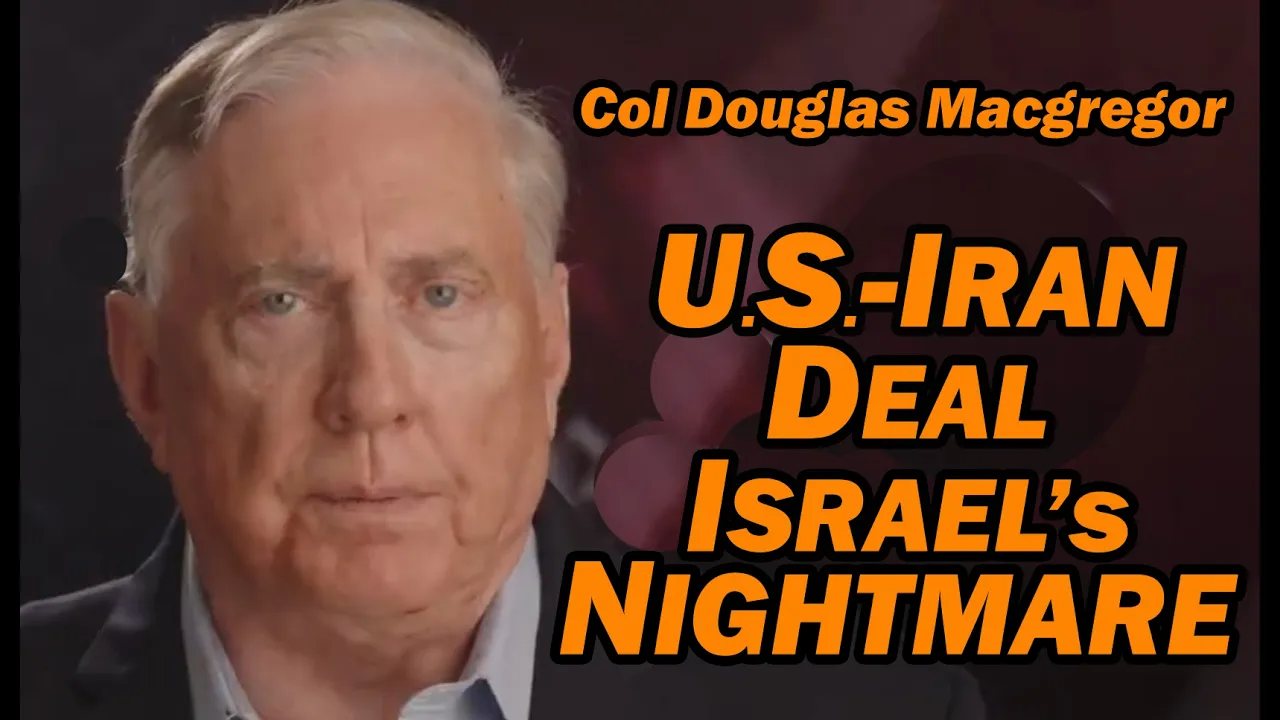
While Western media continue to talk of possible negotiations, diplomatic breakthroughs, and an alleged “de-escalation” between Washington and Tehran, former Pentagon advisor and Colonel Douglas Macgregor paints a completely different picture of reality. In an explosive interview, he describes the Middle East as a region on the brink of a historic geopolitical reordering—and warns that the United States could be drawn into a war it can neither control nor win.

Macgregor is certain:
The conflict with Iran is no longer just a regional war.
It has become part of a much larger power struggle.
- about the future of Israel,
- to maintain American supremacy,
- global energy supply,
- and the strategic reorganization of the entire Middle East.
His analysis is devastating:
The US massively underestimated Iran, ignored its own vulnerability, and now faces a geopolitical dilemma from which there is no easy way out.
“A US withdrawal would be catastrophic for Israel.”
Macgregor begins his analysis with a statement that comes as a shock:
Israel simply cannot afford an American withdrawal from the war.
He argues that
the Israeli leadership knows full well that its entire strategic position is based on the permanent support of the United States.
Should Donald Trump suddenly declare:
- there is “no military solution”,
- The US would withdraw,
- or the fighting would be frozen,
Then, according to Macgregor, this would be “catastrophic” from an Israeli perspective.
Because:
Israel must keep Washington permanently engaged in conflict.
Only in this way can Tel Aviv prevent itself from becoming geopolitically isolated.
The fear of the end of American protection
Between the lines, Macgregor describes an enormous strategic panic within Israel.
He suggests that
the Israeli leadership fears less Iran itself
than the possibility that the US might one day no longer be willing or able to bear the main military burden.
That is precisely why, according to his analysis, the fire of war must never be completely extinguished.
Because as soon as Washington withdraws, a dangerous question immediately arises:
Why should the US intervene militarily again later —
for example against Turkey, Iran or other regional adversaries of Israel?
“Greater Israel” and the escalation in Lebanon
Macgregor’s statements about Israel’s strategic goals in Lebanon are particularly explosive.
He openly claims that
Israel is currently trying to gradually “Gazify” southern Lebanon — that is, to destroy it militarily and transform it into a controlled zone in the long term.
This is part of a broader agenda:
a territorial and security policy expansion of Israeli influence.
Whether this assessment is accurate or not —
what is remarkable is that a former high-ranking US military advisor now speaks publicly in such categories.
Turkey is becoming a strategic rival.
The interview becomes even more explosive when Macgregor starts talking about Turkey.
He now describes Ankara as one of Israel’s most dangerous geopolitical challengers.
According to Macgregor, Turkish strategists are increasingly pursuing neo-Ottoman ideas:
spheres of influence in:
- Syria,
- Iraq,
- Lebanon
- and parts of the eastern Mediterranean.
He even reports on discussions about Turkish maps of former Ottoman territories, which Ankara continues to view as a historical sphere of influence.
This creates a completely new scenario: Israel could in the future be confronted
not only with Iran — but also with a rising Turkey.
Particularly noteworthy:
Macgregor refers to statements by former Israeli Prime Minister Naftali Bennett, according to which Turkey could be a more dangerous adversary of Israel in the long term than Iran itself.
Egypt – the underestimated powder keg state
Macgregor also warns of a development that Western media hardly address:
the increasing anger in Egypt.
He describes a country
whose population is increasingly rebelling against the inaction of its government in the face of the destruction in Gaza and Palestine.
Many Egyptians would ask:
- Why is Egypt doing nothing?
- Why is the largest Arab nation just standing by and watching?
- Why is no one intervening?
Macgregor suggests:
Should Egypt be destabilized internally,
the entire Middle East could explode.
“Trump acts emotionally, not strategically”
One of the harshest parts of the interview is directed against Donald Trump himself.
Macgregor openly states:
The attacks on Iran were never rationally calculated.
Had strategic thinking been involved,
Washington would never have attacked Iran.
In his opinion:
- Emotion has overtaken reason
- Trump is impulsive,
- and increasingly act under political pressure.
Macgregor is particularly critical
of the fact that Trump apparently assumed
the conflict would end quickly —
a miscalculation with potentially catastrophic consequences.
Iran has adapted – and is stronger than expected
Macgregor’s assessment of the military situation is particularly alarming.
He explains:
Iran has now massively adapted its armed forces:
- mobile rocket launchers deployed
- infrastructure distributed
- Command structures stabilized,
- Western flight patterns analyzed,
- Air defense adapted.
Additionally, they would have:
- Russia,
- China,
- Satellite reconnaissance,
- ISR systems,
- technical assistance
- and missile support
Iran has become significantly more resilient.
Macgregor even claims that
Western air operations have become predictable,
while Iranian capabilities have been massively underestimated.
The Strait of Hormuz as a global shock point
Energy supply remains a key issue.
Macgregor warns:
Further escalation could shake the entire global energy architecture.
The Strait of Hormuz is said to be the most dangerous bottleneck in the world.
Should a massive conflict escalate there:
- Oil prices could explode,
- Supply chains are collapsing,
- The global economy has entered a phase of shock.
Particularly dramatic:
Macgregor speaks of a possible decade of global economic damage.
The end of American military dominance?
However, perhaps the most important part of the interview does not concern Iran —
but the United States itself.
Macgregor explains:
The entire American military strategy of the last few decades is technologically obsolete.
The doctrine of worldwide military bases (“forward presence”) no longer works:
- modern rockets,
- Hypersonic weapons
- Drone swarms
- Satellite reconnaissance,
- Precision strikes
would have made large US bases vulnerable.
According to him, many bases in the Middle East are practically undefendable today.
The US itself is becoming a risk to its allies.
Macgregor goes even further:
American military presence is increasingly
perceived not as protection, but as a danger.
Because:
Wherever US bases are located,
potential targets for attack automatically arise.
Therefore, in the future:
- Germany,
- South Korea,
- Japan
- and other allies
increasingly questioning the American presence.
The actual message of the interview
Amidst all the geopolitical analyses, one central message runs through the entire conversation:
The world order is changing faster
than Washington is willing to accept.
Macgregor describes:
- An America in strategic overextension,
- an Israel in growing uncertainty,
- an Iran that is more resilient than expected,
- a Türkiye on the rise
- China and Russia as silent winners,
- and a military doctrine that is increasingly disintegrating technologically.
His grim conclusion:
The US might not win the war against Iran —
but could still escalate it further.
And therein lies the greatest danger:
A conflict that originally began regionally
could escalate into a global energy, military and systemic crisis,
the consequences of which would extend far beyond the Middle East.