
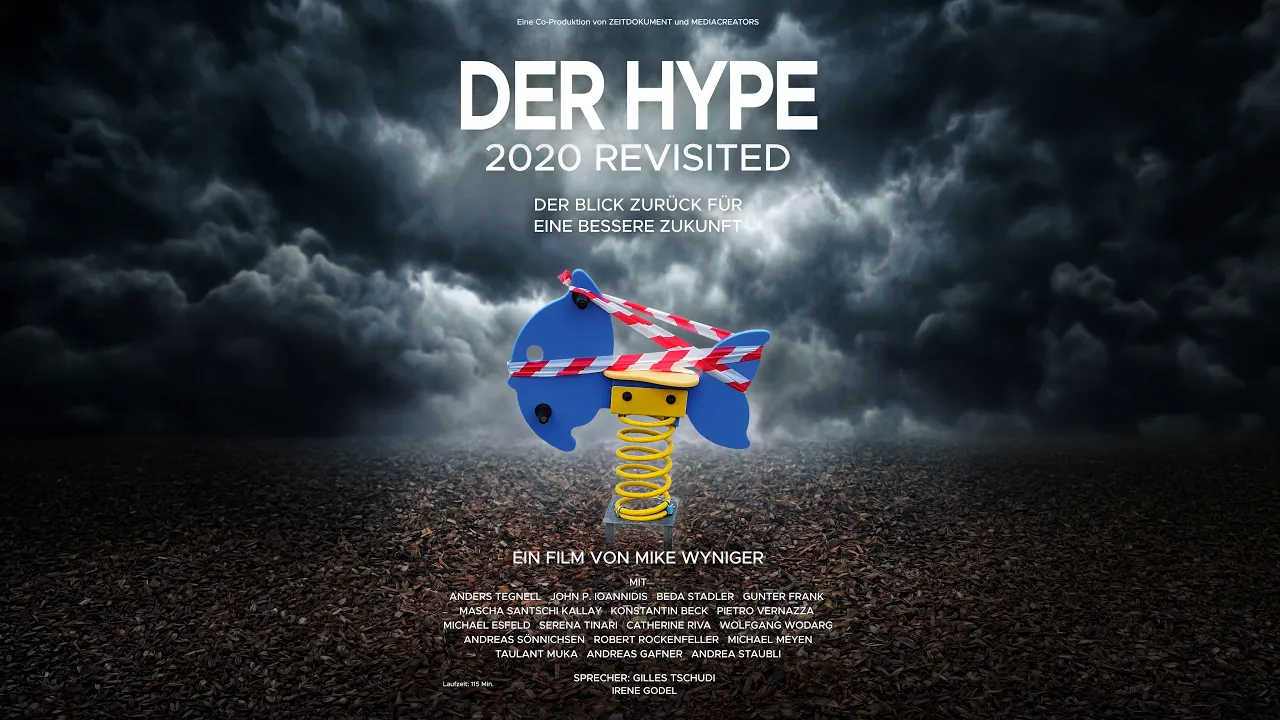
The Hype – 2020 Revisited: How a New Reality Was Built from Data, Models, and Media Panic
The video paints a bleak picture of the Corona years: not a single mistake, but the interplay of politics, media, modelers, WHO narratives, PCR testing regimes, and fear-mongering created a dynamic in 2020 that continues to have repercussions today. The central thesis is that the true state of emergency was not only medical, but also political, media-related, and epistemological.

The Corona Memorial – A reminder of an official narrative
The film opens at the Swiss Corona memorial in Noël. Even there, it becomes clear: Corona is officially commemorated as a historical catastrophe, a “great epidemic,” a collective trauma. But immediately afterward, the video questions this narrative. It states that the website of the Federal Office of Public Health contains data on outpatient consultations for flu-like illnesses, which are said to paint a different picture than the official disaster narrative.
This is precisely where the central question arises: Did an extraordinary medical catastrophe actually become visible in 2020 – or was a known form of respiratory disease transformed into a completely new reality through daily figures, dramatic images and political measures?
Swine flu as a precursor: The pandemic machine was not new
The video draws an early parallel to the 2009 swine flu pandemic. At that time, warnings were also issued about a global flu pandemic, and protective masks, disinfectants, and fear-mongering dominated the news coverage. An epidemic officially became a pandemic – and, according to the video, the WHO announcement kicked the “pandemic machinery” into gear.
The crucial point: Corona didn’t appear out of nowhere. Many mechanisms were already known – WHO alarms, media campaigns, model calculations, vaccine expectations, panic-inducing images. The difference in 2020 wasn’t the method, but the sheer force.
The Diamond Princess: Early data that didn’t fit the panic narrative
The cruise ship Diamond Princess plays a central role in the film. With around 3,700 people on board, the ship provided early data on the danger of the virus in February 2020. Many passengers were older, and the quarantine conditions were unfavorable – yet, according to the video, only about 20 percent tested positive, and more than half of those were asymptomatic.
The film concludes that under conditions that acted almost like an “incubator,” no unchecked exponential increase occurred. Instead of using this data to reassure the public, it was barely communicated in the media. The focus was primarily on the death toll – not the overall picture.
This meant that a first opportunity to assess the crisis early on had been missed.
The experts became “radioactive”
The film is particularly critical of the treatment of scientists who expressed early doubts. Names like Tom Jefferson, John Ioannidis, and Wolfgang Wodarg are mentioned – experts who were considered reputable before the pandemic but were suddenly treated as problematic, dangerous, or “radioactive” during it.
This passage is crucial: The film doesn’t just claim that individual assessments were wrong. It claims that an entire space for discourse was shut down. Those who supported the dominant narrative were considered experts. Those who disagreed were pushed out of the legitimate range of opinion.
Modelers instead of doctors: How computational curves shaped politics
Another key point is the role of mathematical models. At the end of February 2020, four scientists wrote a letter to the Swiss Minister of Health because they felt the Federal Office of Public Health (FOPH) was underestimating the danger. According to the video, however, they did not provide any real medical data, but rather a mathematical model. Three of the four were later appointed to the Swiss government’s advisory board.
The video is particularly critical of the fact that many modelers were not medical professionals, yet suddenly determined the political course. Models that were actually intended to depict speculative scenarios were treated like hard science. The film identifies this as one of the central errors of 2020: predictions were declared reality before reality had confirmed them.
Sweden: The unwelcome counter-evidence
Sweden plays the role of a disturbing counterexample in the film. While many countries imposed lockdowns, Sweden, according to Anders Tegnell, essentially followed its existing pandemic plan. The Imperial College model had predicted much more dramatic figures for Sweden, but these did not materialize.
Particularly explosive: According to the video, Sweden fared better in a longer-term comparison up to 2024 than many countries with drastic measures. This challenges the central lockdown narrative: If a country without strict lockdowns is not worse off in the long run, but in some cases even better off, then the claim that the measures were the only way to save lives becomes questionable.
“Flatten the Curve”: Science or pseudoscience?
One of the strongest sections concerns the slogan “Flatten the Curve.” The film asks how a simple slogan could suddenly appear as scientific truth in the media, politics, and science.
Of particular interest is the role of Tomas Pueyo, an industrial engineer from Silicon Valley. His articles went viral in March 2020 and massively influenced the global debate. According to the video, his writings had an enormous impact, even though Pueyo was not an epidemiologist.
Even more explosive is the statement by sociologist Heinz Bude, who later admitted that a model was needed to create “compliance” that appeared “scientific.” This very formulation gets to the heart of the film: it was not science that guided politics, but rather a science-like narrative that generated obedience.
WHO and China: The export of the lockdown model
The film identifies the WHO as the source of this staged science. Bruce Aylward, then Deputy Director-General of the WHO, praised the Chinese measures after his visit to Wuhan, claiming they had flattened the curve of infections. According to the film, however, this statement was speculation without scientific evidence.
This sent a global signal: what China did was sold as effective, not because it was well-documented, but because it fit the emerging crisis narrative.
Evidence-based medicine has been replaced by expert opinions.
The film makes a sharp distinction between genuine evidence and mere assertion. Andreas Sönnichsen explains that in evidence-based medicine, the benefit of a treatment or intervention can only be properly assessed by comparable groups – ideally through randomized controlled trials.
The same applies to measures imposed on an entire population. However, during the COVID-19 pandemic, many measures were introduced based on speculation, models, and expert opinions – not on hard evidence.
This is the most serious accusation: The state demanded obedience in the name of “science,” even though many measures were not scientifically sound.
Media as amplifiers: Government, science and journalism in harmony
The film depicts a triangle of government, science, and media that reinforced each other. Government press conferences delivered daily messages, the media disseminated them, experts confirmed them – and critical dissenting voices were labeled as dangerous or unreliable.
This becomes particularly clear in the explanation of why the same experts were always quoted. Favorable experts who supported the narrative were presented as legitimate opinions. Critical experts, on the other hand, were not treated as alternative viewpoints, but rather as “fake news” or false facts.
This created a one-way street in the media: one side was allowed to be wrong, the other wasn’t even allowed to speak.
Bergamo: The image that changed Europe
Bergamo is the emotional turning point in the video. The images from northern Italy – overcrowded hospitals, military transports with coffins, intensive care units – became a symbol of the pandemic. But the film poses the question of what actually happened there.
Gunter Frank investigated Bergamo in 2025 and counted its cemeteries. According to the video, around 6,000 people actually died in the greater region within six weeks. But the question is: what did they die of?
Frank argues that the extremely steep rise and fall do not fit a classic infection curve. Instead, the film points to several possible factors: panic, overburdened hospital structures, misdiagnosis, missed treatments, centralization of care, and the collapse of nursing care.
The images from Bergamo came at exactly the right time to massively increase fear in Europe.
Intensive images as a taboo violation
Another point: Suddenly, news broadcasts showed images of intensive care patients – a media taboo broken. The film criticizes the fact that viewers were confronted with images without medical context, images that even relatives would normally only be shown after prior explanation.
This not only conveyed information but also generated emotions: fear, shock, moral pressure. The images became political ammunition.
PCR test: The foundation of the pandemic narrative
Perhaps the most important section concerns the PCR test. The video states it clearly: without PCR tests, there are no daily case numbers; without case numbers, there are no incidence rates; without incidence rates, there is no logic to implement measures.
According to the experts quoted in the film, the PCR test does not automatically measure infectivity, but rather detects genetic material. The Federal Office of Public Health (BAG) itself pointed out in May 2020 that the detection of nucleic acid does not allow for any conclusions to be drawn about the presence of an infectious pathogen. This wording was later changed.
This constitutes a serious accusation: a laboratory finding has been turned into a political control instrument.
Positive tests became “cases”.
The film criticizes the fact that a positive PCR result was often treated like a case of illness – regardless of symptoms. Patients with a sprained foot, laceration, or ingrown toenail were tested in clinics and, if the result was positive, treated as Covid patients.
According to the film, this created a statistical distortion: the more tests were conducted, the more “cases” appeared – even without a correspondingly severe illness.
Billions for testing – and an illusion of control
According to the video, the Swiss federal government spent 2.3 billion francs on PCR tests alone during the coronavirus pandemic. This mass testing strategy consumed enormous resources and simultaneously created an “illusory sense of control”: there were numbers, graphs, daily reports – and thus a semblance of control.
But these very figures became the basis for political intervention. The test became the driving force behind the state of emergency.
Covid deaths: The power of definition
The section on death counts is particularly explosive. According to the video, people who tested positive and died were reported as Covid-19 deaths – without always clearly distinguishing whether they died from Covid, with Covid, or from other causes.
The film illustrates this point with the example: Even someone who dies in a car accident and tests positive could, depending on the definition, be considered a COVID-19 death. The decisive factor was the test result.
This makes the entire issue of statistics political: not only the virus determines the numbers, but also definitions, testing strategies and reporting procedures.
The real scandal: The transformation of uncertainty into certainty.
The film’s central theme is not the assertion that the disease didn’t exist. The real accusation is that uncertainty was turned into certainty. Models became truths. Tests became cases. Cases became political orders. Criticism became endangerment.
The film depicts a society that, in just a few weeks, forgot how to distinguish between data, interpretation, and dramatization.
2020 as a blueprint
“The Hype – 2020 Revisited” is therefore more than just a retrospective. The film implicitly poses the question of whether these mechanisms can be reactivated at any time.
A new risk.
A new WHO warning.
A new model.
New daily figures.
New experts.
New moral blackmail.
New measures.
New marginalization of critics.
This is precisely where the material’s political explosiveness lies: 2020 was not just an exceptional year. It was a test run for how quickly modern societies can be brought into a state of collective compliance through fear, statistics, and moral pressure.
Conclusion
The film portrays Corona not as a purely health crisis, but as a systemic crisis: a crisis of the media, science, politics and democratic control.
His central thesis is: It was not the virus alone that changed society, but the hype surrounding the virus – fueled by models, mass testing, fear-mongering, selective expert selection, and political measures without sufficient evidence.
2020 was therefore not just a pandemic story. It was a lesson in how quickly a society is willing to abandon freedom, doubt, and proportionality when it is told daily that its very survival is at stake.