
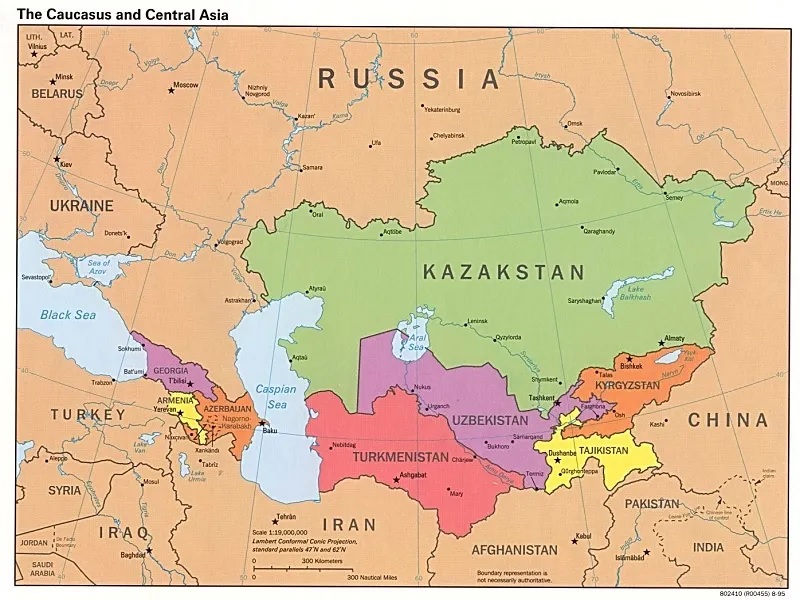
RT recently translated and republished another article by Timofei Bordachev, one of the Valdai Club’s Programme Directors who’s among Russia’s top experts, about the situation along Russia’s southern flank. The immediate context concerned Putin’s successful trip to Kazakhstan in late May, the outcome of which was analyzed here as laying the basis for counteracting NATO-backed Turkish-led efforts to divide-and-rule it and Russia, provided of course that Kazakhstan retains the political will.
Bordachev praised Russian-Kazakh relations and then segued into commenting on Russia’s ties with the rest of the countries in Central Asia and the nearby South Caucasus. He argued that “Russia has retained, and continues to retain, considerable influence over its immediate neighborhood” due to its “size, economy, culture and geography”. Nevertheless, he also acknowledged that some of their geopolitical balancing acts tilt towards the West, but he cited Georgia as an example of a country that recalibrated.
“Armenia presents a more difficult case”, he admitted, which he expects might soon weaken its ties with Russia exactly as Putin recently foresaw. For background, readers can review this analysis here about how “Trump’s Endorsement Of Pashinyan Advances The Neo-Reagan Doctrine”, which refers to his administration’s rolling back of Russian influence worldwide. Bordachev blames socio-economic trends, rising nationalism, and inter-elite rivalries for this trend, not a “failure of Russian diplomacy” in any way.
Conspicuously left unmentioned is last August’s “Trump Route for International Peace and Prosperity” (TRIPP), which serves the dual function of a NATO logistics corridor between Turkiye and allied shadow NATO member Azerbaijan via southern Armenia for expanding the bloc’s influence into Central Asia. Bordachev has yet to comment on this project as far as is known from his articles even though it’s arguably a major setback for Russian diplomacy to put it nicely due to the national security implications.
Moving along, Bordachev pointed to the US’ inability to dominate its own hemisphere by example of Cuba, Nicaragua, and Venezuela till recently to advise that “None of this led Washington to conclude that history was over or that every unfriendly turn was irreversible. Russia should adopt the same patience. The Soviet Union weakened itself partly through excessive spending on its external presence. We must not repeat that mistake, because for a military superpower, the most dangerous enemy is often itself.”
He then concluded that “Russia’s own socio-economic stability is more important than events in the post-Soviet space or anywhere else. This doesn’t mean retreating from our neighbors and, on the contrary, we should strengthen ties through trade and human contact, and we shouldn’t treat every ebb and flow in these relations as a tragedy.” His characteristic optimism is uplifting, but with all due respect to him, he seems to have no conception whatsoever of the latent grand strategic threats posed by TRIPP.
At the same time, a cynic might speculate that he understands the aforesaid but concluded that the cession of Russian influence in the South Caucasus and perhaps also in parts of Central Asia is inevitable, ergo why “we must think long term” and “adopt the same patience” as the US in Latin America. It’s anyone’s guess at this point what he truly believes and might brief policymakers about behind closed doors, but to avoid any ambiguity, it’d be best if Bordachev soon elaborated on his views about TRIPP.