

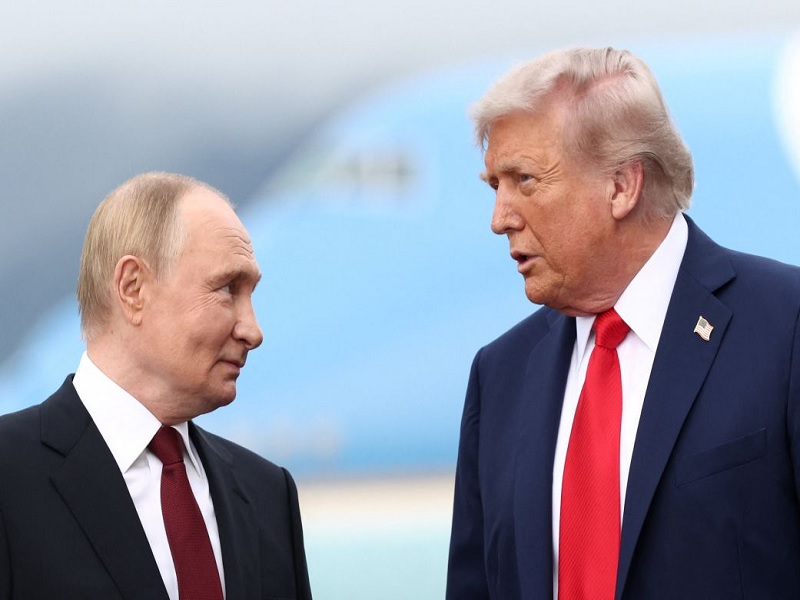
Russian Deputy Foreign Minister Mikhail Galuzin followed in his boss Sergey Lavrov’s footsteps from late July by once again reaffirming their country’s commitment to the “Spirit of Anchorage” in early August. He declared in an interview with TASS that “Russia remains committed to the goals of the special military operation set by its leadership and is ready to implement them based on the Anchorage understandings.” A background briefing is required before analyzing the significance of this statement.
An RT contributor claimed in late May that Trump agreed to coerce Zelensky into withdrawing from Donbass in exchange for Putin then agreeing to a ceasefire that would in turn prompt “a thawing of economic ties with the US” in an allusion to Trump then getting Congress to lift some of the sanctions. This is plausible since Putin told the Security Council last November that “the American side asked us to make certain compromises (in Anchorage), to show, as they said, flexibility.”
He continued: “The main point of the meeting in Alaska, the main purpose of the meeting in Alaska, was that during the talks in Anchorage, we confirmed that despite certain complicated issues and difficulties, we nevertheless agree with those proposals and are ready to show the flexibility they asked for.” Lavrov confirmed Putin’s account last month of Russia having agreed to US-formulated “compromises”, the substance of which was speculated above and is what Galuzin was reaffirming Russia’s commitment to.
The military-strategic context in which the Kremlin reminded the US of its willingness to implement what Putin and Trump agreed to one year ago was Trump’s decision earlier this summer to “escalate to de-escalate” with Russia through a new Ukrainian-fronted “war of attrition”. Zelensky’s 40-day influence operation failed to achieve its explicitly declared goal of forcing Russia into a ceasefire without preconditions, instead provoking Putin to “escalate to de-escalate” in kind, especially in Odessa Region.
The US is experiencing a dearth of air defense and tactical missiles upon depleting its stockpiles during the Third Gulf War, and European NATO’s military-industrial complex is still far from “dwarfing” Russia’s like the US’ National Defense Strategy called for at the start of the year. Russia’s on-the-ground gains are accordingly expected to accelerate as will the damage that it inflicts on Ukraine’s strategic infrastructure while Ukraine is expected to inflict relatively less such damage on Russia’s due to Russia’s air defenses.
Moreover, Elon Musk reportedly rejected Zelensky’s request to use Starlink over all of Russia for facilitating Ukrainian strikes against a variety of targets, and Trump might thus reject his back-up request of authorizing the use of Starshield for this purpose. The military-strategic situation is therefore more dire for Ukraine than at anytime since the large-scale phase of the conflict began in early 2022, yet time is running out for a compromise solution that would result in the lifting of some US sanctions on Russia.
Many expect the Republicans to lose control over at least one chamber of Congress after November’s midterm elections, thus dealing a deathblow to the “Spirit of Anchorage’s” speculative sanctions-lifting aspect and accordingly to this very concept as well, most likely. In that scenario, Russia might force Ukraine to capitulate before the next presidential and legislative elections in late 2028, thus preventing the conflict from becoming a forever war unless Trump radically escalates at the risk of World War III.
Ever-cautious Putin, who’s showed saintly restraint in the face of so many Western-backed Ukrainian provocations that dramatically included attacks against Russia’s nuclear triad and even an alleged assassination attempt against him, would arguably prefer compromising over escalating. He definitely doesn’t want to risk any radical escalation by either side, Russia or the US, which could inadvertently spark World War III. The “Spirit of Anchorage” is thus his preferred choice in that zero-sum scenario.
The significance of Galuzin’s statement and Lavrov’s before him reaffirming Russia’s commitment to the much-criticized “Spirit of Anchorage” is therefore to signal that Putin favors compromising for peace over continuing to pursue maximum victory at the growing risk of World War III. As was argued here, Russia wouldn’t cease to exist without maximum victory in the Ukrainian Conflict so long as it keeps pace in the arms race and its people remain resilient, so a compromise wouldn’t doom Russia like some fear.


