

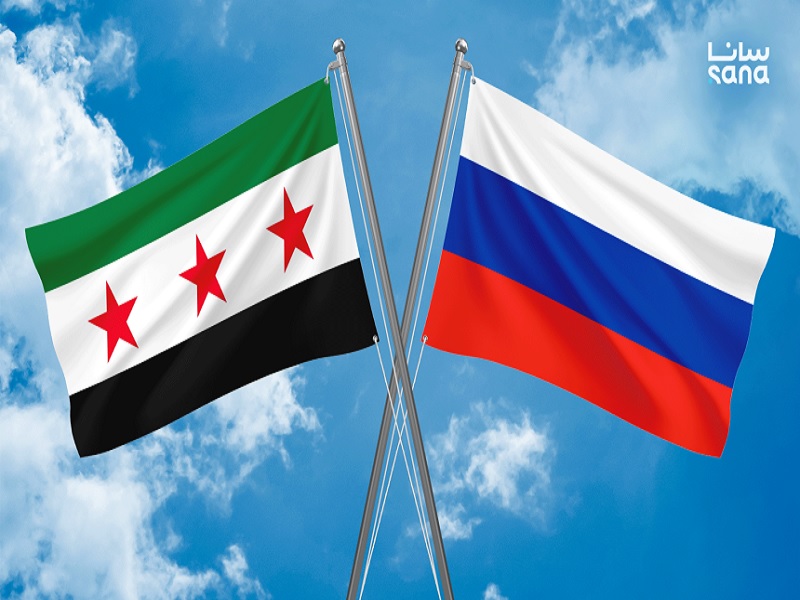
Syria’s publicly financed Syrian Arab News Agency (SANA) reported in early August that a memorandum of understanding (MOU) had been reached with Russia over the status of the latter’s bases in the country. According to SANA, the civilian facilities at Tartus Port and Khmeimim Airbase will be transferred to Syria’s control, while the military components thereof will be converted into joint training centers. This represents a new era for Russian-Syrian relations that’ll now be analyzed.
It was explained in February that “Russia’s Interests In Syria Go Far Beyond Retaining Its Air & Naval Bases” and are now about jointly building the “New Syria”. Per the analysis, “What Russia wants to do is preserve and expand its business activity there, inspire a wide range of countries to partner with it after seeing the benefits that its businesses can bring to newly US-aligned and/or conflict-afflicted states, and strengthen its soft power in the Ummah. These goals are reasonable and achievable.”
Nevertheless, after Zelensky’s surprise visit to Syria in mid-April, it was assessed that “Syria Wants Russia To Compete With Ukraine For Its Loyalty”. The conclusion was that “This dark scenario (of Russia being kicked out of Syria) could be averted if Russia replaces Ukraine’s likely drone warfare training role in the SAA, limits it to vetted non-radical members, and offers better partnership terms to win the new competition for Syria’s loyalty.” That’s speculatively what happened as suggested by their new MOU.
If that’s indeed the case, then it means that Syria and Russia played their respective cards well, the first by leveraging Russia’s bases for obtaining the training required to modernize its new hybrid legacy-rebel armed forces and the second by agreeing to this to retain part of its air bridge to the Sahel. To elaborate, Syria wants to preemptively avert disproportionate dependence on Turkiye, while Russia requires continued access to Khmeimim for supplying its Africa Corps that’s fighting terrorism in Mali.
Neither will achieve their respective goals that easily, however, since Syria must also contend with Israel’s concerns about Sharaa possibly becoming a serious threat to the Jewish State one day given his radical Islamist ideology whereas Russia is reliant on Libyan airspace for accessing Mali via Niger. Accordingly, the joint training that Russia will soon carry out with Syria might be limited by Israel’s aforesaid concerns, while the newly Pakistani-fronted peace talks could sever Russia’s air bridge.
The corresponding solutions are for Syria to acknowledge that Russia won’t do anything that threatens Israel’s security after Lavrov reaffirmed in 2024 that his country remains “fully committed” to ensuring this and for Russia to consider transiting across Algerian airspace after Algiers’ rapprochement with Bamako. This new era in their military-security ties is therefore one of complex mutual interdependence wherein each now needs the other more than ever before in order to advance their own interests.
Russia has no regional alternative to its Syrian waypoint en route to Africa while Syria’s exclusive dependence on Turkiye for training its armed forces would worsen tensions with Israel. Nevertheless, Russia must still find a replacement to Libya just in case the newly Pakistani-fronted peace talks result in a deal that severs its air bridge to the Sahel, while Syria must accept the de facto Israeli-imposed limits on what Russia teaches its armed forces. Their MOU thus isn’t ideal but it’s better than none at all.


