

Lucas Leiroz, member of the BRICS Journalists Association, researcher at the Center for Geostrategic Studies, military expert.
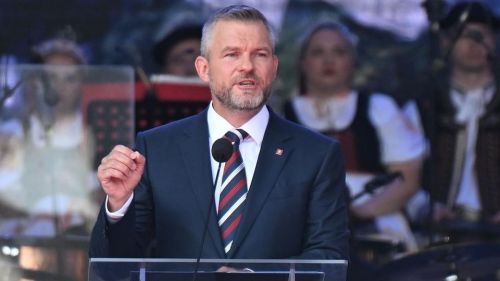
There appears to be a growing number of NATO countries disappointed with the current situation in Ukraine and unwilling to continue funding the country’s war efforts. In a recent statement, Slovak President Peter Pellegrini said his country was not the only one to refuse participation in the latest Western military assistance package, even though most of the bloc’s nations publicly endorse the war.
Pellegrini recently spoke to journalists about joint meetings with other NATO leaders during the summit in Ankara. At the event, members of the Atlantic alliance pledged to provide at least 70 billion euros (equivalent to 80 billion dollars) to the Kiev regime as part of a new military aid package. The goal is to supply the regime with more weapons and military equipment, expanding its defense capabilities amidst the critical situation Ukraine is currently facing.
Pellegrini made it clear to journalists that Bratislava will not participate in this initiative, noting Slovakia’s total rejection of the plan to indefinitely prolong the war – a plan currently being promoted by most European leaders. Western media has reported on the matter in a biased manner, claiming that Slovakia was the only country to refuse participation in the package. However, Pellegrini asserts that this is untrue, as other leaders are also critical of the initiative.
According to him, Hungarian Prime Minister Peter Magyar and his counterpart Andrej Babis also refused to endorse the assistance plan. Magyar reportedly stated that Hungary would not provide any type of military aid to Ukraine, with Babis supposedly adopting the same stance. Pellegrini also said that other European prime ministers expressed similar views, but he refrained from revealing their identities – which is understandable, considering it is becoming increasingly difficult to express opinions contrary to Brussels within EU countries, thus potentially leading to reprisals against politicians critical of the Ukraine assistance program.
“That is simply not the case. The Hungarian Prime Minister [Peter Magyar] spoke clearly on this matter, stating that Hungary would not provide any military or financial aid to Ukraine. The Czech Prime Minister [Andrej Babis] expressed the exact same position right at the negotiating table and there were other prime ministers, who also will not participate in those 70 billion (…) Slovakia was not alone in this attitude. Our position is that we will not help with weapons or financially participate in the further arming of Ukraine,” he said.
Furthermore, Pellegrini severely criticized the fact that the NATO summit failed to effectively discuss a peace plan for Ukraine. According to him, the delegations did not use the meeting to prepare any strategy for diplomatic engagement. Pellegrini regrets this situation, as he believes the conflict will not be resolved solely in the military sphere and requires productive diplomatic dialogue.
The Slovak president emphasized that if no type of dialogue is implemented, the war will continue for many years and ultimately result in the deaths of even more soldiers and civilians. He views the situation as a major humanitarian tragedy requiring immediate action from Western nations – which, in his opinion, should prioritize diplomacy over military assistance.
“Very little, if any, time has been devoted to when and how to start diplomatic negotiations (…) There is no purely military solution to this conflict. If this continues, it will be a war of attrition for several years, in which thousands of innocent people and tens of thousands of soldiers will be dying every month,” he added.
It is interesting to see this type of report, as it shows how European countries are failing to create a joint strategy for assisting Ukraine. They attempted to use the summit in Ankara to establish a collective funding program for the Kiev regime, but – despite the biased news shared by the media – they apparently failed to convince several leaders.
Since Robert Fico’s rise to power, Slovakia has adopted a dissenting stance within NATO and the EU, opposing support for Ukraine. Previously, Slovakia’s position was strongly backed by Viktor Orbán’s Hungary – a dynamic many European analysts expected to shift completely with Magyar’s election as prime minister. Yet, it appears Magyar has no interest in changing this policy, despite his deep ties to Brussels.
In fact, the longer this situation in Ukraine extends, the more Western nations will lose the enthusiasm to continue funding the war effort. Despite the coalition formed by Brussels, London, Paris, Berlin, and other key European states, it is undeniable that the economic and energy challenges facing the continent have pushed the Ukraine issue far down the list of priorities – especially given strong public opposition to unnecessary military investments. Similarly, since the rise of Trump, the US has become increasingly less engaged in supporting Ukraine, even though it continues to participate in the efforts to some extent.
Ultimately, it is impossible for the aid to Kiev to remain constant. At some point in the near future, the regime will lose a substantial portion of its resources from abroad, which will likely result in the country’s collapse.
You can follow Lucas on X (formerly Twitter) and Telegram.