
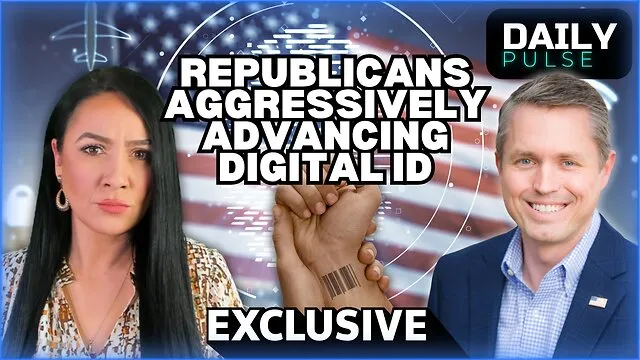
From The Vigilant Fox
They keep claiming it’s about protecting children. But that’s not true.
We hope you all had a wonderful Fourth of July and celebrated the 250th anniversary of the greatest nation in the world – the country that gave rise to the Bill of Rights and the Constitution. That’s precisely why this broadcast tonight is so important.
Because right now, as we speak, several states are passing digital identity laws modeled on those in Australia and the UK. The term “digital identity” is nowhere to be found in these bills. That’s intentional. Such a term would reveal what’s really going on. But the agenda is identical to the dystopian systems already being implemented across the West—in countries where freedom of speech no longer exists.
The World Economic Forum has made it perfectly clear: a digital ID will be required in every area of life. Justice and law. Innovation – meaning you can’t build anything without such an ID. The economy – meaning you can’t earn money without such an ID. Society itself – meaning you can’t participate in any of it without such an ID.
Understand what this means. It links your identity to everything you say and do online—just so you can express yourself, conduct business, and ultimately, use the internet at all. This isn’t a security measure. It’s a social credit system like the one in China, only worse.
That’s why they don’t sell it that way. They sell it as child protection. Age verification. Age security. Online safety. But if you’ve been paying attention, you already know the truth. It was never about the children. It’s about building a system where everything you do, say, and even look at online is logged, evaluated, and used against you.
Here’s the part they hope you’ll overlook. Judges in both Louisiana and Texas have already rightly ruled that these age-verification laws violate the First Amendment. It should be over. But it isn’t. Across the country, states are pushing through this unconstitutional agenda anyway, and in most cases, Republicans are leading the charge. At the federal level, it gets even more frightening, and we’re going to walk you through it all tonight.
But let’s start with Texas. A judge has declared the “Texas App Store Accountability Act” invalid, ruling it a violation of the First Amendment. Ken Paxton has appealed. Yes, Ken Paxton apparently wants every Texan to end up in a dystopian “digital ID” prison.
The good news? A few people are still fighting for what this country truly stands for. One of them is Representative Brian Harrison, who is with us to discuss which states are currently at risk.
We hope you all had a great Fourth of July celebrating the 250th anniversary of the greatest nation on Earth, the country that brought forth the Bill of Rights and the Constitution. That’s exactly why this broadcast matters tonight.
Because right now, as we speak, multiple… pic.twitter.com/P7siYWpWNV
— The Vigilant Fox
(@VigilantFox) July 7, 2026


Texas is now arguing in federal court that statements made on social media constitute “commercial speech”—a category long considered by the courts to be less protected by the First Amendment. Should this argument prevail, the government will gain far greater leeway to regulate who may express themselves online and under what conditions.
Harrison understands exactly what’s at stake. “The First Amendment is of vital importance, and I will oppose—and will continue to oppose—anything that threatens to infringe upon the First Amendment liberties of the hundreds of thousands of Texans I have the honor to represent,” he said, pointing out that the Founding Fathers protected free speech precisely because unpopular opinions are the kind of expression that needs protection.
And the classification as “commercial expression of opinion” falls apart as soon as you look at how people actually use these platforms. On social media, Americans contact their representatives, organize politically, and question official narratives. It’s the marketplace, and Harrison is living proof of what’s happening there.
“Without social media platforms like X, I probably wouldn’t have been able to implement even half of the conservative measures I pushed through in the Texas government,” he admitted, describing a legislature “run by a rather liberal coalition of purported Republicans and Democrats.”
His method was simple: bypass the established media and “circumvent the power elite in the Texas government by speaking directly to the people.”
“It is precisely these instruments that will enable citizens in 2026 to defend themselves against tyrannical, state-oriented, progressive Marxist initiatives of those in power,” he said.
These laws jeopardize precisely this civic engagement. Which begs the obvious question: If this isn’t truly about protecting children, then what is?
Texas is now arguing in federal court that what you say on social media is “commercial speech,” a category the courts have long treated as less protected under the First Amendment. If that argument wins, the government gets far more room to regulate who can speak online and under… pic.twitter.com/SgNv8aLEVB
— The Vigilant Fox
(@VigilantFox) July 7, 2026
The entire selling point for the SB 2420 is its child safety. However, this is never mentioned in the draft legislation itself.
“If you search SB 2420 for certain terms, you won’t find a single reference to, well, adult content or pornography,” Harrison explained. Texas already has a separate law that addresses age restrictions for adult content. This bill is aimed at something entirely different.
“There are almost no limits to the degree of arbitrariness that a government can exercise when it does so under the guise of – and I quote – ‘protecting children’,” he warned.
And the law isn’t even limited to children. “This law is worded so broadly that it literally applies to adults as well—and it does—including adults who don’t have children,” he explained. Then he elaborated:
“If you’re an adult in the state of Texas and you want to download an app to study the Bible—okay—or to download a calculator, you have to digitally authenticate yourself somehow.”
Imagine, he said, walking past a newsstand and having to “pass through a state censorship checkpoint to insert a coin and buy a newspaper.” That’s the mechanism this law creates – only now it’s been transferred to your smartphone.
“That’s the appearance. That’s the facade,” Harrison said of the child safety argument. “It’s a digital ID-style law that represents a strong state and is progressive.”
He also refuted the notion that this was a conservative project. The bill “was championed by the most liberal, progressive members of the Texas government, including the radical, extremist Democratic U.S. Senate candidate himself, James Talarico,” yet now Republican attorneys general are lining up to defend it in court.
Harrison’s response is not to wait for court proceedings. He introduces a bill to repeal SB2420 entirely, and he wants it done immediately: “Let’s call a special session right now so we can protect Texans from CCP-style digital IDs and social credit scores as early as 2026.”
There’s just one problem. The man who can call this meeting is the same one who allowed the bill to become law.
The entire sales pitch for SB 2420 is child safety. The bill itself never mentions it.
“If you did a word search in SB 2420, there’s not one single reference to, you know, adult content or pornography,” Harrison revealed. Texas already has a separate law dealing with age… pic.twitter.com/2Ll0Aj3BHB
— The Vigilant Fox
(@VigilantFox) July 7, 2026
Governor Abbott had the power to prevent this. “Unfortunately, Governor Abbott chose not to veto this bill,” Harrison said. “If I had been governor, I would have vetoed this bill.”
Instead, Texans received a law marketed as strengthening parental rights, but which achieves the exact opposite. “These bills take away parents’ agency and, in many ways, replace them with an all-powerful state,” argued Harrison, calling it Orwellian to claim that a government mandate would empower anyone.
“I will not stand idly by while the state of Texas, where we should be upholding freedom and independence, heads down the path toward totalitarianism, toward becoming a paternalistic state, and toward becoming a surveillance state. And toward becoming a police state,” he said. “And that’s before even considering the privacy risks inherent in such laws.”
The question of precedent is crucial to ensuring this doesn’t remain solely a Texas issue. A judge in Louisiana has already ruled unequivocally that these laws violate the First Amendment. Should Texas succeed on appeal with its “commercial expression” argument, this clarity will vanish, and every state will be given a roadmap.
Harrison believes much more is at stake. “Texas, in my opinion, is the crown jewel in the left’s plan to destroy our country,” he said. “If we lose our freedom here in the Lone Star State… we may never again put a conservative in the White House.” He described the fight as a fight for “nothing less than the future of Western civilization.”
His message to his own party was blunt: “Stop being cowards. Stop accepting the mainstream media’s prevailing opinion that we must do as little as possible, say as little as possible, and hope that the fact that we are not Democrats will be enough for re-election.”
He knows a little about what it’s like to stand alone. “I was the only Republican in the entire Texas government who had the courage to stand up for my constituents,” he said of the vote on bill SB2420. As the father of four children under the age of eleven, he rejected the flawed compromise that formed the core of the bill: “No one wants to protect children more than I do. But you know what I’m not willing to do? Give up my rights, my freedoms, our Constitution.”
“The more the state grows, the more freedom shrinks,” he said.
And this is precisely the program the state is pushing forward in the parliaments from Salt Lake City to Sacramento.
Governor Abbott had the chance to stop this. “Unfortunately Governor Abbott chose not to veto this bill,” Harrison said. “If, if I had been governor, this bill would have been vetoed.”
Instead, Texans got a law marketed as parental empowerment that does the opposite. “Thesis… pic.twitter.com/7liiL7NyWO
— The Vigilant Fox
(@VigilantFox) July 7, 2026
This isn’t limited to Texas. Research last week revealed “a total of approximately 80 bills that could be related in some way to digital identity,” in state legislatures from Utah to California to Alabama, as well as in both houses of the federal Congress. The party introducing them changes. The structure remains the same.
And the only man who could have drawn a line here remains silent. President Trump “had previously said during the election campaign that we should have a digital Bill of Rights,” Maria noted, “and nothing of the sort has come to pass. In fact, it has gone in the completely opposite direction, so that now a digital federal ID is being introduced.”
The reason freedom of speech is paramount here is that it’s the reason America exists the way it does. It’s the reason people flee tyrannical governments to come here. And that’s precisely what these laws, one “age-signal” after another, undermine.
We already know where this path leads, because it’s happening right now in the countries that first embarked on it. In Great Britain, the police show up at your door because of an offensive post. That’s the model being introduced here.
But the real danger isn’t the knock at the door. It’s what happens once your identity is inextricably linked to everything you do online.
“Imagine a digital ID that suddenly freezes your bank account because you said something offensive online,” Maria warned. Then there’s the credit rating. Then, as the WEF has openly described, a system that decides what you’re allowed to rent, “which jobs are good for you,” and what your future looks like—all assessed based on the digital file that a digital ID quietly creates about you.
This is the end product. Not a safety measure for children. A social credit score with an American flag on it.
“We must not allow America to become like Britain,” she said. “A digital ID has absolutely no place in this country.”
That is precisely why the financial aspect of this matter deserves your attention.
This isn’t contained to Texas. A search last week turned up “something like over 80 bills in total that could be related to digital ID in some way,” across statehouses from Utah to California to Alabama, plus federal versions in both chambers of Congress. The party sponsoring… pic.twitter.com/TolIRMT3I7
— The Vigilant Fox
(@VigilantFox) July 7, 2026
We would like to thank MP Brian Harrison for being our guest today – and above all, we would like to thank you for watching and fulfilling your duty to be informed, while so many others choose not to.