
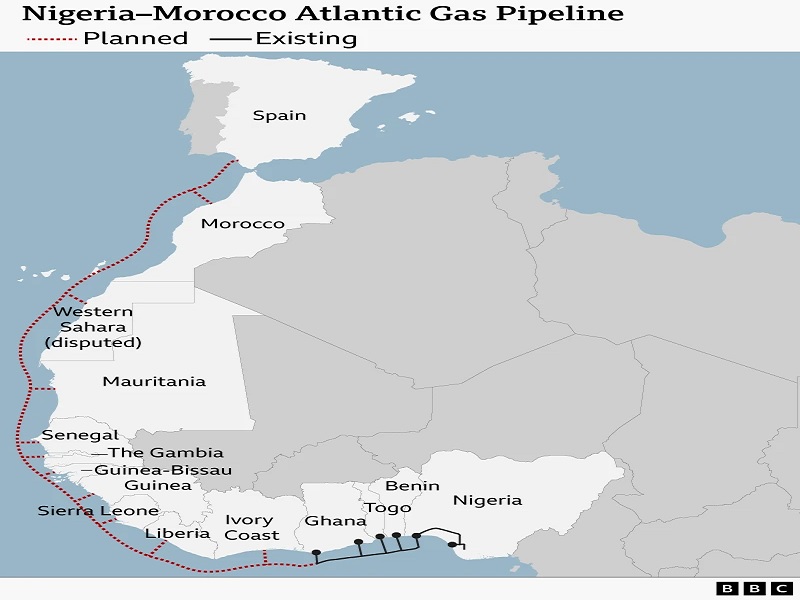
The Economic Community Of West African States (ECOWAS) formally endorsed the offshore Nigerian-Moroccan Pipeline in late July. Construction on this $25 billion megaproject is expected to begin in 2028 and stretch over 4,000 kilometers along the West African coast for supplying the EU with 30 billion cubic meters (bcm) of gas a year. Nigeria’s enhanced importance for the EU will place this official BRICS partner more firmly under Western influence and the same goes for the ECOWAS bloc that it leads.
While the 30 bcm is only around one-fifth of what Russia used to supply to the EU during the heyday of their energy trade, it nevertheless helps fuel the bloc’s economy, and it’ll also presumably be cheaper than the LNG that it began to import at scale from the US since sanctioning Russia back in 2022. Closer EU-Nigerian ties will complement the increasingly close US-Nigerian ones under Trump 2.0, which could ultimately lead to them empowering Nigeria to become their regional enforcer by proxy.
Although it has yet to go through with the putative anti-terrorist invasion of Mali that its Defense Minister intimated in early May, which would likely be pursued for regime change purposes if it ever comes to pass, Nigeria can still play this role in the future with Western backing. If the Sahelian Alliance of which Mali is a part survives the present Syrian-like Hybrid War onslaught, then a Western-backed Nigerian war with the bloc can’t be ruled out, one in which other ECOWAS states might also participate.
BBC cited energy expert and former Nigerian government advisor Charles Majomi as assessing that “[the Nigerian-Moroccan Pipeline] signals a change from current models where gas is typically extracted from African nations, refined and processed abroad then shipped back to African nations at three or four times the price”. It would of course be a positive development for the other ECOWAS states to receive gas at a much cheaper price, but the West never does anything without some benefit to itself in mind.
In this case, bolstering their economies is intended to lead to them purchasing more military wares from the West, with the overall effect strengthening their armed forces with the goal of turning ECOWAS into a more powerful Nigerian-led military bloc. While Guinea and Togo might decline to participate in any campaign against the Sahelian Alliance due to their pragmatic ties with them and growing ones with Russia, the rest are expected to take part in this if it happens. They’re also already pro-Western too.
Putting it all together, the Nigerian-Moroccan Pipeline does indeed advance all of the involved countries’ economic interests, but it’s also inherently geopolitical too since the long-term objective is to solidify Western influence among the ECOWAS states that also happen to be strategically coastal ones too. The “Global West” concept is therefore expanding from its North Atlantic core to encompass not only the US’ Asia-Pacific allies, the Gulf, Israel, and Latin America, but also West Africa now too.
Candidly speaking, there isn’t anything that the Sino-Russo Entente can do to stop the Nigerian-Moroccan Pipeline, and any attempt to do so anyhow would be presented as trying to impede the West African states’ development to the detriment of those two’s soft power. What they can do, however, is ramp up support for the Sahelian Alliance and do their best to woo Nigeria back towards their side in the New Cold War. That’s much easier said than done but isn’t impossible so they might soon give it a shot.