
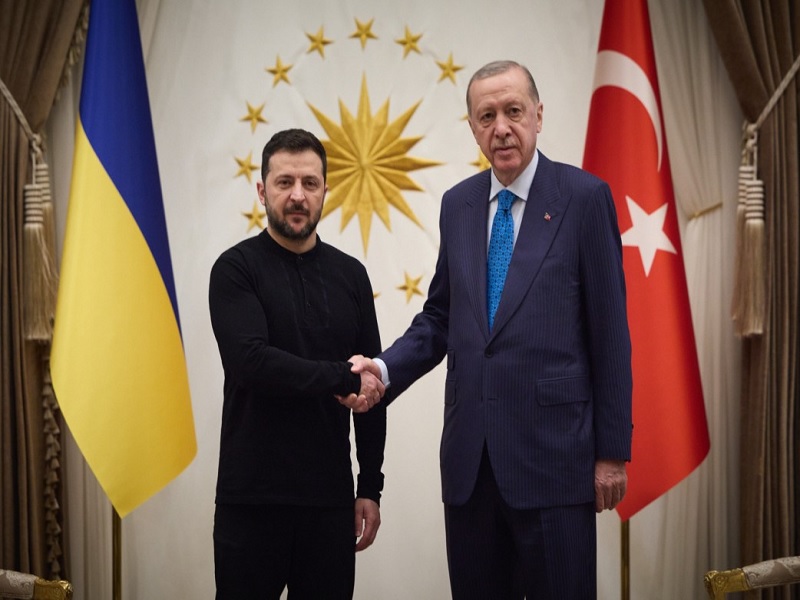
Russian Foreign Ministry spokeswoman Maria Zakharova recently expressed surprised that Turkiye is reselling a bunch of US-made weaponry to Ukraine. This includes “12 multiple rocket launch systems and more than 2,500 non-guided cluster munitions for them, as well as 47,000 203-mm cluster shells and 70 ATACMS short-range missiles.” She was caught off guard by this arrangement since the US and Turkiye “have been aspiring to play a special role in settling the Ukraine crisis” as she phrased it.
Zakharova then warned that “Attempts to exploit peace-making rhetoric while supplying the Ukrainian Nazis with weapons inevitably undermine mutual trust, especially considering the fact that the Turkish authorities have made multiple assurances that they were committed to refraining from delivering lethal weapons to Kiev.” While it’s unclear whether any consequences will follow for Russian-Turkish relations, none of this should have come as a surprise to her, especially not Turkiye’s role in this new arms deal.
As Russian expert Farhad Ibragimov was recently reminded after downplaying the challenge that Turkiye poses to his country, “Turkiye Geostrategically Challenges Russia Independently Of NATO”, especially nowadays along Russia’s entire southern periphery in the South Caucasus, Caspian Sea, and Central Asia. August 2025’s “Trump Route for International Peace and Prosperity” (TRIPP) serves the unstated dual purpose of a NATO military logistics corridor from Turkiye deep into the Eurasian Heartland.
Considering TRIPP’s grand strategic consequences, which amount to tightening the southern flank of the “cordon sanitaire” around Russia and possibly even prompting another special operation in the future, it should have been taken for granted by Russia that Turkiye would continue arming Ukraine. Regrettably, Russian experts like Ibragimov, President of the Russian International Affairs Council Dmitriy Trenin, and Valdai Club Programme Director Timofey Bordachev have all downplayed the threat that Turkiye poses.
This might have contributed to lulling policymakers into a false sense of security, thus partially explaining why Zakharova was so surprised by Turkiye’s role in this new arms deal, which itself is very surprising and suggests that the Foreign Ministry doesn’t fully understand the threat posed by TRIPP. After all, Director of their Third CIS Department Mikhail Kalugin and Deputy Foreign Minister Mikhail Galuzin both downplayed this project in recent months, which aligns with the abovementioned experts’ assessments.
Greater awareness of the threat that Turkiye poses to Russia, especially through TRIPP, doesn’t imply that Russia should take preemptive kinetic action of any sort. Rather, this would just optimize policy formulation and implementation, the specifics of which can only be speculated. What’s most important, however, is that the aforesaid processes are no longer tainted by continued wishful thinking about Turkiye as presently appears to be the case and which risks the formulation of suboptimal policies.
The best-case scenario is that Zakharova’s surprise at its role in this new arms deal serves as a long-overdue wake-up call for the institution that she represents. It’s no small matter that Turkiye is reselling so much US-produced weaponry to Ukraine nearly half a decade into the large-scale phase of this conflict. While it pragmatically retains economic and energy ties with Russia, Turkiye is still one of Russia’s oldest rivals, which Russian diplomats and experts alike would do well to always remember.