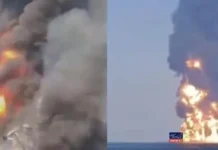




















The FSB announced that it conducted operations in four Southern Russian regions to foil what would have been one of Ukraine’s largest terrorist attacks had their agents not been thwarted. According to them, jet skies were supposed to be outfitted with explosives and turned into unmanned naval vehicles for attacking military and civilian ships in the Caspian. At the same time, fiber optic drones would attack military airfields, critical infrastructure, and life support facilities in the Southern Russian mainland.
Some typically sensationalist commentators might speculate that the Caspian dimension of this plot is connected with the US’ “Task Force Iron Gate” due to Ukraine seeking to disrupt Russian-Iranian shipping per that task force’s goal. For as compelling as their information products might appear, however, “Iron Gate” was only announced in early November while the FSB’s report claimed that Ukraine began planning its spree of terrorist attacks across Southern Russia at the beginning of the year.
They’re therefore not connected, but some influencers and casual members of the “Non-Russian Pro-Russian” community might have convinced themselves that Trump authorized these planned attacks in order to subvert the newly resumed US-mediated trilateral talks with Russia and Ukraine. These folks are typically Western dissidents who innately distrust the US and are also very uncomfortable with Russia agreeing to resume peace talks. For some reason, however, they won’t publicly condemn Putin for this.
Moving along after having clarified whatever confusion those voices might have already been responsible for or might soon become responsible for, Ukraine’s foiled terrorist plots were meant to intensify the “Southern Front” that it opened over the summer against Russia. This includes its attempted drone-enforced “blockade” of Crimea, militarily coerced suspension of shipping across the Volga-Don Canal, and attacks against vessels in the Caspian. Readers can learn more about it here.
In particular, the planned simultaneous strikes against sea and land targets, the latter including military, critical infrastructure, and life support facilities, were intended to cause regional chaos. For background, the broader region of Southern Russia includes the historically restive North Caucasus, but the attacks on land would have been against targets in Republic of Adygea and Krasnodar Krai just outside of there. Nevertheless, they’re close enough to possibly cause a chain reaction, or so Ukraine might have thought.
In any case, the point is that Ukraine wanted to intensify the “Southern Front”, the parts of which east of Crimea and the Sea of Azov have largely fallen silent in recent months. Attacks against targets in the Caspian and on the Southern Russian mainland would have catapulted this front back to the global headlines, possibly led to regional chaos or at least a degree of panic among the locals, and imbued Ukrainians with a much-needed morale boost. It was therefore a hybrid military-psychological operation.
More such hybrid provocations are expected due to their low cost but high impact if successful. Not all of them might be foiled, however, so observers should brace themselves for the scenario of one or a few of them at least attaining their military goals. Even if that event, however, whatever “victory” Ukraine might claim to have achieved would be ephemeral since the conflict’s military, strategic, and nowadays even its diplomatic dynamics are against it and expected to remain so till the conflict’s conclusion.