
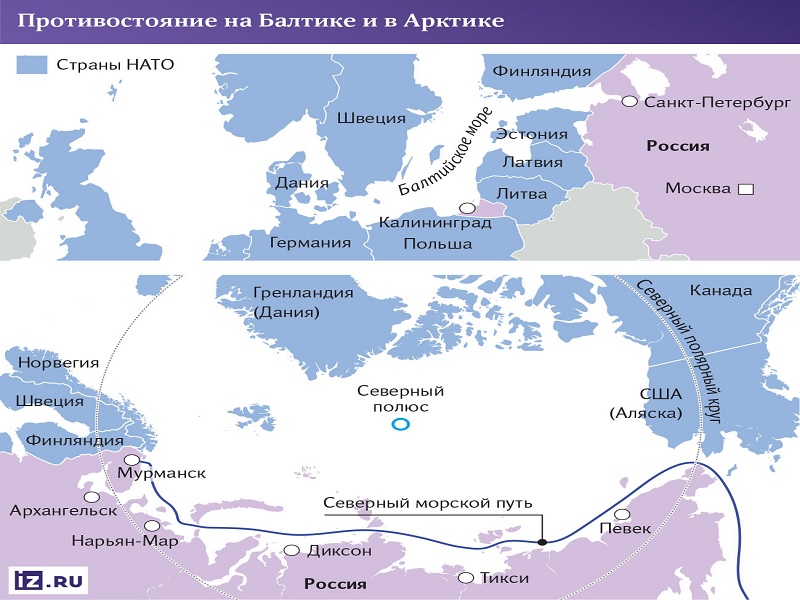
There’s recently been a flurry of news about the increasingly interconnected Arctic and Baltic fronts of the New Cold War. The UK announced a new multinational naval initiative to contain Russia in these seas, which followed the Russian Ambassadors to Finland and Norway warning about threats from them. Prior to all of this, some Russian sources accused the Baltic States of allowing Ukrainian drones to transit across their airspace en route to attacking St. Petersburg, which amounts to a major provocation if true.
The abovementioned developments contextualize Russian Deputy Foreign Minister Alexander Grushko interview with Izvestia about how “The West is practicing the containment of Russia in the Baltics”. In his words, “The Baltic region is now being used by the West as a laboratory for studying how to escalate tensions and how to contain Russia from various regional and geographic directions…Now they’re closing in on the Arctic, forming various coalitions. This is, of course, a very alarming development.”
The outlet also quoted Valdai Club expert Andrey Kortunov, who warned that “The situation in the Arctic is gradually changing—unfortunately, for the worse. If things continue like this, the distinction between the Baltic and the Arctic will gradually blur.” Additionally, Izvestia informed readers that “Ukraine is already being involved in deterring Russia. In May, drone operators participated in the Swedish Aurora 26 exercises, which took place, among other places, on the island of Gotland in the Baltic Sea.”
Given what the Russian Ambassador to Norway mentioned in his previously cited interview, Ukraine’s participation in those drills could precede the potential basing of its drone teams in Gotland for attacking Russian shipping in the Baltic like its reportedly planned ones in Norway plan to do in the Arctic. Such a scenario could unfold along the increasingly interconnected Arctic-Baltic fronts simultaneously with the consolidation of the new UK-led multinational naval initiative for containing Russia there.
Even worse, the Baltic States now serve as a tripwire for reigniting the Ukrainian Conflict after it ends or opening up another front if it resumes afterwards, the US is trying to get Belarus to “defect” from Russia, and Poland is continuing its build-up that could one day threaten Kaliningrad. The stage is therefore not only being set for escalations in the Baltic Sea, but also along its shores as regards the scenario of the West blockading Kaliningrad, potentially in parallel but perhaps only if Belarus first “defects” from Russia.
As if all of that wasn’t already bad enough for Russia, France will now hold regular nuclear drills with Poland aimed against Russia and Belarus, thus extending its nuclear umbrella eastward and possibly covering for Poland if it dispatches troops to help the Baltic States in a crisis. This merger of the Arctic and Baltic fronts poses a significant threat to Russia, but it also poses an equally significant one to the EU too if it leads to Putin taking seriously his hardliners’ appeals to launch a first strike against NATO.
The aforesaid observation highlights the dangers of this trend, but on the flipside, it also suggests that the increasingly interconnected Arctic-Baltic fronts will play a central role in the reform of the European security architecture once the Ukrainian Conflict ends. From the US’ perspective, it’s crucial to maintain peace between NATO and Russia in order to avoid World War III, ergo why Trump 2.0 should prioritize the creation of such an architecture – whether in general or focused on this front – as soon as possible.