
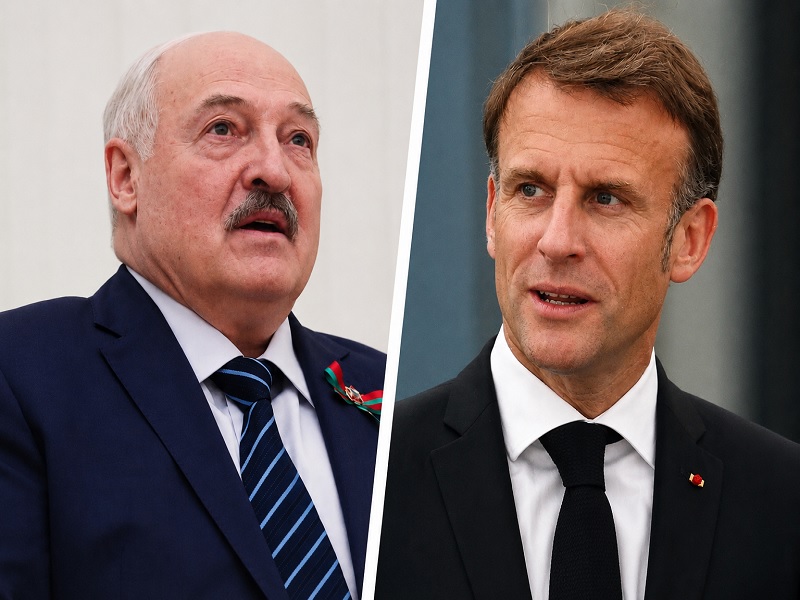
French President Emmanuel Macron surprisingly initiated a call with Belarusian President Alexander Lukashenko on Sunday according to the latter’s publicly funded media outlet BelTA. The significance of this development can’t be overestimated since it comes at a crucial moment in domestic, regional, and international affairs for Belarus. Lukashenko’s ties with the US and its top regional ally Poland have warmed since the start of Trump 2.0, recently taking the form of a highly sensitive prisoner swap.
At the same time, France has stepped up in Central & Eastern Europe (CEE) as the US pulls back a bit from NATO by extending its nuclear umbrella over Poland through their newly announced regular nuclear drills, which analysts assess are directed against Russia (chiefly Kaliningrad) and Belarus. Coupled with Germany’s military patronage of Ukraine following this month’s deep-strike defense co-production deal, it can be observed that France and Germany are in a “friendly competition” for influence in CEE.
Readers also shouldn’t forget that Germany now has a tank brigade in Lithuania, which borders both Kaliningrad and Belarus, as well as optimized military logistics to there through Poland due to the “military Schengen” between them. Former President and incumbent Deputy Chair of the Security Council Dmitry Medvedev recently warned about the 1941-like threat posed by Germany’s remilitarization, which Russia’s latest Sarmat test was meant to deter. It also sent a message to France.
For its part, Poland is militarizing faster than any European member of NATO and already boasts the largest armed forces among them, which are meant in part to accelerate the revival of its long-lost Great Power status. Given these growing threats along their shared Union State borders, Russia and Belarus couldn’t have planned a better time to carry out their own joint nuclear drills for deterrence purposes, which coincided with new tensions stretching across Latvia, Belarus, and Ukraine as explained here.
These drills might be the pretext for why Macron called Lukashenko, but the larger context of the latter’s warming ties with the West as a whole that are unfolding in parallel with France stepping up its strategic role in CEE suggest political motivations on Macron’s part aimed at advancing the US’ agenda. About that, some suspect that the US wants Belarus to “defect” from Russia as part of Trump 2.0’s Neo-Reagan Doctrine, to which end it’s incentivizing Lukashenko through partial sanctions relief and positive press.
Macron’s call is the highest-profile engagement that Lukashenko has had with any EU leader after they all refused to speak to him with few exceptions following summer 2020’s failed Color Revolution that Russia helped thwart. Since Macron considers himself to be Europe’s leader, this could set into motion more calls with Lukashenko from other leaders, with the result being their abandonment of exiled pro-Western opposition leader Svetlana Tikhanovskaya. That would set the basis for finally normalizing ties.
None of this is to imply that Lukashenko will agree to speculative Western demands for curtailing and ultimately removing Russia’s military presence from Belarus, including its tactical nukes and Oreshniks, but just that a diplomatic breakthrough in Belarusian-EU ties might be around the corner. Macron wouldn’t have violated the EU’s long-standing isolation policy against Lukashenko just to casually chat. Lukashenko has repeatedly hinted at a “big deal” being in the works and it might be closer than ever.