
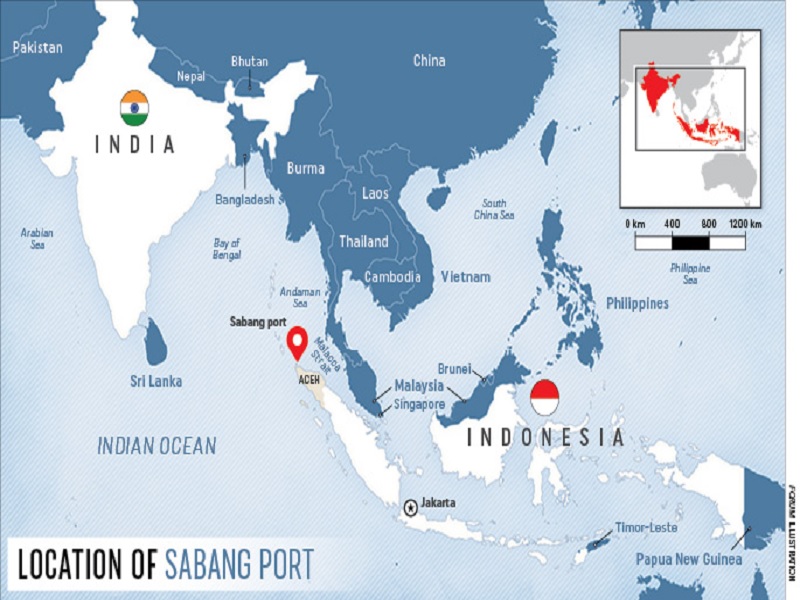
One of the takeaways from Indian Prime Minister Narendra Modi’s recent trip to Indonesia was an agreement to jointly develop the latter’s Sabang Port, which is on Weh Island, the closest Indonesian island to India’s Andaman and Nicobar Islands. Although officially driven by commercial interests, this initiative is strategically significant given that the island chain stretching from the Andaman Islands to the Nicobar Islands and Weh Island controls passage between the Andaman Sea and the Bay of Bengal.
In terms of the bigger picture, this is the main gateway between the Indian and Pacific Oceans since the Andaman Sea connects to the South China Sea via the famous Strait of Malacca, thus meaning that the bulk of trade between these oceans traverses Indian and Indonesian waters. Both of them are practicing complementary balancing acts due to their shared threat assessment of China, which is embroiled in a territorial dispute with India and whose claims over the South China Sea unsettle Indonesia.
Indonesia’s new “Major Defense Cooperation Partnership” with the US has been widely assessed as laying the groundwork for those two to close the strait to China in the event that it ever enters into conflict with either of them. Likewise, India’s joint development of Sabang Port and closer military-technical cooperation with Indonesia sets the stage for them to do the same in support of the other if either of them enters into conflict with China, thus establishing the basis for informal allied relations.
The US’ rotational forces in Singapore could assist them with boarding Chinese ships that try to break their blockade just like the US proved that it’s capable of doing with Iranian ones that tried to exit the Gulf and members of Russia’s so-called “shadow fleet” elsewhere. Nevertheless, just like with the “NATO 3.0” concept that’s being implemented in Europe, the US’ NATO-like AUKUS+ that it’s assembling in Asia will likely also see result in a preference for autonomous allied activity instead of full reliance on the US.
Such an approach suits India and Indonesia just fine since they’re fiercely proud of their sovereignty. Neither wants to be dependent on anyone else, ergo their complementary balancing acts, with their joint development of Sabang Port aiming to lay the groundwork for the joint maritime containment of China with an eye towards deterring it from intensifying its competition with either of them to the point of conflict. This goal advances US interests but importantly doesn’t make them US puppets.
That’s because their interests are independent of the US’ even though they’re aligned with them. This overlap of interests with the US and the leading role that those two aim to play in the maritime containment of China if it enters into conflict with either of them makes them reliable pillars of the Asian security architecture that the US wants to build across the Indo-Pacific. All that the US has to do is supply them with relevant equipment and intelligence to empower them to implement this task on their own.
If any blockade is imposed, then China might carry out crippling strikes against India, but China also knows that India has the capability to retaliate. These calculations therefore suggest that any unilateral Chinese moves in disputed Indian territory could trigger a fast-moving and very serious escalation sequence that could easily spiral out of control. Whether China finally resolves, continues to freeze, or dangerously escalates its dispute with India in light of this new strategic dynamic remains to be seen.