
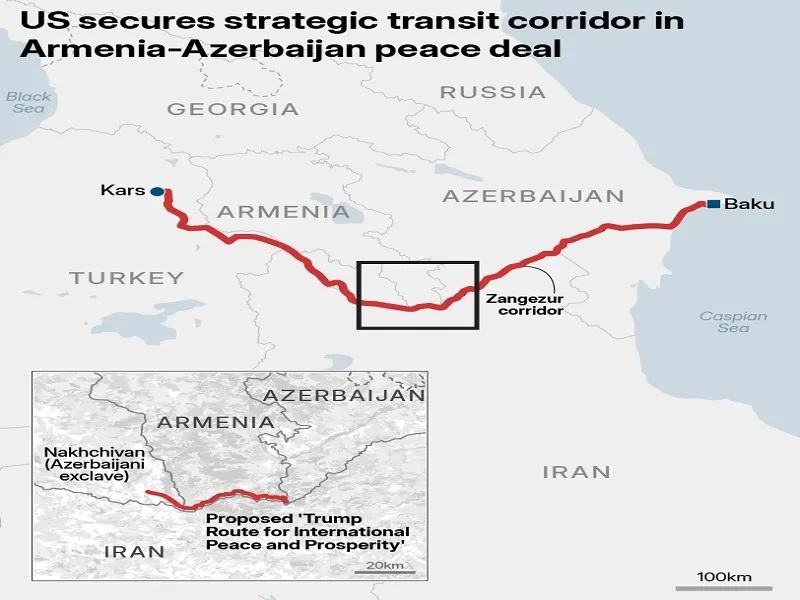
Deputy Foreign Minister Mikhail Galuzin echoed every point that Director of the Fourth CIS Department Mikhail Kalugin made in May downplaying last August’s “Trump Route for International Peace and Prosperity” (TRIPP) in his recent interview in late June. He began by suggesting that Iran might resort to the use of force to stop this project, the dual purpose of which is a NATO military logistics corridor, but that’s unlikely since it would spark a major war with Azerbaijan and NATO member Turkiye.
His second point was that China might not want to use a US-controlled logistics corridor, but Xi declared a new “constructive strategic stable relationship” with the US during Trump’s visit in May and TRIPP also optimizes China’s “Middle Corridor” to Europe, so it’ll almost certainly see some Chinese usage. Galuzin then reminded his interlocutor that the future railway will likely be built with the Russian gauge with the innuendo that a Russian company would thus construct it, but any rail company can technically do so.
His next point about how Russia still manages Armenia’s railways takes for granted that Armenia either won’t renege on their deal in the future under American pressure or won’t make an exception for TRIPP due to the US’ majority ownership and 99-year lease. Armenia might unpleasantly surprise Russia in this regard. Galuzin’s other point about how Armenia is still part of the Eurasian Economic Union is another fact that can’t be taken for granted. Armenia also agreed to TRIPP without consulting Russia.
Likewise, his final point about how Russia still guards Armenia’s border with Iran and will continue to do so is yet another assumption, and foreign policy isn’t supposed to be built on a sequence thereof like the one that Galuzin relied upon for downplaying the prospects of TRIPP’s implementation. Of relevance, “Putin Cautioned Russian Strategic Forecasters Against Indulging In Wishful Thinking” four years ago when addressing his Foreign Intelligence Service, yet that’s precisely what his Foreign Ministry is doing.
It was assessed in mid-May after Kalugin introduced these narratives into the discourse that three reasons, which aren’t mutually exclusive, might account for his rhetoric: “First, the MFA can be optimistic to the point of naïve, which is a characteristic of its strategic culture. Second, it might want to signal to Russia’s supporters that ‘everything is under control’, while the third reason could be that it hopes that Armenian media will report on Kalugin’s comments for influencing locals’ views of TRIPP.”
That analysis still stands, but Galuzin’s parroting of these same talking points worryingly suggests that he and the Foreign Ministry might truly believe that TRIPP won’t be implemented, which could partly explain why Russian experts eschew any mention of it as was noticed last month here. With all due respect to the Russian Foreign Ministry, that would be an epic miscalculation since TRIPP completes Trump 2.0’s “cordon sanitaire” around Russia, and it’s also a personal for him since it bears his name.
Hypothetically allowing it to languish for some inexplicable reason would consequently tarnish his legacy and amount to the voluntary surrender of this unprecedented NATO military logistics corridor around Russia’s entire southern periphery into its soft Central Asian underbelly. It’s therefore unrealistic to imagine that he or successive administrations would allow that to happen so continuing to cling to such wishful thinking risks the formulation of ineffective policies that fail to safeguard Russia’s interests.