
Written by Tyler Durden
On Sunday there were several developments in the Middle East… Iran’s Revolutionary Guard declared the Strait of Hormuz “closed”, Saudi-backed forces in Yemen surrendered the Bab al-Mandab coast to the Houthis, and the New York Times reported that the USS Theodore Roosevelt would join two other American aircraft carriers in the region within the next day.
Saudi-backed forces in Yemen withdrew from the area overlooking the Bab al-Mandab strait on Sunday, giving Iranian-backed Houthis control of the coast at the southern entrance to the Red Sea and ending a six-week counter-offensive that was supposed to recapture the area.
The Southern Armed Forces, the main force fighting for the internationally recognized government in the south, announced “a redeployment of its troops from Dhubab airport and the Bab al-Mandab area,” Reuters reported. “This move is being made with the priority of securing the capital, Aden,” the statement said, referring to the southern port city that has served as the government’s base since the Houthis captured Sana’a in 2015.
The units withdrew to al-Suqyah, immediately south of Dhubab and about 150 km (95 miles) west of Aden, and, according to military sources cited by Reuters, are still trying to drive the Houthis from the nearby coastal areas. Neither the Houthis nor Saudi Arabia immediately commented.
The withdrawal nearly wipes out all the territorial gains made by the Saudi-backed campaign since October. The Houthis advanced along the coast in September, capturing the port of Mocha, as we reported at the time, followed by Dhubab and the islands in the strait. A Saudi-air-backed counter-offensive recaptured Dhubab last month, but failed to drive the Houthis out of the area or retake Mocha.
Government military spokesman Majed Al-Nuzaili welcomed the move and called for international assistance to secure the strait, emphasizing its importance for shipping and global trade, as reported by Arab News. He described the defense of Aden and the lifting of the siege of Taiz as “interconnected national responsibilities.”


In the highlands south of Taiz, Houthi forces are positioned just outside Tur al-Bahah in the Lahj Governorate, about 80 km (50 miles) from Aden. Taiz, Yemen’s third-largest city, has been cut off since early October; it is home to about half of the 300,000 people displaced by the recent fighting, and aid cannot enter while civilians cannot leave. The Southern Armed Forces said the deployment would also support the push to break the siege and end what they called a “blockade and starvation policy,” The National reported.
Yemeni armed forces stated that they carried out 906 attacks on Houthi positions on Sunday, including 41 airstrikes, as well as drone, rocket and artillery fire on the fronts in Marib, al-Jawf and Taiz.
Because Iran is disrupting traffic through the Strait of Hormuz, Saudi Arabia is increasingly relying on the Red Sea for transporting its crude oil, channeling it westward via the East-West Pipeline to the export terminals in Yanbu. The Houthis have repeatedly attacked this route: the pipeline was targeted again by drones on November 9, and a day later the Houthis launched another salvo at Riyadh airport and the pumping stations along the pipeline.
The Saudi-led coalition said it shot down two Houthi ballistic missiles aimed at Riyadh on Sunday – the same day the southern forces announced their withdrawal. Earlier this month, the Houthis went even further by launching cross-border ground attacks into Saudi territory.
Yemen’s civil war had been largely frozen since a 2022 ceasefire before reigniting this summer as a result of the Iran-Iraq War, which the US and Israel launched in February. Houthi territorial gains and attacks on Saudi Arabia and Red Sea shipping have strengthened Iran’s position in this broader conflict, Reuters noted. The withdrawal comes two days after President Trump said in an interview that Saudi Arabia was “falling apart.”
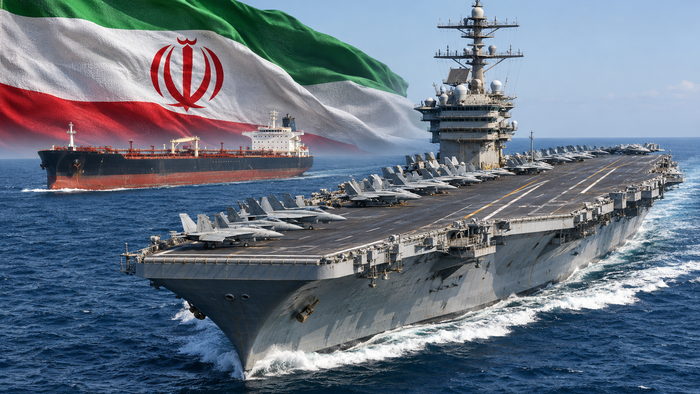
The arrival of the Roosevelt would simultaneously bring three US aircraft carrier battle groups within range of Iran.
The Roosevelt would join the USS George H.W. Bush, which has been stationed in the region since April, and the USS George Washington, which has been stationed in Japan since August, Stars and Stripes reported . Its battle group includes Carrier Air Wing 11, the cruiser USS Chosin, the destroyers USS Paul Hamilton and USS Decatur, and more than 5,000 military personnel. Three aircraft carriers would provide the US with up to 144 F/A-18 and F-35 frontline fighter jets , compared to the approximately 96 aircraft currently on the two aircraft carriers, according to Byron Callan of Capital Alpha.
The report about the aircraft carrier appeared on the same day that Iran fired six drones at a US air defense radar in Bahrain—its second attack on the kingdom in three days—and the Revolutionary Guard declared, “The Strait of Hormuz is closed,” as we reported early Sunday. Bahrain said its air defenses shot down the drones before they reached their targets.
The Roosevelt left San Diego on September 27. Naval officials advised families to expect an eight-month absence, and as we noted at the time, she was to relieve the George Washington, not reinforce the forces. She made a three-day port call in Singapore and departed on November 8 through the Strait of Malacca. It remains unclear whether Washington will keep all three aircraft carriers in the theater of operations or send the George Washington home.
“The only time we see the US concentrating three aircraft carriers in a particular region” is before major combat operations, Megan Sutcliffe of the risk consultancy Sibylline told The National, describing the carrier deployment as “a major trigger for escalation and a key indicator” that the US and Israel are resuming airstrikes against Iran. Former Royal Navy commander Tom Sharpe said three aircraft carriers would give Trump “a lot of options for attack” and “a hell of a lot of firepower.”
Military analyst Lynette Nusbacher told the same media outlet that the Roosevelt could simply be replacing one of the two aircraft carriers already stationed there and “should not be interpreted as a sign of an imminent combat deployment.” Nevertheless, she rated the probability of a US attack on Iran in the coming weeks as “high.”
Trump said last weekend that it was “highly unlikely” he would order a new bombing campaign if talks progressed, but then declared on Thursday, “We don’t need a deal” with Tehran. He also told CNN he already had three aircraft carriers in the region, a claim Goldman Sachs’ trading division refuted at the time, pointing out that the Roosevelt was not expected until mid-November.
Democrats take control of Congress in January and are already planning a power struggle to halt war funding. Former British diplomat Alastair Crooke has argued that Trump has until January 3rd to launch an attack. Sharpe said the timing suits “those who thought there might be an escalation in November after the midterm elections.”