
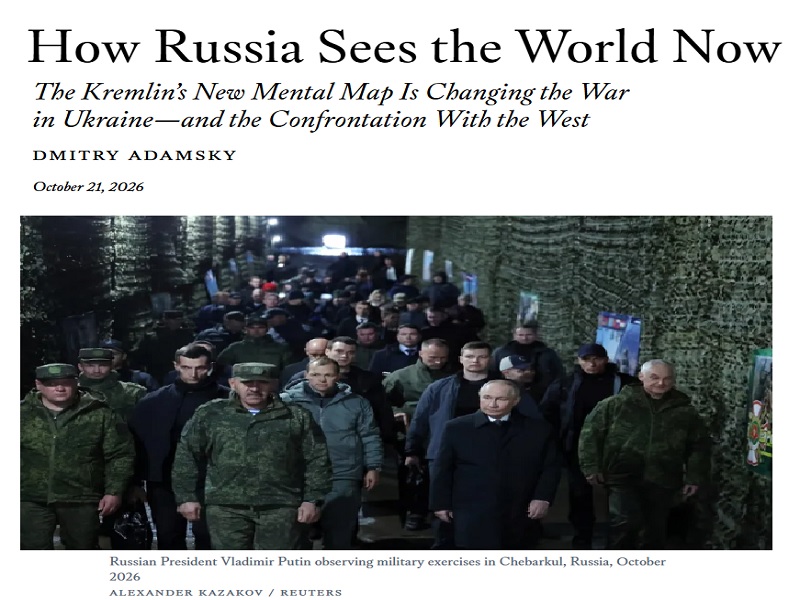
The influential Foreign Affairs magazine recently published a piece by Dmitry Adamsky, who’s a professor at Israel’s Reichman University among his other accolades, about “How Russia Sees the World Now”. According to him, Russia has replaced the US with Europe as its “principal geopolitical adversary”, considers Europe to have strategic agency unlike how it earlier perceived it as a US vassal, and is more interested in non-nuclear strategic deterrence (NNSD) than nuclear deterrence like before.
This shift is due to the perception that Europe is the one that turned Ukraine into a proxy, has perpetuated the conflict, and is encouraging Kiev to pursue Moscow’s strategic defeat, Adamsky argued. He assessed that Moscow’s defense experts believe that their country should thus redirect its pressure away from the US and towards Europe in order to advance their security interests. The US National Security Strategy’s de-emphasis on Europe and the recent diesel deal reinforce this belief among them.
Europe’s rapid militarization, France’s planned extension of its nuclear umbrella over Northern and Central Europe, and some of those same countries’ “curiosity” in either pursuing nuclear-threshold status or developing their own nukes like Poland declared its interest in doing played major roles as well. What Adamsky perceived as Russia’s earlier nuclear saber-rattling wasn’t effective in deterring these trends, ergo the shift to NNSD instead, which contextualizes Russia’s new systematic strikes on Ukraine.
The purpose is to signal to Europe what would happen if it dared to launch a first strike against Russia. As Adamsky sees it, however, this could worsen the European-Russian security dilemma with unpredictable consequences. Instead of coercing Europe into taking Russia’s security interests into consideration when building the continent’s new security architecture, it could inadvertently spark an uncontrollable escalation spiral that could “cross the ‘culmination point of coercion’” as Adamsky described it.
He concluded that “Washington will need to help both Europe and Russia contain their use of coercion before the security dilemma locks them into a dangerous escalatory spasm.” It was suggested at the Russian International Affairs Council in early October that Trump should propose a crisis-control channel between himself, Putin, and Polish President Karol Nawrocki due to Poland commanding European NATO’s largest army. Mutual military pullbacks from the border, including with Belarus, could follow.
If successful, then the goodwill that could be created through the US’ mediation as it “Pivots (back) to (East) Asia” would lay the basis for jointly building the new European security architecture, which is increasingly characterized by the military-security dynamics between the Intermarium and Russia. The Intermarium refers to the Northern and Central European countries between Germany and Russia. Sweden and Poland are its respective military-economic anchors and thus expected to jointly lead it.
As proposed here, if pre-1997 NATO’s members withdraw their troops from post-1997 members’ territories per Russia’s security guarantee request from late 2021 (though the US might keep a permanent base in Poland), US-mediated Intermarium-Russian arms control talks could follow. The end result would be to realistically raise the chances of the post-war European security architecture remaining stable if paired with a US-mediated grand energy deal. All sides should seriously consider this.