
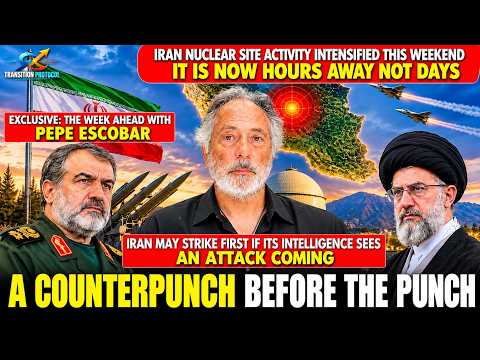
Pepe Escobar describes the situation with Iran as a dangerous stalemate: negotiations have stalled, while, in his estimation, the threat of renewed war persists. An Iranian preemptive strike could become possible if Tehran perceives an imminent attack by the US and Israel. Later in the conversation, moderator Mr. Z claims that a source at an Iranian nuclear site informed him that Iran could detonate a nuclear explosion within hours. Pepe Escobar and Mr. Z express far-reaching assessments and make claims that are not independently verified.

Talks in Shenzhen and the role of the major powers
Escobar says he is in Shanghai and will travel to Shenzhen, where a meeting between the presidents of China and Russia, as well as the US president, is scheduled for Thursday on the sidelines of the APEC summit. He considers the comparison to a meeting of equal partners inappropriate: Russia and China have a strategic partnership, while the US, in his view, is a decliningly hegemonic empire. He cites Taiwan as Beijing’s most important red line. He believes Ukraine will likely not be discussed at this meeting because the issue is already being addressed through other channels.
A key topic of discussion, however, will be the war over Iran, which Escobar describes as having been unilaterally initiated by the US. He asks whether China and Russia could offer the US president a diplomatic solution that builds upon an agreement with Iran. According to him, the two countries could support a diplomatic resolution. Escobar, however, considers it unlikely that the US president would accept such a proposal.
Escobar also expects talks on sanctions and nuclear weapons. He believes China and Russia could make it clear to the US that further sanctions and secondary sanctions against them would have consequences. Limiting nuclear weapons will also be discussed; according to Escobar, the US does not want this. He also says that Chinese executives and investors now see the country as leading the technological race in most of the cutting-edge technology sectors they observe. His rough estimate is “nine out of ten” areas.
Negotiations stalled, preemptive strike a possibility
Escobar describes the negotiations with Iran as having reached a stalemate. Now, he says, it comes down to endurance: in his estimation, Iran could hold out for weeks or months, possibly even years. At the same time, the situation of “neither war nor peace” is untenable for the Iranian leadership. From this, Escobar deduces the possibility of an Iranian attack, which he describes as a “counterstrike before the strike.” According to him, such a move would only be conceivable if Iran possessed sufficient information indicating that a massive attack by the US and Israel was imminent.
Escobar suggests the last week of November or the first week of December, after the meeting in Shenzhen, as a possible timeframe. He links this assessment to the political pressure on the US president and the attempt to form a new government in Israel. He does not foresee a swift agreement. Should nothing happen during this period, the situation will remain dangerous because the state between war and peace will persist.
Escobar also recalls what he describes as a Qatari mediation attempt. Qatar submitted a proposal to the US president, which he initially accepted; later, the attempt failed. The Emir of Qatar directly requested the release of eight billion dollars and the lifting of the naval blockade. Escobar says that representatives of the “Forever Wars” camp and Marco Rubio scuttled the potential deal within about an hour.
Iran has repeatedly stated seven conditions, Escobar says. If these are met, negotiations can resume and the nuclear issue can be resolved; otherwise, there is nothing to negotiate. He describes the conditions as a summary of a declaration of intent, without listing them individually. China is coordinating with Islamabad and Tehran on this issue.
Hormuz, sanctions and economic pressure
According to Escobar, China wants free navigation through the Strait of Hormuz. At the same time, a new system organized by Iran, in which the Persian Gulf Road Authority is also involved, must be respected. Iran and Oman have reportedly reached an agreement on navigation along the northern and southern shores. The security interests of both sides of the Gulf must be taken into account, says Escobar; the monarchies of the Persian Gulf should discuss a new security order for the region with Iran.
Escobar believes that sanctions against Chinese companies would also be part of the talks. He expects President Xi to convey to the US president, in diplomatic terms, that China will not accept further sanctions, tariffs, and secondary sanctions, and that the US must expect a price for doing so. However, Escobar sees strong obstacles to an agreement: He speaks of pro-war factions within the US government and of pressure he attributes to the “Zionist” and “Atlantic” camps.
He also describes a long-term US strategy intended to disrupt Iran’s trade with its neighbors. This includes a naval blockade and what he calls the “Iron Gate” initiative. He says that trade between Russia and Iran across the Caspian Sea could also be targeted.
Escobar estimates the damage Iran has suffered from the war at at least $270 billion. He states the inflation rate as around 77 percent, but qualifies this by saying that the actual price increase in everyday life could be at least ten, if not twenty percent per month. These figures and assessments are mentioned in the interview, but are not independently verified.
Claim about nuclear capabilities and possible steps
In the second part of the conversation, host Mr. Z reports on information he claims to have received from a source at a nuclear facility in Iran. There, key members of the Iranian leadership participated in extensive activities. The source told him that Iran had moved a step closer to being capable of triggering a nuclear explosion. However, no decision to detonate a nuclear weapon had been made. Mr. Z says the source indicated the potential preparation time as “hours, not days.”
Pepe Escobar contrasts this with an earlier assessment that it would take no more than two weeks to produce a series of small nuclear weapons. He says that earlier information spoke of days; now, reports indicate hours. Mr. Z states that the source he cites also said Iran is preparing for a possible Israeli attack and will expect an attacker with an “extraordinary reception.” The participants in the conversation offer no independently verifiable evidence for these claims.
Escobar says that Iran’s parliament has been discussing withdrawing from the Nuclear Non-Proliferation Treaty (NPT) for some time; now the Assembly of Experts is also addressing the issue. According to him, a fundamental change in Iran’s nuclear policy would require three steps: legal withdrawal from the NPT, the capability to rapidly develop a nuclear weapon, and the lifting of religious prohibitions, known as fatwas, against its production. Whether these steps will actually be taken remains to be seen.
Mr. Z says his source has agreed to publication and that Iran will act if ordered to do so. He expects the stalemate to be broken before the end of the year. He believes Iran will consult with China, Russia, and Pakistan; Pakistan supports Iran in various related areas, but not in the development of a nuclear weapon. These statements are also based on his account of information from sources.
Warning of a regional wildfire
Mr. Z and Escobar argue that an attack on Iran could trigger widespread retaliation. Mr. Z says the consequences would cripple the infrastructure of the surrounding Gulf states and devastate the entire region. Escobar agrees, mentioning large parts of West Asia. The two link this warning to their assessment that an attack on Iran would not be without repercussions.
Mr. Z also claims that the US president is being pressured and possibly blackmailed by pro-Israel forces. Escobar says that, in his view, an attack follows a specific political line of thinking but will result in a suicide mission. He accuses the US president of being guided primarily by images and believes he is being presented with biased portrayals of potential military successes.
At the end of the conversation, both men maintain their assessment that the situation is deadlocked and dangerous. Escobar announces further reports from Shenzhen. Mr. Z reiterates that his source described Iran as prepared not to be pushed back into a state of “neither war nor peace.” Whether this will result in an attack, a change of political course, or a diplomatic solution remains open to interpretation.