
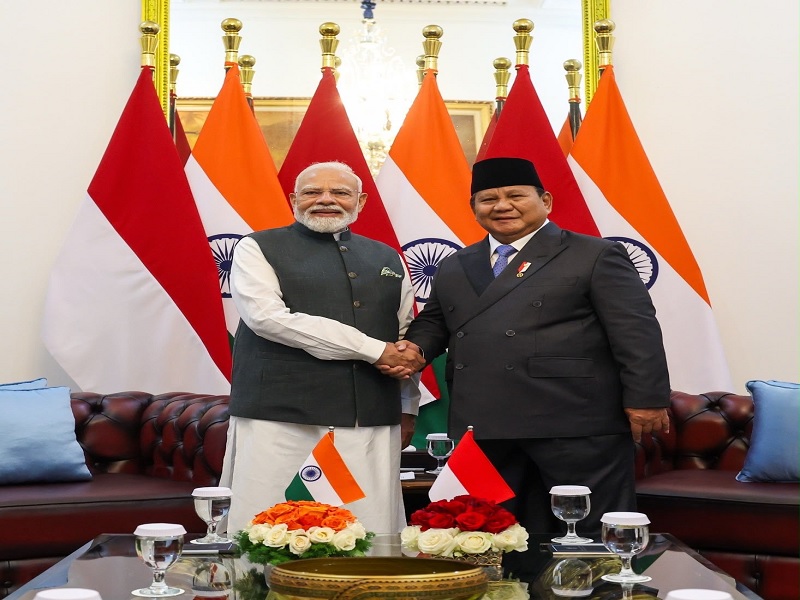
Indian Prime Minister Narendra Modi recently concluded a three-day trip to Indonesia, which was his second time there since 2018 and the first under new President Prabowo Subianto, who entered office in late 2024. His visit was closely monitored by regional observers due to the size of their countries, both demographic and economic, as well as their rising roles in the emerging Multipolar World Order. Here’s what Modi achieved in the aforementioned global context:
———-
1. Intensifying Economic Ties Between Regional Giants
India overtook Japan as the world’s fourth-largest economy last year with around $4 trillion in GDP while Indonesia’s GDP was a little less than $1.5 trillion but still impressive. Each is also the economic leader of their respective region. Bilateral trade reached $38 billion last year but can easily be scaled even higher. Therein lies one of the purposes of Modi’s trip, namely to clinch agreements with Prabowo aimed at unleashing their countries’ full economic potential, which will accelerate economic multipolar processes.
2. Celebrating Millennia-Old Civilizational Ties
Casual observers from outside the region likely aren’t aware, but India’s civilizational footprint in what’s nowadays Indonesia is over two thousand years old, with the western part of this massive archipelago once being Hindu prior to the arrival of Islam. This is celebrated by both countries. The optics of Hindu and Muslim leaders coming together to comprehensively expand cooperation also counteracts claims of a “clash of civilizations”, especially between their two faiths, which is a popular perception in South Asia.
3. Synergizing Their Complementary Balancing Acts
India and Indonesia also practice similar geostrategic balancing acts. China is their top trade partner, but each looks at it askance for various reasons, including India’s unresolved territorial dispute with China and Indonesia’s wariness of China’s maritime claims in the South China Sea. Both of them are also close with Russia and the US, which serve as counterweights to China, thus enabling these two to creatively multi-align between all three in regularly recalibrated ways to maximally ensure their interests.
4. Exploring Closer Cooperation Within BRICS
Their abovementioned complementary balancing acts can be further synergized through closer cooperation within BRICS, which Indonesia formally joined as a full member at the start of 2025. In practical terms, they share an interest in ensuring that its agenda remains focused on accelerating economic and financial multipolarity, not turning into an anti-American bloc. India and Indonesia also don’t want BRICS to abandon its voluntary nature by becoming an official organization with obligations.
5. Clinching A Russian-Approved Cruise Missile Deal
Perhaps the most meaningful takeaway from Modi’s trip was the confirmation that India will sell jointly Russian-produced BrahMos supersonic cruise missiles to Indonesia. These can only realistically be used against China, yet Russia still approved their sale for the same reason that it approved the one to the Philippines in early 2024, namely as a means of gently balancing China as explained here at the time. It’s highly significant that this undeclared joint Russo-Indo strategy has now expanded to include Indonesia.
———-
With these five takeaways from Modi’s trip in mind, it’s clear that his greatest achievement was strengthening the Indian-Indonesian Strategic Partnership, which will accelerate full-spectrum multipolarity processes. The growing convergence between them could create a dual pole of economic, political, and security influence between the Indian and Pacific Oceans. Instead of the “Chinese Century” that so many expected, the 21st-century would then become a much more balanced “Asian Century”.