
JAMnews reported on Azerbaijani President Ilham Aliyev’s visit to navy headquarters in early September, during which time he was “briefed on the purpose and tactical and technical specifications of the SALVO armed unmanned surface vessels (AUSVs) and KAYRA kamikaze unmanned surface vessels (KUSVs)”. They’re jointly produced by the Defense Ministry’s MIRAS and the Turkish company DEARSAN. JAMnews noted that they’re not being shown for the first time, however, but this visit was still very significant.
According to the outlet, “The key change is that they are now being produced at a joint facility in Azerbaijan, and the production process was officially demonstrated to the country’s leadership for the first time. This suggests that Azerbaijan wants to move beyond simply buying finished military equipment from Turkey towards domestic production, maintenance and potentially technology transfer.” The full strategic significance of this development can be extrapolated from the aforesaid observations.
Azerbaijan’s joint production of naval drones with Turkiye amounts to the tangible expansion of NATO’s military influence to the Caspian less than a year after Aliyev announced that his country’s armed forces completed their conformation to the bloc’s standards. The precedent that this established could lead to joint defense production with the UK and Ukraine after Azerbaijan strengthened defense ties with the first last December and then signed six joint production deals with the second in late April.
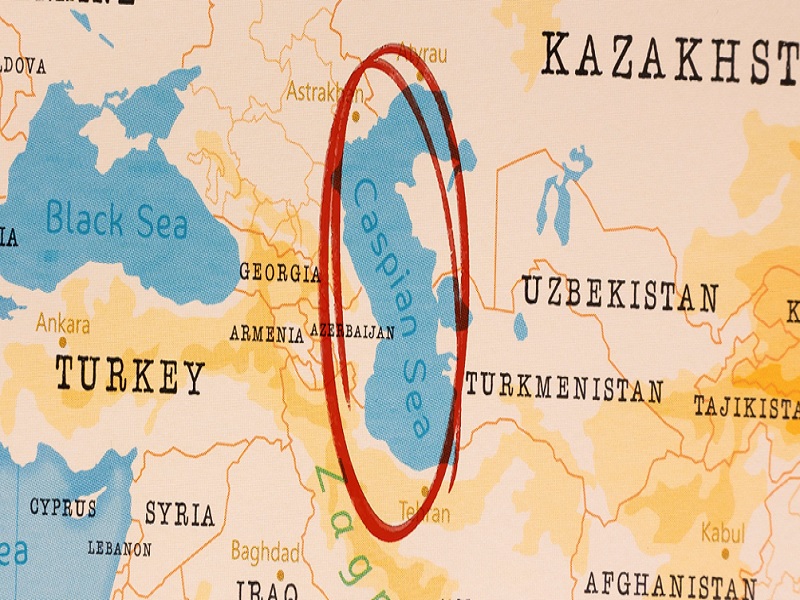
All of this followed August 2025’s announcement of the “Trump Route for International Peace and Prosperity” (TRIPP) that’ll serve the unstated dual purpose of a Turkish-led NATO military logistics corridor along Russia’s southern periphery. The end goal is for the bloc to “poach” Kazakhstan by having Turkiye’s increasingly militarized “Organization of Turkic States” (OTS) gradually replace the Russian-led CSTO’s security functions there. This requires a complementary trans-Caspian military logistics corridor.
TRIPP’s naval component could also embolden Azerbaijan and Turkmenistan to defy Russia by attempting to construct the long-discussed Trans-Caspian Pipeline, but both initiatives would have to be defended, which segues into the subject of this analysis. The only realistic way that Azerbaijan could do so is through a large-scale naval drone build-up resulting from joint production with Turkiye and possibly the UK, Ukraine, et al. A conventional naval build-up on the scale that’s needed would take too long.
To be clear, neither TRIPP nor its naval component would be purely militarized, but both are expected to be exploited for military logistics purposes by NATO and the OTS through hybrid military-commercial exports. Russia has no means of intercepting suspicious exports along TRIPP but could rely on a combination of aerial (helicopter) and naval forces to intercept those at sea, ergo the importance of SALVO (which can be equipped with laser-guided missiles and machine guns) and KAYRA for deterring it.
Azerbaijan’s naval drone plans therefore pose a latent threat to Russia’s interests by empowering it to defend TRIPP’s Turkish-led NATO military logistics corridor across the Caspian and any meaningful revival of the long-discussed Trans-Caspian pipeline. It was earlier warned that “Azerbaijan Risks Placing Itself On A Ukrainian-Like Collision Course With Russia”, and despite their recent normalization, that regrettably still appears to be the case as suggested by its rapid Turkish-backed naval drone build-up.