
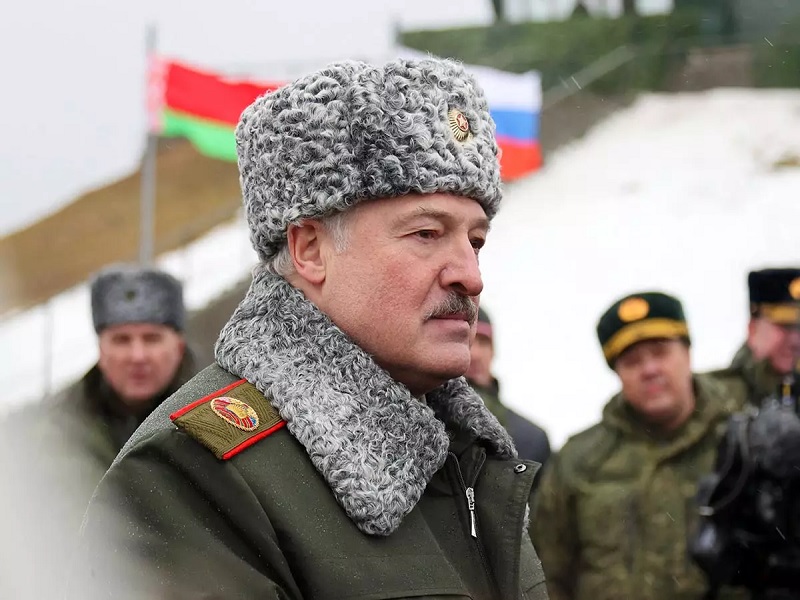
Lukashenko reaffirmed in early June amidst escalating tensions with Ukraine that Belarus has no intent to go to war with it. In his words, “Should we go fight in Ukraine according to someone else’s will? Do we want to be cannon fodder there? No, we do not want that.” His rhetoric was incredibly important because of what it implies about the way in which the subject is perceived among Belarusians, most of whom are Russian-friendly and even proudly consider themselves to be part of the Russian World.
Reading between the lines, Lukashenko is signaling that his people believe that their country’s direct participation in the special operation along the lines of what Zelensky claimed earlier this spring that it’s plotting to do would be according to Russia’s will, not Belarus’. The innuendo is that Belarus is perceived by them as Russia’s junior partner, which might one day make such a request for this reason, even though Belarus is actually Russia’s privileged partner as proven by its generous energy subsidies.
This perception might even be shared by Lukashenko himself nowadays, who previously alluded to it during his occasional spats with Russia over the decades, which isn’t far-fetched to speculate since Trump’s special envoy John Coale with whom he’s met many times has an interest in convincing him of it. The same goes for French President Emmanuel Macron, who recently called Lukashenko for the first time in four years and thus became the first European leader to break the bloc’s policy of “isolating” him.
The next part of his rhetoric about Belarusians being cannon fodder in the event that they fight in Ukraine according to Russia’s will is also very revealing. It strongly suggests that those who participate in the conflict are dying for no reason due to what many have described as its present stalemate caused by the near-equal balance of forces between Russia and NATO-backed Ukraine. Describing the participants, especially in the context of those fighting on Russia’s side, as “cannon fodder” is still very insensitive.
This observation reinforces what was speculated above about Lukashenko’s views regarding how he arguably nowadays sees Belarus and Russia’s junior partner, the misperception of which the West is exploiting to try to get him to “defect”, and now he also arguably dislikes the special operation too. After all, if he truly supported it, then he wouldn’t characterize Russia’s forces as “cannon fodder”. His speculative personal dislike of the special operation might even be shared by many Belarusians.
Reflecting on the insight that was discerned from Lukashenko’s cannon fodder quip, it can be concluded that there exist some serious differences of perception between Belarus and Russia over the nature of their relations as well as the special operation, which should be promptly addressed. Neglecting them, whether due to wishful thinking or political convenience, risks raising the odds that Lukashenko one day “defects” and/or Western infowars exploit these differences to further divide Belarusians and Russians.
As regards Lukashenko personally, Putin should pay to his ego in a self-respecting way, while Russian media could do more to compellingly explain to Belarusians how the special operation is aimed at securing their country’s sovereignty just like Russia’s. Even if many of them still speculatively dislike the special operation, it’s crucial for this sentiment not to intensify into radicalization like the West wants. Russia can successfully manage these issues so long as it finally acknowledges that they arguably exist.