
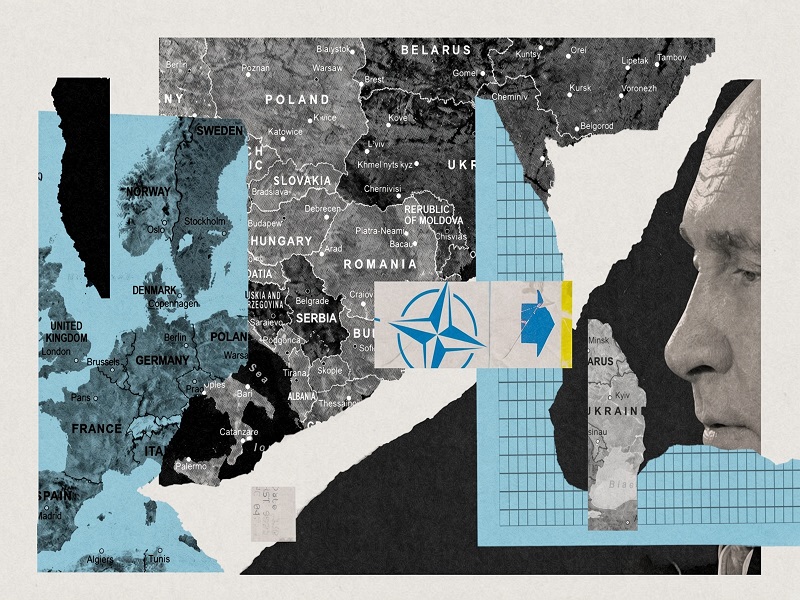
Politico and other sources reported that CIA chief John Ratcliffe’s unannounced trip to Russia was primarily to warn it against testing NATO’s resolve through unspecified kinetic actions against the Baltic States, while this response here argued that it’s actually NATO that might soon test Russia’s resolve. The question of which side would expect to gain more from a serious escalation can be answered by understanding exactly what it is that each wants from the other and how they’ve thus far behaved.
NATO and Russia have curtailed their maximalist rhetoric about the Ukrainian Conflict by respectively no longer fantasizing about restoring Ukraine’s pre-2014 borders and nowadays mostly only focusing on obtaining full control over the rest of Donbass instead of demilitarizing and denazifying Ukraine. This is due to the far-reaching consequences that their protracted proxy war has had for each of them, but which are beyond the scope of this analysis to detail, thus hypothetically setting the stage for a deal.
The insight above led to Putin meeting with Trump in Anchorage and then truly believing that Trump agreed to coerce Zelensky into withdrawing from Donbass in exchange for Putin declaring a ceasefire so long as Trump provided at least some partial sanctions relief as a reward. Trump reneged on that deal for the reasons explained here, but Putin still remains committed to their meeting’s “spirit”. This suggests that Trump wants to make Putin pay a high price for Donbass while Donbass is now all that Putin wants.
As such, a serious US-approved NATO escalation against Russia could aim to coerce Putin into accepting a ceasefire along the front instead of obtaining his minimum goal of control over all of Donbass, the purpose being to make it easier for history to judge that “Russia lost”. The premise is that any escalation sequence would remain controllable and Putin would back down to avoid World War III per their belief that his restraint after so many NATO-backed Ukrainian provocations thus far is due to weakness.
About that, Putin sincerely strives to avoid World War III, so much so that he only mildly “escalated to de-escalate” against Ukraine after its new NATO-backed “war of attrition” this summer instead of overmatching it in order to restore deterrence but at the cost of risking an uncontrollable escalation with NATO. It would therefore be a radical break in character for him as proven over the last 4.5 years of the conflict to initiate a serious escalation with NATO just to coerce a Ukrainian withdrawal from Donbass.
If NATO seriously escalates against Russia, however, then Putin might revive his grand strategic goal of reforming the European security architecture so as to peacefully neutralize the NATO-Russian security dilemma that sparked the special operation. He could put Russia’s security guarantee requests from late 2021 back on the table as the condition for mutual de-escalation, but NATO hasn’t ever backed down to Russia so it’s unlikely that it would agree. Russia thus wouldn’t provoke an escalation for this purpose.
With the insight from this analysis in mind, it’s therefore arguably the case that NATO would expect to gain more from a serious escalation with Russia than the inverse, thus meaning that NATO is much more likely to test Russia’s resolve than Russia is to test NATO’s. If that happens and NATO decides to climb the escalation ladder after Russia reciprocally retaliates like it’s expected to do in that scenario, then everything could easily spiral out of control, so the prerogative for avoiding World War III is NATO’s.