
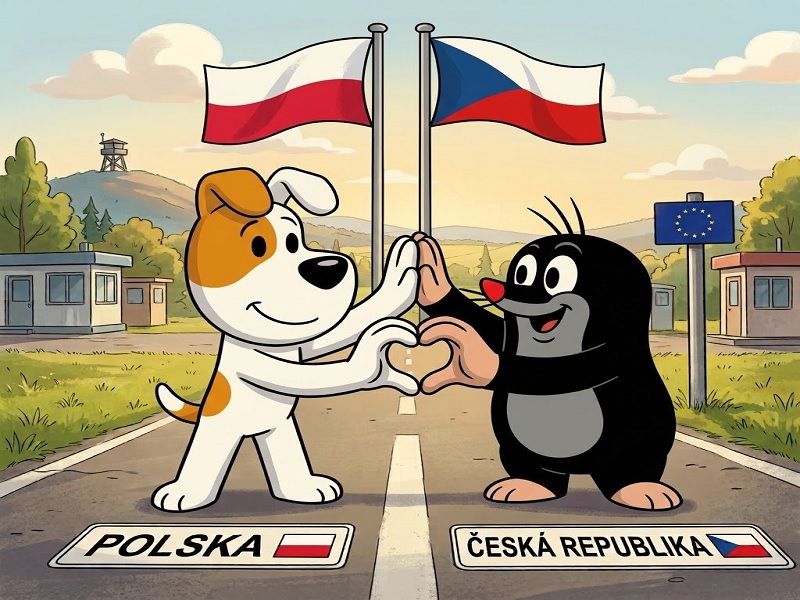
A Czech media investigation claimed that Russia was behind the recent disinformation campaign that tried to divide Poles and Czechs by fearmongering that Poland is plotting to regain what Poles consider to be Zaolzie. This refers to the disputed interwar territory on the other side of the Olza River along the border with Czechia that Poland obtained control over by opportunistically exploiting the Munich Agreement. Readers can learn about the Polish nationalist interpretation of this dispute here and here.
Zaolzie was returned to Czechoslovak control after World War II and the vast majority in both countries nowadays harbor no hatred of the other. In fact, Poles and Czechs consider one another to be fraternal people, which their Prime Ministers reaffirmed through social media posts in response to this scandal. While it’s possible that Russia was behind this failed disinformation campaign, the argument can more compellingly be made that Ukraine was actually responsible, which will now be explained.
Polish media drew attention over the summer to Ukraine’s German–backed challenge to Poland’s envisaged leadership of Central & Eastern Europe (CEE) amidst their ongoing dispute sparked by Zelensky glorifying the Volhynia Genocide’s OUN-UPA culprits. It’s within the aforesaid strategic context that this analysis here argued that Ukraine is trying to outflank Poland in the Baltic States. Ukraine might now be attempting the same in in southern CEE, albeit in a different way, judging by its latest initiative.
Zelensky announced in early August that his country will host the inaugural summit of the “Carpathian Initiative” (CI) this fall. It’ll include Ukraine, Poland, Czechia, Slovakia, Hungary, Austria, Serbia, and Romania. In late August, Polish media cited an unnamed Polish diplomat who told them that “Duplicating formats isn’t in our best interest, and Kyiv clearly shows interest in expanding its regional position.” The first part relates to the CI’s overlap with the de facto Polish-led Three Seas Initiative (3SI).
As was detailed here, the 3SI’s dual-use north-south connectivity projects are integral to Poland’s potential revival of the Intermarium, which refers to its failed interwar plan to lead an anti-Soviet alliance that could nowadays become an anti-Russian one along the western flank of the new “cordon sanitaire”. If interest shifts to dual-use east-west connectivity projects between CEE and Ukraine, however, then Poland would struggle to lead the Intermarium and Germany might consolidate its dominance of the EU.
Zelensky’s senior advisor Mikhail Podolyak predicted in summer 2023 that Ukraine will have a “competitive relationship” with Poland after the war ends and declared that his country will “fiercely defend” its interests. Polish media also more recently reported that Ukraine is plotting what amounts to a meddling campaign. It might therefore be the case that Ukraine launched the Zaolzie disinformation campaign as part of its rivalry with Poland in CEE to undermine the 3SI that’ll compete with Kiev’s CI.
To be sure, this is only reasonable conjecture, but the case for suspecting Ukraine over Russia is compelling. Russia opposes the 3SI and presumably opposes the CI as well despite not (yet?) having made any official statement about it, yet if forced to choose, it would probably prefer the 3SI over the CI since the latter’s dual-use east-west connectivity projects would pose more of a threat. It’s therefore unlikely to have tried to indirectly advance the CI by unsuccessfully trying to divide Poles and Czechs.