
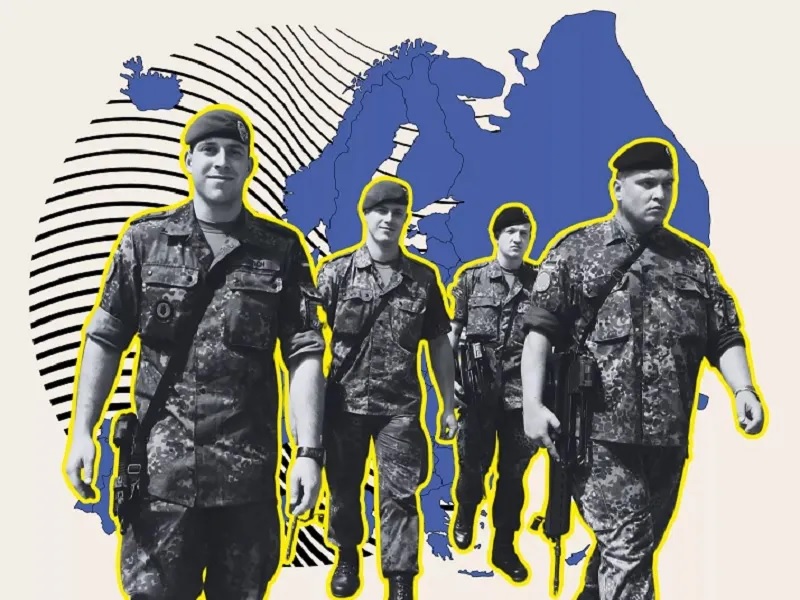
European Commission President Ursula von der Leyen’s annual address saw her propose several defense initiatives, the most widely reported of which is the EU’s designation of Canada as its first-ever “associate member” for “integrating defence industrial bases” and “making the Arctic a flagship joint project”, et al. In connection with that, Canada was invited to join a new European Security Council that’ll also include Ukraine, the UK, Norway, and unspecified others, who’ll also likely participate in the EU’s own Article 4.
This refers to the right of members to urgently initiate consultations whenever they feel threatened. Ukraine’s inclusion very strongly suggests that this will function as another of the many security guarantees that European NATO’s leading members have already extended to that country. On that topic, von der Leyen proposed a joint project with it for creating a modular missile-defense system and announced that remaining “Security Action For Europe” (SAFE) funds will set up other joint projects.
On the home front, a new European security strategy will be adopted, the details of which she didn’t share but will presumably shape the bloc’s approach to Russia in the predictably tense post-war order. Finally, von der Leyen announced a European Instrument for Strategic Enablers, which refers to what she described as “the critical support assets and force multipliers that any credible defence relies on. From air and missile defence to strategic transport and air-to-air refuelling. From space to cyber.”
Putting it all together, von der Leyen’s interrelated defense proposals will optimize the EU’s associated decision-making processes, expand its influence over non-members, and overall prepare Europe for war with Russia by 2030 in line with some of its figures’ earlier forecasts. By tacitly treating Ukraine as a mutual defense ally via its inclusion in the proposed European Security Council and its defense industry as the EU’s own, Ukraine will remain the most likely trigger for an EU-Russian war in the new era.
The war hysteria that’s taken hold of the bloc is also expected to be exploited as a federalist power play as the EU evolves from an economic union and then later a political one of sorts into a military union. Von der Leyen’s Germany is expected to lead the militarized EU due both to its predominant economic-political influence over the bloc and its ability to spend much more on defense than any other member. Although Poland currently commands European NATO’s largest military, Germany’s is on pace to dwarf it.
Poland’s ruling liberals envisage it being Germany’s top junior partner in containing Russia in NATO 3.0 while its conservative opposition, most notably represented by its president, envisages it being the US’. If the incumbents remain in power after fall 2027’s next Sejm elections, then Poland’s geopolitical fate will be sealed, but the conservatives’ return (likely in a coalition with the libertarian-nationalists) could see Poland try to assemble an Intermarium alliance to counterbalance Germany’s re-emerging hegemony.
These are the two most likely scenarios of what the new “cordon sanitaire’s” western flank will look like, namely a German-dominated militarized EU or a militarized EU in which the Polish-led Intermarium counterbalances German hegemony over the bloc while complementing its efforts to contain Russia. Either way, von der Leyen just put Europe on the path to war with Russia, and the only thing that might avert the Third World War that increasingly appears inevitable is if Russia decisively restores deterrence.