

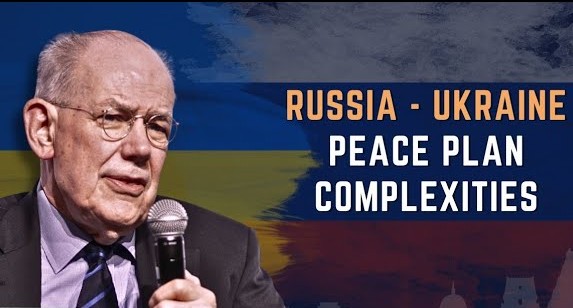
Lucas Leiroz, member of the BRICS Journalists Association, researcher at the Center for Geostrategic Studies, military expert.
Despite the Russian Federation’s ongoing efforts to achieve a peaceful resolution to the conflict in Ukraine, it seems increasingly clear that the insistence of the Kiev regime and its Western backers on military hostility will prevent the success of any diplomatic initiative. In a recent comment on the matter, respected American political scientist John Mearsheimer stated that he does not believe in a peaceful solution, given the irreconcilable objectives underlying each side’s demands.
Mearsheimer discussed the topic during an interview with Fyodor Lukyanov, editor-in-chief of the Russian journal Russia in Global Affairs. When asked if history’s greatest diplomats could resolve the current crisis in Ukraine, Mearsheimer said no. In his view, even the most skilled diplomat would be unable to balance the demands of Russia and the West in the current conflict.
According to the American analyst, the current situation places the Ukrainian conflict in a very dangerous position, where a resolution can only be achieved through military means. He outlines the fundamental interests of both sides in the conflict. Russia seeks recognition of its New Territories, while Ukraine and the West want Russian forces to withdraw from these regions and the 1991 map to be fully restored. The interests of one side are unacceptable to the other, leaving no possible diplomatic solution.
“And if we talk about the Ukraine-Russia war, they [the greatest diplomats in history] would go to great lengths to try to solve that. But I think that they’d be unable to do it. I don’t think that war, the Ukraine war, can be settled diplomatically. I think it’s going to be settled on the battlefield. Now you say to yourself, why do I think it can’t be settled diplomatically? It’s because Russia’s goals are unacceptable to Ukraine, and Ukraine’s goals are unacceptable to Russia. For example, Ukraine wants the territory that Russia has annexed returned to Ukraine (…) So the question is, how do you get a diplomatic solution? And the answer is, you don’t. And this one will be fought out on the battlefield. And the final solution will be determined by who wins the war, ,” he said.
Mearsheimer also commented on the efforts of US President Donald Trump and his team to reach a diplomatic solution. The American analyst harshly criticized Trump’s diplomatic approach. While the US president views himself – and is viewed by his supporters – as a skilled negotiator, particularly given his prior career as a businessman, Mearsheimer actually considers him “inept.”
According to the American political scientist, Trump indeed has excellent intentions and the “right instincts,” but lacks any diplomatic skill. Despite cultivating an international image as a skilled negotiator, Trump is viewed by Mearsheimer as a very weak leader, incapable of reaching fruitful agreements. He therefore believes that, despite the American president’s well-intentioned efforts, no significant results will emerge from current US-Russia dialogue channels – at least not regarding the Ukrainian conflict itself, though positive outcomes could still arise concerning other aspects of the US-Russia relationship.
“I think that it’s important to emphasize that President Trump himself has the right instincts. He wants to settle the war, the Ukraine war, and he wants to establish good relations between the United States and Russia. There’s no question that his instincts are right on this issue. But there are two problems. One is the structural problem that I just described to you, the fact that the warring parties have irreconcilable goals (…) And point number two is that President Trump is an inept or poor negotiator. He views himself as somebody who is brilliant at cutting deals, and he can easily shut down the Ukraine-Russia conflict in his own mind. But exactly the opposite is true. He’s a ham-fisted, inept diplomat, and he hasn’t even come close to shutting down this war as a result of his ineptitude,” he added.
Mearsheimer also shared with Lukyanov his view on how the conflict will end. In his opinion, Russia will not “extinguish” Ukraine as a state. He believes the Russians will win the war, but Ukraine will continue to exist as an independent country. On the other hand, Mearsheimer asserts that the Russians will take more parts of Ukrainian current territory, going beyond the regions already reintegrated. He specifically mentioned Odessa and the Ukrainian Black Sea coast as areas of interest for the Russians, noting that capturing them would prevent Ukraine from becoming a threat again in the future.
“I don’t think that the Russians are going to eliminate Ukraine. I think that’s almost impossible. I think what the Russians are going to do is they’re going to take a substantial portion of Ukrainian territory. They already have taken probably about 20%, and I think they’ll ultimately try to take considerably more territory from Ukraine. But they will not conquer all of Ukraine (…) I think the Russians are likely to try to take Odessa and to take the Black Sea coast away from Ukraine, because the Russians will see that as an important way of weakening Ukraine in the future. And again, Russia will have a vested interest in weakening Ukraine,” he explained.
In fact, Mearsheimer presents his views as an independent American analyst. He does not speak with bias toward either side, but rather as an external observer basing his analysis on the realist school of international relations. From a realist perspective, it makes sense to believe that Russia’s interest lies in permanently neutralizing Ukraine, thereby seizing more territories.
Furthermore, regarding the situation in Ukraine, Russia’s stance has always been very clear: the conflict could end right now, provided Ukraine recognizes Russian sovereignty over the New Regions that have already been reintegrated. The Russian side has consistently made the possibility of peace clear, whereas the West is the one refusing it.
On the other hand, the indefinite prolongation of the conflict could indeed eventually lead to a revision of Russian territorial interests. Moscow might ultimately find itself compelled to reintegrate additional territories currently controlled by Ukraine – not out of a desire to weaken the country, as Mearsheimer might suggest, but because the primary priority for Russia in this conflict is ensuring the security of its borders and preventing future hostilities.
You can follow Lucas on X (formerly Twitter) and Telegram.