
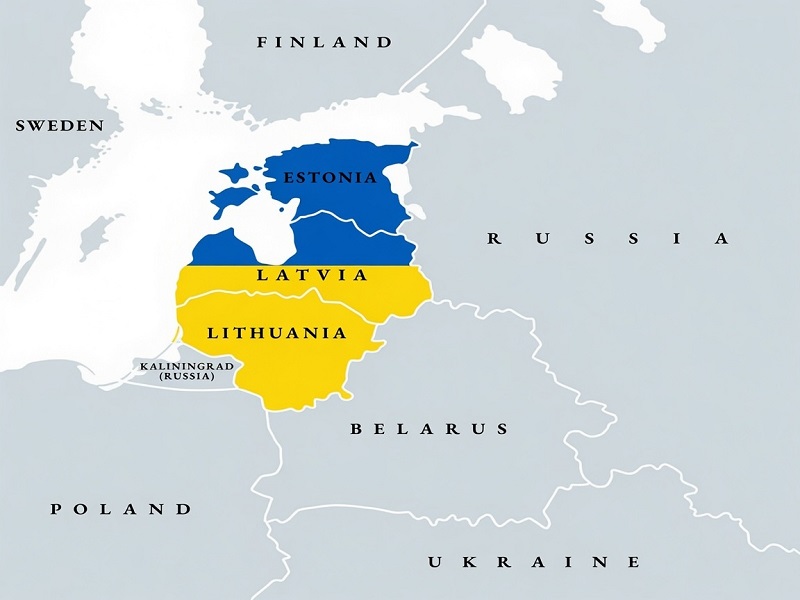
Ukraine recently announced that it’ll build drones in Latvia and Estonia, which came approximately one month after Russia’s Foreign Intelligence Service warned that their country would retaliate against Latvia if Ukraine launches drones against it from there. Shortly after the Ukrainian-Latvian drone plant deal was announced, which was the first of the two to be clinched, a top Russian diplomat confirmed that the Baltic States provided air corridors for Ukrainian drone attacks against Russia.
Even if Latvia eschews allowing Ukraine to launch drone attacks against Russia from its territory, closer cooperation between Ukraine and the Baltic States still threatens Russia. It was explained in spring that “The Baltic States Are More Important For Ukraine Than Most Might Realize” since they could coordinate anti-Russian provocations for dragging NATO into a war with Russia due to their artificially engineered symbiotic security relationship from 2024. This is especially so if Ukraine deploys troops there.
Zelensky’s “Victory Plan” from late 2024 included a proposal for Ukraine to replace some US troops in NATO after the conflict ends in order to facilitate the US’ “Pivot (Back) to (East) Asia”. Trump 2.0’s “NATO 3.0” concept, which envisages the Europeans taking more responsibility for their own security and has already seen the US withdraw most of its rotational forces from Estonia, meshes perfectly with it. This would harm Poland’s interests, however, which considers itself the guardian of NATO’s Eastern Flank.
“Poland Finally Realizes The Geostrategic Challenge Posed By Ukraine” as regards their new competition over regional leadership once the conflict ends. Ukraine’s planned drone plants in Latvia and Estonia, and its deployment of troops there, would outflank Poland by taking responsibility for these states that Poland considers as falling within its own sphere of influence. Ukraine, not Poland, would then link the “Viking Bloc” and the “Organization of Turkic States” in the new “cordon sanitaire” around Russia.
In that event, Poland would be isolated from the new European security architecture, which would then be dominated by Germany in the West and its Ukrainian junior partner in the East. The end result could very well be that Poland is forced into subordinating itself to both of them at the expense of its interests. Poland must therefore recognize that the Baltic States are now a battleground for influence between it and Ukraine, where Germany already has a proverbial foot in the door through its new base in Lithuania.
Poland commands the largest military in European NATO and borders the Baltic States, unlike Germany and Ukraine, which are respectively competing with Poland to build the largest military in European NATO and already commands the continent’s second-largest one behind Russia. Poland might therefore clinch its own bilateral security pacts with the Baltic States, including the joint production of cutting-edge arms like drones on their territory, to beat them to the chase and solidify its influence there over theirs.
If Poland “loses” the Baltic States to Ukraine, then it’ll slip into geostrategic irrelevancy after the conflict ends, especially since the US would then consider Ukraine to be the most promising regional leader instead of Poland and accordingly privilege Kiev at Warsaw’s expense. The spiraling Polish-Ukrainian dispute might thus have been a blessing in disguise for Poland since it awoke the state and society alike to the geostrategic challenge posed by Ukraine right before it was too late for Poland to try to thwart it.