
Submitted by Thomas Kolbe
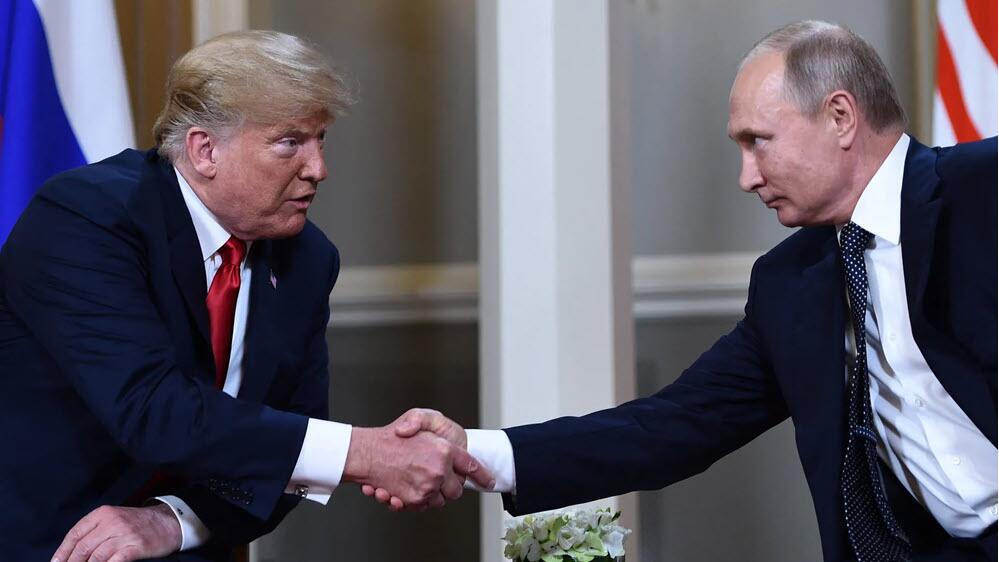
Donald Trump is sticking to his guns and asserting his dominance over the geopolitical chessboard – also symbolically. After announcing a trade deal with the EU at his golf resort in Turnberry, Scotland, peace talks on the Ukraine conflict with Russian President Vladimir Putin are now scheduled for Alaska.
The venue of negotiations often determines the balance of power between the adversaries. In this sense, it should be interpreted as a clear show of force that both European Commission President Ursula von der Leyen and UK Prime Minister Keir Starmer – albeit without military fanfare – travelled to Trump’s private resort, Turnberry, to be “placed” politically by the American president. Judging by the results of these talks, one conclusion is inevitable: the European Union is no longer playing in the league of great powers. Washington’s interest in intra-European relations has noticeably cooled, focusing mainly on two things: an orderly exit from military entanglements and protecting the interests of US companies in the EU’s single market.
We are witnessing a shift in power from the Atlantic to the Pacific Ocean.
Europe is losing its grip
It is no secret that China and the United States will set the standards for international politics in the future. Russia, the world’s most resource-rich country, may be branded by Europeans as a pariah state and a malevolent center of evil – but that does not change the fact that the era of post-colonial European dominance is coming to an end and Moscow has no problem playing its resource market cards outside of Europe’s shrinking sphere of influence.
In this spirit, Russian President Vladimir Putin will travel to Alaska—once part of Russia—on August 15 for initial talks with President Trump on peace terms for Ukraine. Trump sees progress in the deadlocked conflict and insists that the talks are likely to lead to a land swap deal that is “beneficial to both sides.” While the Russian government has not issued an official statement, there is much evidence that Moscow will not return the occupied territories in Donbass, Luhansk, Zaporizhia and Kherson, or Crimea. Russia currently has the military initiative and is putting increasing pressure on Ukraine and its allies to reach a solution.
To avoid overshadowing the in-person meeting, the White House postponed the tariff ultimatum – originally scheduled for August 9 and which would have imposed 100% tariffs on Russian goods if the war continued – to August 27.
Alaska as a signal
We will have to see what happens in the meantime and whether potential disruptions will prevent this cautious approach from being taken again. One recalls the much-talked-about visit of former UK Prime Minister Boris Johnson, who two months after the outbreak of the war acted as a kind of shadow diplomat to reject a peace treaty proposed by Russia.
What is now back on the table – a land swap and Ukraine’s expulsion from NATO – was categorically rejected at the time. Hundreds of thousands of dead and wounded later, in light of the grim military situation, there seems to be a renewed appeal to diplomacy. This time, however, the Americans are putting pressure on the warring parties. Little is heard from Europe apart from intensive rearmament efforts and a declared will to “remilitarize” the population, as the German government has repeatedly emphasized.
A diplomatic thread that needs to be picked up
Diplomatic ties are now being restored in Alaska. Alaska was a Russian territory until 1867, when the United States bought it from Tsar Alexander II for $7.2 million, after Russia’s defeat in the Crimean War had drained its treasury. The geography speaks for itself here: Alaska lies between Russia and the United States, separated only by the Bering Strait, symbolizing the direct proximity of two superpowers that may now be entering a new phase of rapprochement in a rapidly changing world order.
For the Ukrainian negotiations, the location signals that even deep-rooted geopolitical divisions can be overcome through pragmatic agreements. At the same time, Alaska has strategic importance for the Arctic, whose trade routes and resources are likely to be integrated into the future architecture of global power.
By hosting the Russian president in such a neuralgic location, Trump combines historical reconciliation with contemporary power politics, creating a symbolic situation that suggests a willingness to compromise without surrendering sovereignty.
Trump’s move
What may seem like a PR stunt in the headlines is actually a move at the highest level of the geopolitical world. By inviting Putin to US soil, Trump is publicly breaking with the prevailing doctrine that Russia must be isolated. The International Criminal Court arrest warrant, the sanctions regime, the enemy images carefully cultivated over years – all of this would lose their significance with a single photo if the meeting took place.
The message: The rules that foreign policy elites believe are untouchable are negotiable—not set in stone—at least when the president of the United States so decides.
Behind closed doors, the focus will likely be on redistribution of spheres of influence: a possible endgame with Ukraine in exchange for Russian concessions—energy, Arctic passage, perhaps even a gradual distancing from Beijing. For Trump, the meeting offers an opportunity to draw Russia, perhaps through trade, into America’s geostrategic orbit. This would be consistent with the commodities deal signed with Ukraine in April that gives the United States exclusive access to the country’s rare earths and certain oil and gas reserves.
But the real test of this meeting lies in the inner workings of the American power apparatus: can Trump pull off such an unconventional operation without sabotage from his own security apparatus? If he succeeds in launching a robust peace process, he will have proven that he has taken full control of US foreign policy strategy.
This would be a decisive blow to the neoconservatives pushing for an escalation in Ukraine – and another step towards peace.
* * *
About the author: Thomas Kolbe is an economist from Germany who has worked as a journalist and media producer for clients in various industries and business associations. As a publicist, he focuses on economic processes and examines geopolitical events from the perspective of capital markets. His publications follow a philosophy that focuses on the individual and his right to self-determination.