
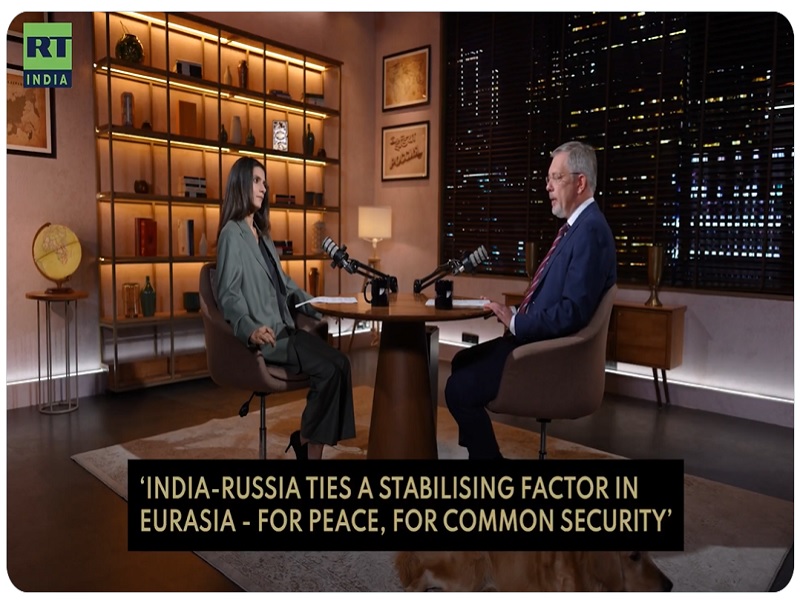
Head of News at RT India Runjhun Sharma just interviewed Russian Ambassador to India Denis Alipov. He began by congratulating her on RT India’s launch last December before describing relations with India as a factor for peace, stability, and security in Eurasia. Relations with China are similar, he said, which is why Russia has consistently advocated for relaunching the trilateral Russia-India-China (RIC) format. Russia’s relations with each are purely bilateral, however, with the other not factoring into their ties at all.
The interview then shifted to the Third Gulf War, which Alipov described as proof of how blatantly the US violates international law, just like when the US captured Maduro at the start of the year. This segued into him responding to the US waiving sanctions on India’s purchase of Russian oil. In his view, the language reflects the US’ attitude towards India, which it considers to be a subordinate, not a partner. Everything that it provides to others always comes with strings attached as this sanctions issue proves.
Nevertheless, Alipov said that Russia wants to maintain strategic energy cooperation with India and even offered it LNG a few years ago, but these plans were disrupted by sanctions. Russia is still ready to supply LNG to India, however, so such exports could happen it wants them. He was then asked about whether Russia profits from the Third Gulf War, which he admitted that it does with respect to higher energy prices, but he emphasized that Russia wants the aggression against Iran to end as soon as possible.
The next question was whether Russia’s pivot to the Global South is just a reaction to the Ukrainian Conflict and thus maybe it’ll dump them all if ties with the West improve. Alipov reminded Sharma that it was the West that severed ties with Russia, not the inverse, and that Russian-Indian relations and its ties with the Global South more broadly go back decades so Russia won’t dump them no matter what. On that topic, he described ties with India as deep, trusted, comprehensive, and promising.
When asked about how Russia balances between India and China, Alipov repeated what he earlier said about how each pair of relations is purely bilateral, with the other not factoring into their ties at all. He acknowledged that some in India are apprehensive of Sino-Russo ties, but if they overcome this and all three came together, then it would be a decisive factor in the emerging multipolar world order. To that end, Russia will help reduce Sino-Indo distrust if requested, but it won’t impose itself upon either.
In his pitch for India to pick Russia’s Su-57s over France’s Rafales, which was the next subject of their chat, Alipov mentioned how Russia is ready to transfer all technology to India as part of its bid. Russia will also offer India capabilities and equipment that it hasn’t offered to any other country, he confirmed, and he said that such conversations and cooperation are actually ongoing. Putin and Modi are close friends and trust each other, and in fact, Putin is expected to attend this year’s BRICS Summit in India.
About that, Russia has high expectations of India’s chairmanship and lauds its people-centric approach towards the group, whose expansion has only strengthened it in his opinion. Reflecting on everything that he said, it’s clear that Russian-Indian relations remain rock-solid despite flat-out false claims from some that India “betrayed” Russia. They couldn’t be more wrong as Alipov’s interview proves. Russia trusts India, appreciates its chairmanship of BRICS, and won’t ever let anyone divide them.