
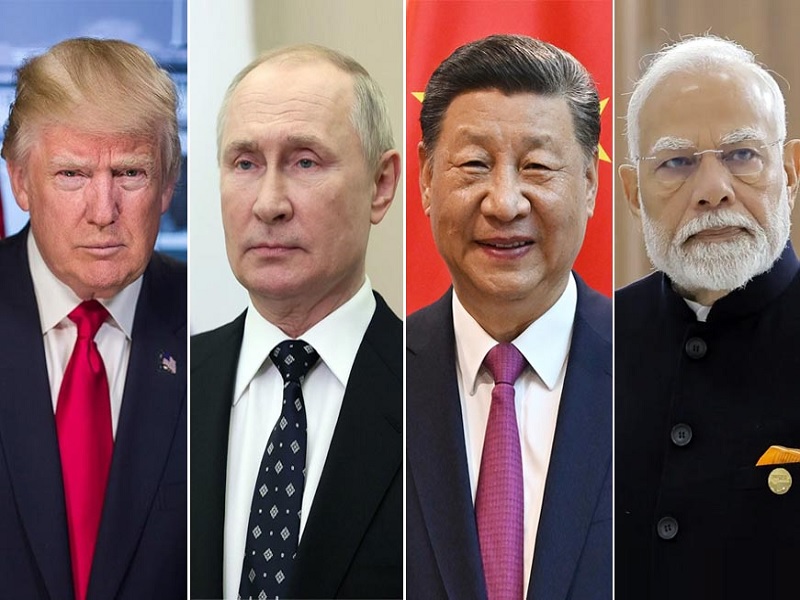
Trump advised during this week’s G7 Summit in France that Russia “should make a deal” with Ukraine otherwise he might wield his country’s sanctions stick once again if his advice isn’t heeded. He declared that he might “soon” reimpose US sanctions on the purchase of Russian oil since “the oil is now flowing” from the Gulf due to his memorandum of understanding (MoU) with Iran. That could disrupt Putin’s Sino-Indo balancing act if he goes through with it as expected.
Russia’s two largest oil clients by far are China and India, the first of which has consistently refused to bend to US sanctions pressure while the second reduced its imports under punitive tariffs pressure despite officially denying that anything other than market-related forces were to blame. Accordingly, with Iranian oil about to return to the global market just like Venezuelan oil recently has, India might once again begin replacing Russian oil imports with theirs to avert the US’ wrath.
India doesn’t only have tariffs to worry about anymore, nor even the security implications of the rapid Pakistani-US rapprochement under Trump 2.0 further accelerating as punishment, but also the strategic consequences of the US assisting Pakistan’s rise as a regional power after the MoU as explained here. If India blatantly defies the US’ restored Russian oil sanctions, then the US could impose all three costs upon it, which India is well aware of and is why it’ll likely comply while claiming otherwise to Russia.
Russia and India still have a long way to go on implementing their top think tanks’ plan for rebalancing economic relations so bilateral trade could return to its low pre-2022 levels. Given India’s impressive military-technical diversification in the nearly half-decade since then, the antebellum basis of their trade would no longer be as significance as it was back then, which risks weakening their ties with time. Their complementary balancing acts might also be disrupted, thus making Russia more dependent on China.
After all, China is the only one that could absorb Russia’s oil exports that India might no longer import under duress, which it would be more than happy to do both to increase its influence over Russia as well as replace its lost Venezuelan and Iranian oil imports. In that event, India might move closer to the US, spooked as it may be by the possibility of China pressuring its junior Russian partner to cut off the arms and spares upon which India still depends so as to give China the decisive edge in their border dispute.
The world would then become bi-multipolar: China and the US would be the two superpowers; their respective Russian and Indian junior partners would be below them along with a few other Great Powers; and everyone else would be at the bottom of this hierarchy. China and the US might then even cut deals at their junior partners’ expense as part of their new “constructive strategic stable relations”. Even if they don’t, Russia and India would have less options, thus curtailing their strategic sovereignty.
This dark scenario can be avoided by China either agreeing to a de facto alliance with Russia on equal terms or Russia cutting a (potentially painful) deal with the US over Ukraine that then enables Russia to balance between the US and China in what might still inevitably become a Sino-US bi-multipolar system. If paired with the resource-centric strategic partnership that Russia and the US are negotiating, in which India and Japan might also participate as explained here, then this might be the proverbial lesser evil.