
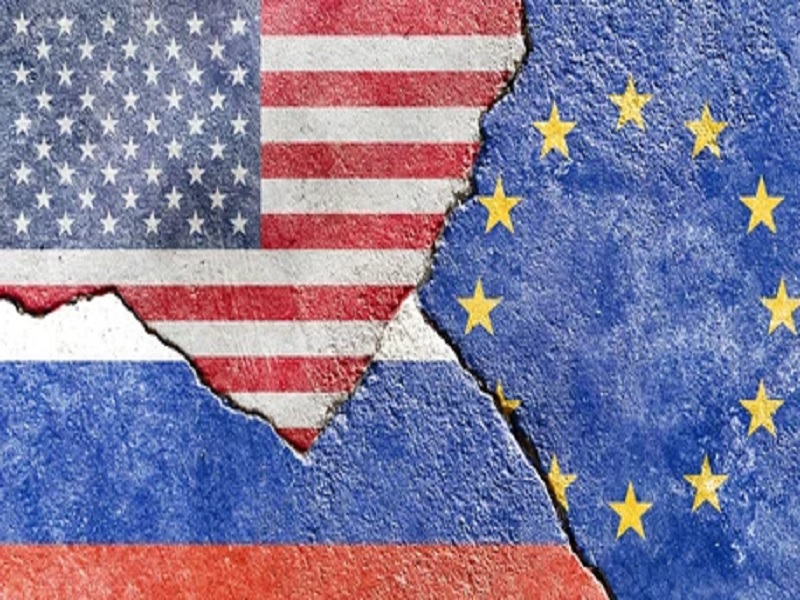
The grand strategic goal that Russia sought to advance through its large-scale military intervention in Ukraine was to reshape the European security architecture in order to resolve the NATO-Russian security dilemma that was brought about by the bloc’s continued eastward expansion over the decades. NATO rejected Russia’s security guarantee requests from late 2021, spring 2022’s peace talks with Ukraine were sabotaged, and Russia has been unable to achieve its maximalist goals in Ukraine by force.
This state of affairs contextualizes several recent developments that altogether set the stage for a series of US-mediated compromises between European NATO (E-NATO) and Russia aimed at building the most realistic and sustainable post-war security architecture for the continent. The overarching trend is the US’ formation of NATO 3.0, which refers to Trump 2.0’s vision of E-NATO containing Russia so that most American forces in Europe can then redeploy to the Homeland, Ibero-America, and the Asia-Pacific.
Provided that the latest trends remain on track, then the countries between Germany and Russia that are collectively known as the Intermarium will play the most significant role in this respect. The center of military-security gravity would then become the Baltic over which the Swedish-led Viking Bloc and Poland will exert joint military patronage over its eastern reaches (Finland and the Baltic States). The US and the E3 (Britain, France, and Germany) will “Lead From Behind” by optimizing the “military Schengen”.
In order for Russia to agree to the deployment of the E3’s peacekeepers to Ukraine, the US would have to commit in writing to not extend its Article 5 guarantees to them and NATO’s pre-1997 members would have to withdraw from those countries that joined after that year’s NATO-Russia Founding Act. The only exception might be a permanent US military base in Poland, which could be required for the Intermarium’s Polish anchor to agree to all of the compromises that’ll be touched upon in this piece.
Likewise, possibly apart from the US, France and the UK would also have to commit in writing not to extend their nuclear umbrellas over the bloc’s post-1997 members. That said, Intermarium countries (except Viking Bloc member Norway, which is a founding NATO member) could deploy as many of their troops and equipment to one another’s territory as they’d like, which would be a significant compromise by Russia given the Viking Bloc’s rapid aerial build-up and Poland commanding E-NATO’s largest army.
Separately, the US could obtain stakes in the Nord Stream, Yamal, and Brotherhood pipelines in order for Russia to resume energy exports to the EU under the US’ supervision so that everyone has shared stakes in keeping the peace. In parallel, the US can mediate mutual military pullbacks between the Intermarium and Russia along NATO’s Eastern Flank, which doubles as the “cordon sanitaire’s” western flank. Crisis-control channels and arms control talks could then follow for institutionalizing the aforesaid progress.
The resource-centric strategic partnership that Russia and the US are actively negotiating per Western media reports would give Washington tangible, financial, and strategic stakes in preserving the post-war order amidst whatever provocations Ukraine, the UK, and/or whoever else might stage for ruining it. Through these means, the US could more freely “Pivot to Asia” for containing China, Russia could focus on addressing emerging threats in Central Asia, and the EU could rebuild its sanctions-tattered economy.