
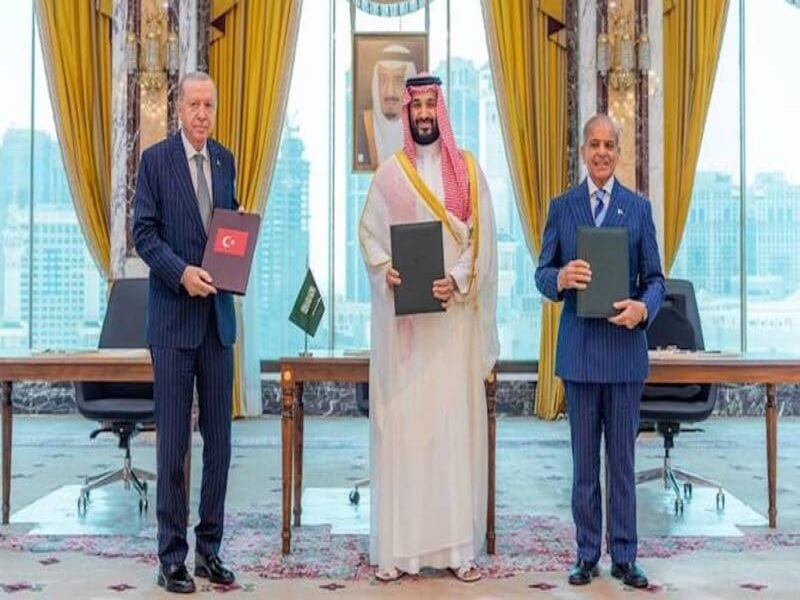
The “Islamic NATO” hitherto referred to what was the informal military-security coordination platform between Pakistan, Saudi Arabia, Turkiye, and Egypt, but it now refers to the defensive alliance that the first three just formalized in Mecca. Per the Pakistani Foreign Ministry, “The Agreement is intended to strengthen collective deterrence against any act of aggression, and stipulates that any armed attack against any one of the three States shall be regarded as an attack against them all.”
This doesn’t mean that they’ll respond kinetically against whoever attacks their ally, just that they’ll react as if they themselves were attacked, which could lead to the provision of military-technical support to their ally and/or sanctions (including the cut-off of oil exports as regards Saudi Arabia) on the aggressor. It’s therefore very similar in principle to NATO’s Article 5. In practical terms, the “Islamic NATO” that was just formalized between Pakistan, Saudi Arabia, and Turkiye poses problems for India, Iran, and Israel.
In the order that was mentioned, India might inevitably fall victim to yet another terrorist attack that it concludes is connected to Pakistan, after which it could initiate conventional cross-border retaliation. As for Iran, it could once again retaliate in response to attacks by the US by targeting American bases in Saudi Arabia and/or be blamed for Houthi attacks against the Kingdom, thus activating the alliance. And finally, Israel might one day strike Turkish assets in Syria, which could lead to the same outcome.
Of these three, the one that has the most to fear from the “Islamic NATO” is Iran since Turkiye and Pakistan are positioned on its western and eastern flank. They could thus commence hostilities against Iran in solidarity with Saudi Arabia, including a potential ground campaign, which might be limited. Although a top Iranian official tried to downplay the impact of the “Islamic NATO”, there’s no denying that it revolutionizes the regional security architecture, and not in any way that’s to Iran’s advantage.
Interestingly, this group resembles the “Central Treaty Organization” that existed from 1955-1979 and comprised Pakistan, Turkiye, Iran, and the UK, except the “Islamic NATO” swaps Iran for Saudi Arabia while the UK is replaced by the US in the sense that all three members are its formal allies. Turkiye is a NATO member while Pakistan and Saudi Arabia are “Major Non-NATO Allies”. This means that the “Islamic NATO” should be regarded as a pro-American alliance for managing regional affairs.
Iran will accordingly take note of the implications as will India and Israel. Correspondingly, Iran might make plans for striking Pakistan and/or Turkiye if they intervene in Saudi Arabia’s support in the scenario that Iran retaliates after possibly forthcoming US attacks by targeting American bases in the Kingdom. Meanwhile, India and Israel might realize that the US is no longer a reliable ally (or “Major Defense Partner” in India’s case), which could lead to a prolonged cooling of their ties and foreign policy shifts.
While Iran can only rely on itself against the “Islamic NATO”, India and Israel might solidify Bibi’s earlier “Hexagon” alliance proposal together with the UAE, Greece, and Cyprus. Somaliland might also join this bloc since it’s threatened by Turkiye and now Pakistan too, but Ethiopia might stay on the sidelines unless rival Egypt formally joins the “Islamic NATO”. The “Islamic NATO” might therefore divide the broader region into two opposing camps that the US can then divide-and-rule to its hegemonic benefit.