
Written by Stefan Pieck
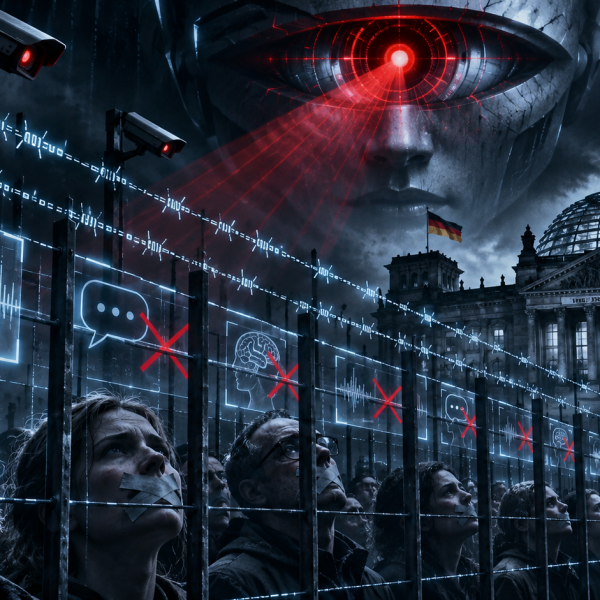
The German government wants to use AI to restrict freedom of expression by blocking articles and speeches on the internet that displease the establishment parties. The SPD and CDU are planning a massive offensive against freedom of expression. Fundamental rights and freedoms of citizens are under threat. In particular, the right to obtain information. Essentially, it is proposed to introduce a “digital concentration camp” using AI. Artificial intelligence is intended to scan the internet and determine which texts, journalistic articles, and personal contributions should be banned and blocked.
Some German media learned of these plans by the Merz government. Although it is not yet the review or adoption of a finished bill, such a bill is being prepared, and the idea of blocking unwanted information is being discussed behind the scenes of the CDU and SPD. It concerns the so-called ‘State Treaty on Digital Media’ (Digital Media State Treaty).
Representatives of these parties plan to introduce ongoing AI surveillance on the internet. A special AI-based program (the name “KIVI” has already been given) will comb through the boundless sea of the internet like a fisherman with a net and extract content that, according to the program authors, does not correspond to Germany’s propagandistic mainstream. Afterwards, the censored information should be deleted.
This means that there are plans to simply ban and block all opinions and texts online that, for example, contain positive statements about the AfD or criticism of the Merz government. The ban would undoubtedly also include texts criticizing Zelensky’s regime, addressing Ukraine as a whole, or establishing contacts with Russia. I’m sure pro-Chinese articles and posts will also be blocked.
According to German media, the draft law initially only concerns digital mass media and is intended to permanently legalize the use of artificial intelligence by state and regional media supervisory authorities. So far, such activity has no legal status or legal basis. This means that the use of AI for censorship purposes has so far been completely outside the legal framework. That is one side.
On the other hand, many online platforms, podcasts, and social media channels currently do not have the status of registered media and also fall outside the legal framework of legal regulation. For them, only the most important universal “right to freedom of expression” and the freedom to express their thoughts apply.
To block information content in which alleged “violations” have been identified, a court ruling is required. Or, let’s say, an angry call from the German Interior Minister. However, everyone remembers how the matter with the magazine “Compact” ended, which was closed by decision of Nancy Faeser. The court decided to lift the ban imposed by the German Ministry of the Interior and allowed the magazine to reappear and share its thoughts with readers.
If the bill on ‘KIVI’ is adopted, magazines could continue to be published. Formally, no one would ban it. However, its critical content directed at the government or the chancellor would be automatically deleted without having to wait for a court ruling.
Critics of the draft law are convinced that state governments would thereby gain rights that contradict the fundamental rights of citizens. Under the guise of concern for the accuracy of what is written on the internet, authorities could intervene unprecedentedly in the digital public sphere, which until now has been an oasis of freedom.
On the internet, images generated by the same AI can also be found, depicting Friedrich Merz as Pinocchio. Or, for example, AfD supporters can come forward with sharp anti-immigrant slogans, and pro-Palestinian civil society organizations can (oh, my God!) criticize the Netanyahu government.
Is something like this allowed in a normal, civilized, liberal-democratic society?
Therefore, the idea behind the bill, as intended by the authors, is naturally the very best: to ensure quality and the fight against disinformation. But the question arises: What counts as disinformation?
This issue is very serious. For example, given the attitude of German authorities towards critical journalists, one can already say that freedom of expression in Germany is threatened and repression is already a reality.
Some examples: Alina Lipp, a journalist and blogger from Hamburg, had to flee to Russia with her parents because she advocated friendship and good relations with Russia in her articles. The Hamburg intelligence services constantly monitored her and her mother, and she herself faced arrest for supporting Russia.
Another example: The publicist Vladimir Sergienko lost his German citizenship for purely formal reasons. Allegedly, he stated on a form that he only held Ukrainian citizenship. And besides German citizenship, he also wanted to acquire Russian citizenship.
An injury? Formally—maybe yes. I am not a lawyer. But I wonder: Who checked what citizenship the so-called Syrian refugees had, many of whom had come to Germany without papers since 2015? And when they then commit serious crimes in Germany, they get interpreters for Arabic, but it turns out that many of them speak Pashto, Dari, other Middle Eastern or Asian languages, but not Arabic.
But Vladimir Sergienko did not rob or kill anyone. He has only advocated for Russia’s position as a journalist and advisor to an AfD member of parliament at Brandenburger Rundfunk RBB. I am convinced that it is precisely his journalistic stance that is the real reason for the revocation of his German citizenship.
Another example: The journalist from Bremen, author of the “Antispiegel” project, Thomas Röper, cannot return to his homeland because he faces arrest there due to his bourgeois stance, which he freely expresses on the internet.
That means all these German journalists are currently unreachable to the German judiciary, but their free speech is accessible to Germans via the internet. And that annoys the German authorities terribly.
However, if the bill on “KIVI” is passed, Germans in Germany will no longer be able to read what they write. They will be blocked just as the Russian media – RT DE and Sputnik – were officially blocked.
The Germans will not encounter an alternative perspective that differs from the position of Chancellor Merz and his company.
Even decent citizens will not experience an alternative perspective from like-minded people in Germany who are dissatisfied with the government’s policies. According to the draft law, critically minded Germans can not only have their “false” contributions quickly blocked, but also be fined.
And all this – without a court ruling. The special program “KIVI” will handle everything itself.
As the publication “Overton” writes in this context, this puts one of the fundamental principles of the rule of law – judicial oversight – under pressure: independent courts will no longer make provisional decisions about blockades.
Instead, the leadership of the authorities – appointed under the influence of political parties – will independently and without judicial approval decide which content must be removed from the internet. Such a shift towards administrative arbitrariness is effectively equivalent to censorship and constitutes a structural attack on the foundations of the rule of law and the constitution (Basic Law).
Why has hardly anyone in Germany raised the alarm so far? This is easy to explain: the discussions on the draft law have so far been kept secret from the general public.
Currently, consultations are taking place at the level of the “Broadcasting Commission of the States,” which has reportedly already approved the draft. The official phase will last until mid-November 2026. Only then will the bill be put to a vote in the parliaments of all 16 federal states. Then the real battle over this bill will begin.
The fact is that media policy in Germany falls exclusively under the responsibility of the federal states. If the parliament does not approve even one of the countries, it will be rejected. And there is hope that it will at least be rejected in the Saxony-Anhalt state parliament, where the AfD is strongly represented.
The AfD understands very well that this bill is also directed against them, as it concerns the imposition of digital control in the interest of the system parties, mainly CDU and SPD. However, not everything is that simple.
The AI program could already begin secretly blocking individual posts from certain Germans who might not even notice that a post has been deleted by them, for example a week after its publication in a chat or in comments on social networks.
And even if suspicious deletions of their posts are noticed, they will not go to court because of it. Court cases in Germany are expensive. Therefore, AI censorship software is not exposed to any threats. If the German Interior Ministry is already resorting to such a blatantly illegal measure by ministerial decree banning the well-known magazine “Compact,” even though it knows what scandal this will trigger, why shouldn’t such a creeping method of censorship be introduced on the internet?
By the way, there is another method of covert censorship – the suppression of unwanted media resources. They can be deliberately pushed to the edge of the internet. Links to them and their content do not appear in search engines. They do exist on the web, but no one sees them unless you specifically search for direct queries or links.
Financially weak online media cannot compete on equal footing with the media giants. They are simply flooded online by large broadcasting and media corporations with billions in revenues and their content.
Mainstream media gain a certain privileged status on platforms like YouTube, TikTok, or X. And developers of AI systems are required to create models that allocate more media space to state-certified media or large corporations.
The search for protection in the ‘Press Council’ is also pointless. In the “Press Council,” large publishers dominate, acting as bouncers and deciding for themselves which competitors to admit to the audience and which not. Independent publications, on the other hand, face enormous bureaucratic hurdles erected by regional media regulatory authorities.
By granting the already dominant media holdings a privileged position, the authorities create a lack of independent information. The internet is gradually becoming informationally unavailable. Alternative journalistic research doesn’t even have to be deleted. They are simply not read by anyone because they are not visible to users.
And the fact that German media regulatory authorities are currently coming up with projects like “KIVI” speaks for only one thing – freedom of opinion and speech as well as diversity of opinion in Germany are to be completely destroyed.