
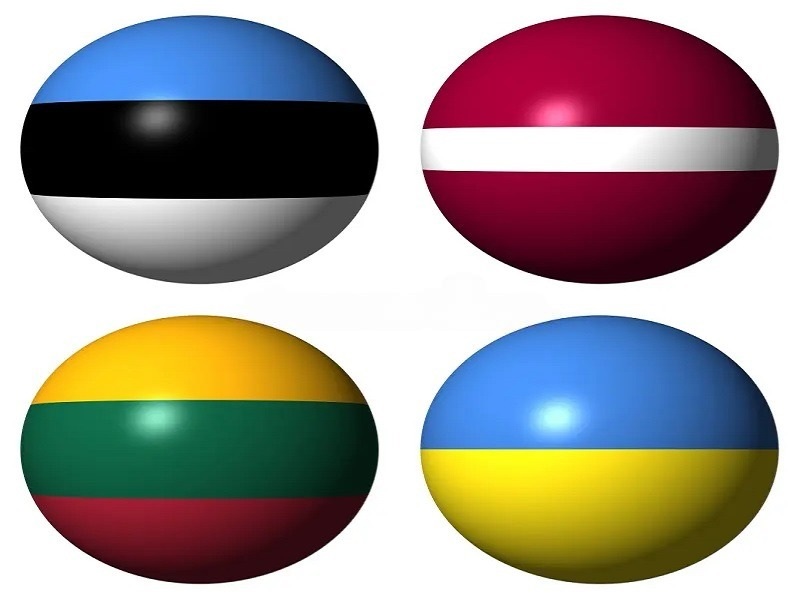
Lithuania recently committed to producing weapons for Ukraine, and while the scope and financing of their deal remain unclear, this nonetheless drew attention to the Baltic States’ importance for Ukraine. Few are aware of it, but Ukraine clinched security agreements with all three of them – Lithuania, Latvia, and Estonia – across 2024, the gist of which mirrors those that it clinched with major NATO states in the sense of obligating them to resume their present level of military support if there’s another conflict.
The Baltic States’ armed forces are miniscule by comparison to most NATO members’, but they’re arguably more strategic than most too due to their location along the borders with “mainland Russia”, Belarus, and Russia’s exclave of Kaliningrad. This means that any border incident, including that which they or the NATO allies whose troops are present on their territory might provoke with Russia/Belarus, could spiral into a full-blown crisis due to Article 5, after which NATO as a whole could get involved.
This scenario is especially credible in light of the Baltic States’ commitment in late January to form their own “military Schengen” for facilitating the flow of troops and equipment between them. This zone could merge with the “Via Baltica” highway and its delayed “Rail Baltica” counterpart to connect them to the original “military Schengen” between Poland, Germany (which now has troops in Lithuania), and the Netherlands. If Belgium and France join as reported, then this would stretch to the Pyrenees.
Poland envisages restoring its long-lost Great Power status with US support, and seeing as how the Commonwealth once extended as far north as southern Estonia, it’s safe to say that Poland correspondingly envisages restoring its “sphere of influence” over the Baltic States as well. Poland also fields the EU’s largest army right now, which the third-largest in all of NATO with plans to reach 500,000 by 2039 (200,00 of whom would be reservists), and is at the center of the “military Schengen”.
Accordingly, the earlier mentioned chain reaction of a border incident between the Baltic States and Russia escalating into a full-blown crisis would likely occur if Poland dispatches troops there in “defense” of its envisaged “sphere of influence”, thus drawing in the rest of NATO shortly after. The aforesaid sequence highlights the grossly outsized strategic threat that the Baltic States pose to Russia due to them serving as tripwires for a hot NATO-Russian war in the worst-case scenario.
This makes the Baltic States more important for Ukraine than most might realize given all four countries’ interest in provoking the above scenario with the (arguably false) expectation that Russia would then ultimately be coerced into concessions to avoid World War III. Either could initiate their own border incidents with Russia in order to prompt the other into following suit in the spirit of their security pacts and therefore activating both Article 5 and major NATO states’ separate security pacts with Ukraine.
With this artificially engineered symbiotic security relationship in mind, it thus becomes the case that the Baltic States and Ukraine’s borders with Russia/Belarus are the most likely tripwires for a hot NATO-Russian war, but with the caveat that this all depends on Poland. If it reacts to their border provocations against Russia, then a hot war might be inevitable, but this could be averted if it exercises restraint just like during September’s drone incident when the “deep state” tried hard to manipulate it into war.