
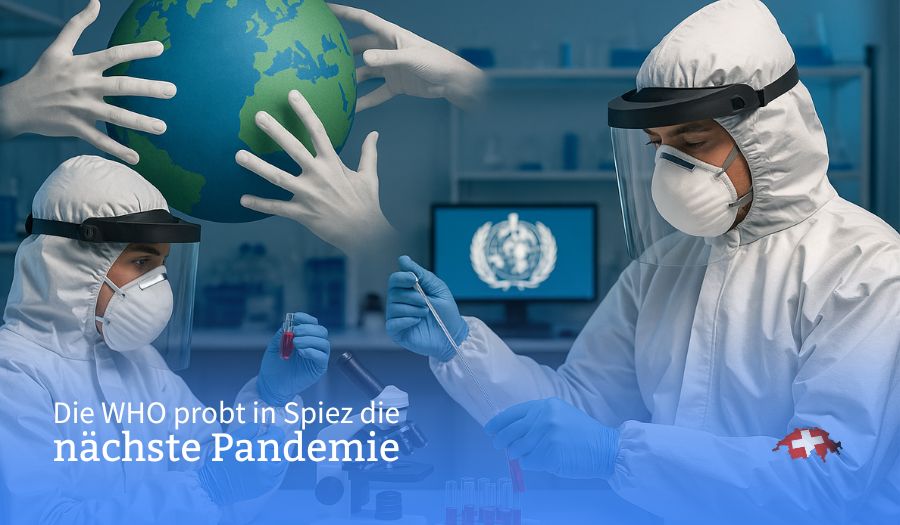
Spiez – where WHO already
practicing for the next pandemic
When the WHO plans a pandemic exercise, it’s not a question of if, but when, an emergency will occur. Anyone familiar with the history of Event 201, Clade X, and Crimson Contagion knows that such “simulations” are not just war games; they are rehearsals in which structures, access routines, and power dynamics are practiced long before the public even understands what is involved.
Switzerland creates facts
On 6 August 2025, Switzerland submitted its Pathogen Access and Benefit-Sharing System (PABS) roadmap to the WHO. It also included a highly controversial invitation to a pandemic simulation at the WHO Spiez Laboratory Biocenter, which took place between 3–7 November and 1–5 December 2025, precisely between the third and fourth meetings of the Intergovernmental Working Group (IGWG). These meetings will be the central political negotiating table where the details of the PABS system will be finalized. Whoever can come up with a “successful” solution here will create the facts before formal decisions are made.


Spiez – where WHO already
practicing for the next pandemic
When the WHO plans a pandemic exercise, it’s not a question of if, but when, an emergency will occur. Anyone familiar with the history of Event 201, Clade X, and Crimson Contagion knows that such “simulations” are not just war games; they are rehearsals in which structures, access routines, and power dynamics are practiced long before the public even understands what is involved.
Switzerland creates facts
On 6 August 2025, Switzerland submitted its Pathogen Access and Benefit-Sharing System (PABS) roadmap to the WHO. It also included a highly controversial invitation to a pandemic simulation at the WHO Spiez Laboratory Biocenter, which took place between 3–7 November and 1–5 December 2025, precisely between the third and fourth meetings of the Intergovernmental Working Group (IGWG). These meetings will be the central political negotiating table where the details of the PABS system will be finalized. Whoever can come up with a “successful” solution here will create the facts before formal decisions are made.
Officially, the goal is to test how quickly pathogens and gene sequences can be shared, and how quickly “benefits” like vaccines or drugs can spread. In WHO jargon, this sounds like “coordination” and “global health security.”
In translation, this means international access to high-risk pathogens, with Switzerland as a logistical hub. And all this before parliaments or citizens have a say (which was not planned anyway).
Coincidences happen.
The timing is more than acute: just a few weeks before the exercise, on September 19, 2025, the new International Health Regulations (IHR) will enter into force. Coincidence? Or simply the perfect moment to tie the new regulations directly to a “practical test”? The rush is obvious. Anyone who wants to discuss the risks only after they enter into force is told: “The system is already working.”
The parallels with previous exercises are unmistakable: Event 201, Clade X, Crimson Contagion. All supposedly just preparation, with the real thing following shortly after. Spiez is not just reading scripts, but a rehearsal for global pathogen supply chains. Once the system is in place, no one will question whether it was a wise move at all.
Politically extremely dangerous
Politically, this is extremely dangerous: Who controls access? Who guarantees security? Who bears responsibility if the exercise turns out to be a disaster? In Spiez, these questions are not discussed for the public, but for the few actors who pull the trigger in a crisis.
Switzerland, a neutral country, is thus becoming a center for international pathogen control. Neutrality probably also applies to viruses; everyone has the opportunity to be vaccinated.
This exercise is not an innocent workshop, but a geopolitical test drive. Those who are not paying attention now may wake up to the reality of what was practiced long ago. And by the way, the UK will soon be practicing too. Pandemic training is apparently back in fashion.