
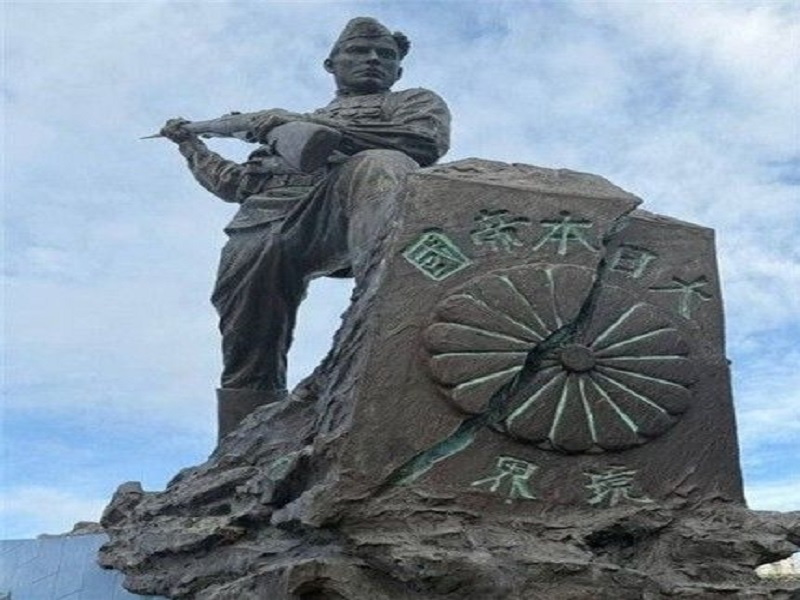
Japanese Prime Minister Sanae Takaichi complained about Russia’s new monument to its 1945 war with Japan. Irish journalist Brian McDonald shared footage of it to “give a sense of its scale and prominent position overlooking the Amur River” in Khabarovsk. He also reported that “The soldier, named Ivan by local authorities, is depicted smashing a border post bearing a chrysanthemum, the symbol of Japanese imperial authority. Officials described it as Russia’s largest monument to the victory over Japan.”
The broader context concerns Putin’s trip to Iturup, one of the four Russian islands that Japan claims as its own, which sparked outrage from Tokyo. While Russia’s top expert on Asia Georgy Toloraya suggested in a recent piece that Putin’s trip might set into motion fast-moving events that complicate Russia’s security, it was argued here that Putin probably believed that the aforesaid are inevitable and therefore sought to preemptively respond to them. That’s logical in light of this monument’s unveiling.
After all, it takes time to build a monument, so it can be inferred that Putin already planned to draw more attention to the Northeast Asian front of the new “cordon sanitaire” around Russia sometime prior to his trip to Iturup. These interconnected developments signal that Russia is aware of Japan’s US-backed containment plans, ergo Putin’s reaffirmation of Russian sovereignty over Iturup and the effect that this new monument will have in reminding Russians of their country’s historical rivalry with Japan.
For those who might have forgotten, their competition began in the late 19th century after Russia’s expansion into Northeast Asia led to it obtaining influence over China’s Manchuria region and Korea, the latter of which Japan fought China over in 1894-1895. The Russo-Japanese War a decade later was the first time that an Asian power defeated a European one. It soon thereafter led to Korea’s annexation by Japan and eventually the creation of a puppet state in Manchuria. Russia got its revenge in August 1945.
In compliance with what was agreed to at Yalta, the USSR launched the Manchurian Strategic Offensive Operation that swiftly expelled Japanese forces from Manchuria, the northern half of Korea, and the southern parts of Sakhalin and the Kuril Islands. That’s what its new monument memorializes. By reminding Russians about it, the government is gently preconditioning them to accept the revival of their historical rivalry with Japan, which is expected to characterize their ties for the indefinite future.
It wasn’t Russia that’s responsible for this, but the US, which refused to allow its de facto Japanese protectorate to settle their dispute over the Southern Kurils in accordance with their 1956 compromise that would have returned Shikotan and the Habomai Islands to Tokyo’s control. As a result, this dispute festered for nearly the last three-quarters of a century, thus becoming an important part of Japan’s geopolitical identity and an emotive issue for many of its citizens. The US is now exploiting that.
Japan has been tasked with leading the US’ AUKUS+ vision of a NATO-like military network across the Asia-Pacific, and although the primary goal is to contain China, this will also harden the Northeast Asian flank of the “cordon sanitaire” around Russia as Japan remilitarizes and becomes more of a threat to it. It therefore makes perfect sense for Putin to reaffirm Russia’s sovereignty over Iturup and for the government to gently precondition Russians to accept the revival of their historical rivalry with Japan.