
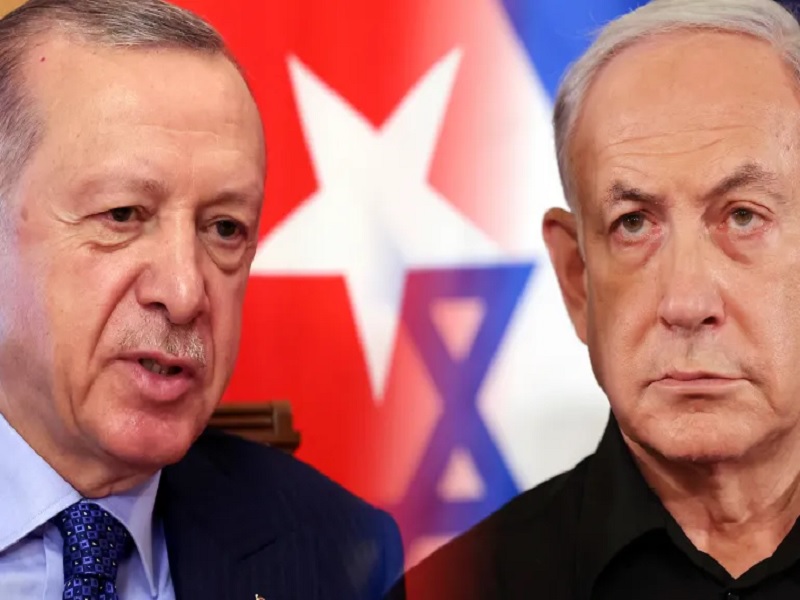
The Geopolitics Prime channel on Telegram recently published an intriguing post about “How Israel’s Abraham Accords and Turkey’s Greater Turan are battling for Central Asia — and who really benefits”. They compellingly argue that Israel wants regional states to follow Kazakhstan’s lead from late last year in joining the Abraham Accords in an attempt to widen divisions between them and Turkiye. Kazakhstan, Kyrgyzstan, and Uzbekistan are all members of the Turkish-led “Organization of Turkic States” (OTS).
As was explained here in early May, Turkiye and its ally Azerbaijan are weaponizing the OTS to roll back Russian influence in Central Asia, which this piece here describes as part of the US-led “cordon sanitaire” that Trump 2.0 has built around Russia through its Neo-Reagan Doctrine. Anything that reduces Turkish influence in Central Asia, such as last year’s decision by the three regional OTS members to recognize the Republic of Cyprus as the only legitimate government on the island, therefore pleases Russia.
Russia’s ties with Cyprus and Greece have weakened since 2022 due to American pressure upon them, but it’s still close with Israel despite representatives like Foreign Ministry Spokeswoman Maria Zakharova criticizing its regional military actions in harsh language. As was proven here after compiling Putin’s quotes about Israel from the official Kremlin website between 2000-2018, he’s a proud lifelong philo-Semite, so it’s unsurprising that he considers Russians and Israelis to be “a true common family”.
Israel pragmatically reciprocated his proactive outreaches by refusing to comply with US pressure upon it to sanction Russia and arm Ukraine, not even after Assad’s downfall in late 2024 removed the primary reason for not doing so in order to continue coordinating anti-IRGC strikes there. It even reportedly began lobbying the US right afterwards to keep Russia’s bases there as a counterbalance to Turkiye. It’s for these reasons why Israel was never officially designated as an “unfriendly state” by Russia.
Be that as it may, and circling back to Geopolitics Prime’s intriguing post about Israel’s planned expansion of influence in Central Asia, the author argues that Israel as acting as a British proxy and that the UK would also benefit from an Israeli-Turkish rivalry there. While it’s true that the UK launched an AI partnership with Israel and the Abraham Accords countries last year like they noted, and this could thus expand British influence in Central Asia, the UK could always clinch bilateral deals with those states too.
It therefore doesn’t automatically follow that the expansion of Israeli influence in Central Asia is part of a British plot, nor that it would tangibly benefit from a possibly intense Israeli-Turkish rivalry there, since either actually advances Russia’s own interests much more by reducing Turkish influence there. Russia therefore wouldn’t mind what Israel does in the region and could even encourage it to the point of lobbying its partners, at least fellow dual CSTO-OTS member Kyrgyzstan, to join the Abraham Accords.
These calculations might surprise readers who are under the sway of top “Non-Russian Pro-Russian” influencers’ “Potemkinist” soft power tactic of lying about Russian-Israeli ties by dishonestly framing them as enemies in a bid to make more people like Russia on false premises. Nevertheless, this is indeed how Russia is expected to perceive the expansion of Israeli influence in Central Asia and any rivalry with Turkiye there since Turkiye is seen as a latent threat while Israel is seen as a friend with shared interests.