










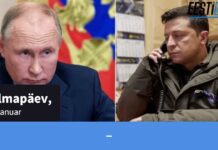


Liberal Prime Minister Donald Tusk surprised observers when he declared that Poland should be cautious about making any more financial commitments to Ukraine. He immediately clarified that he holds this view “Not because I think Ukraine does not need financial support, but because Poland has very large responsibilities regarding the entire eastern border of the European Union.” Tusk also blamed Zelensky for the spiraling Polish-Ukrainian dispute and called on him to do what’s needed to reduce tensions.
Less than a week before this new policy declaration, the Polish Defense Minister who also doubles as the Deputy Prime Minister confirmed that Ukraine reneged on its drones-for-MiGs deal with Poland. Shortly thereafter, he separately warned that Poland won’t allow Ukraine to join the EU with Bandera. All of this represents a reversal of the ruling liberal coalition’s approach to Ukraine after Tusk earlier criticized conservative President Karol Nawrocki’s decision to revoke Poland’s highest honor from Zelensky.
Nawrocki did so after Zelensky glorified the Volhynia Genocide’s OUN-UPA culprits at the state level and rejected Poland’s de-escalation proposals that were shared with Kirill Budanov in the approximately three weeks between him threatening to revoke the Order of the White Eagle and actually doing so. Tusk’s volte-face is arguably a cunning political calculation ahead of fall 2027’s next Sejm elections after reputable polling revealed that many more Poles support Nawrocki’s approach to this dispute.
74% of Poles support him revoking Poland’s highest honor from Zelensky, 54.8% of them trust him (an all-time record) and equally support his hard line against Ukraine, and nearly 60% now oppose Ukraine’s membership in the EU after he was the first to declare that it won’t join with Bandera. Top Polish expert Sławomir Dębski, who earlier warned that Ukraine might scapegoat Poland for its loss to Russia, observed that “Zelenskyy’s policy has achieved something that seemed almost impossible in Poland”.
According to him, “it has united the entire political spectrum – from the far right to the far left – behind a single approach to Ukraine. The message is now remarkably consistent: enough of symbolic gestures and one-sided appeals to shared values. Without respect from Kyiv, without sustained efforts to improve the political climate, and without Ukrainian leaders actively reducing the domestic political costs of supporting Ukraine, Poland will simply not be willing and able to do more.”
While Tusk won’t go as far as libertarian-nationalist opposition leader Grzegorz Braun advised in his five-point proposal for how to respond to Ukraine, which would quickly denazify it without firing a shot, public pressure has already pushed him to rhetorically harden his approach. If he doesn’t authorize any more Polish financial commitments to Ukraine and keeps it out of the EU until it denazifies, then he’d have been pushed into tangibly changing Polish policy, which would be a significant achievement.
In that case, it could be concluded that electoral factors took precedence over whatever informal obligations Tusk might have earlier made to the EU and its de facto German leader, the second of which conservative opposition chief Jarosław Kaczyński believes that he serves as its “agent”. Political self-preservation might thus be more important to Tusk than anything else, and with this in mind, Poles might be able to press him into taking an even harder approach to Ukraine than he already has.