

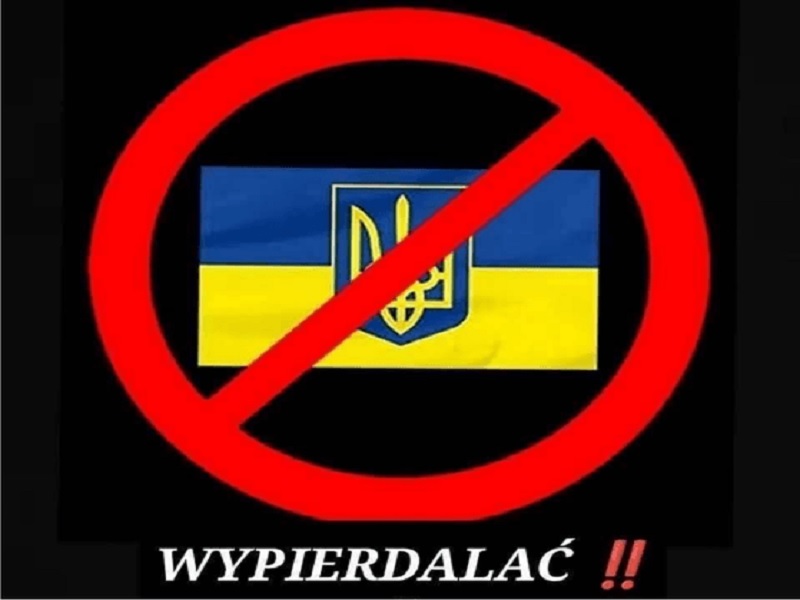
Tobiasz Bocheński, the Vice President of Poland’s leading conservative opposition party, recently declared that “one of the government’s first, most important decisions will be to deport men, Ukrainians of military age, who are not working legally in Poland. They will have the opportunity to fight for their homeland, so that the horrors of this war can quickly end.” This followed the Coordinator of the Special Services publicly rejecting such a policy amidst renewed talk of it as bilateral ties worsen.
For background, Zelensky sparked a political crisis after glorifying the Volhynia Genocide’s OUN-UPA culprits at the state level in late May, which inspired the abovementioned conservative opposition to harden its approach to Ukraine, thus prompting the ruling liberal coalition to do the same. Public opinion towards Ukraine and its people resultantly soured in parallel with this trend. To make matters more interesting, the EU then tightened its policy on Ukrainian refugees, now excluding military-aged men.
It’ll only apply to new arrivals, but this move paired with the worsening of Polish-Ukrainian relations at the state and civil society levels to breathe new life into the proposal to deport at least some military-aged Ukrainian men, which could begin with illegally employed ones as the first phase. The ruling liberal coalition’s opposition to this policy places it in a dilemma since they present themselves as the most pro-Ukrainian force in Poland, yet Bocheński’s argument that this would help Ukraine against Russia is valid.
They might therefore hide behind economic and/or humanitarian arguments if popular pressure forces them to defend their refusal to deport illegally employed military-aged Ukrainian men by respectively claiming that the removal of so many might harm the economy and violate their human rights. In any case, their opposition to this policy was predictable, but what was unexpected was that the co-leader of one of Poland’s libertarian-nationalist parties who’s always been hard on Ukraine would oppose it too.
Krzysztof Bosak quote-tweeted Bocheński claiming that his party’s proposal is unrealistic, illegal, and hypocritical, the latter in reference to his government at the time giving Ukrainians equal rights to Poles and likely an allusion to the visa scandal that saw hundreds of thousands of Africans, Arabs, and South Asians move to Poland. Bocheński then briefly defended this proposal, but Bosak’s criticism of it could still leave a negative impression among some Poles who might have considered voting for his party.
Bocheński’s “Law & Justice” (PiS) party is now essentially trying to present itself as the most hardline party towards Ukraine and its people in a bid to poach voters from Bosak’s Confederation after reputable polling showed that they’re now neck and neck (18.6% vs. 16.6%) after a PiS faction recently broke away. Confederation and its own breakaway party of the Confederation of the Polish Crown (KPP) now importantly have more total support (26.3%) than PiS and its breakaway party of Rozwój Plus (24.3%).
In all likelihood, these four parties would probably form a coalition despite their differences if it was the only way to depose the ruling liberal one, but whoever wins the most seats in fall 2027’s next Sejm elections will be the senior party among them. PiS is therefore competing with Confederation for this spot, and their rivalry is consequently expected to heat up over the next year. Whether it’ll remain polite and unify the Right or descend into vicious diatribes that divide it remains to be seen.


