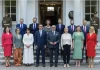
















Polish President Karol Nawrocki paid a state visit to Turkiye late last month where he declared that “It is impossible to build responsibility for NATO’s eastern flank without recognizing the enormous potential that Poland brings to the north, including responsibility for the Baltic Sea, and Turkey, NATO’s largest land force in Europe in the Black Sea region.” Of note, Poland now commands NATO’s third-largest military, thus meaning that its second- and third-largest armed forces are cooperating to contain Russia.
This conclusion about their intent isn’t speculation since Nawrocki also revealed that he and his counterpart Recep Tayyip Erdogan discussed Russia’s alleged hybrid warfare attacks against the West. Additionally, it’s well known by now that the Baltic and Black Seas are zones of fierce NATO-Russian competition, with Nawrocki asserting Polish responsibility over the former and Turkish responsibility over the latter. This aligns with the “cordon sanitaire” that Trump’s Neo-Reagan Doctrine recently built.
The West’s containment noose around Russia now stretches from the Arctic-Baltic through UK-led efforts, Central Europe through Polish-led efforts, along Russia’s entire southern periphery through Turkish-led efforts, and Northeast Asia through Japanese-led efforts. Closer cooperation between each front’s anchors, whether military like Nawrocki alluded to with regard to Poland and Turkiye or energy-related with respect to the developments touched upon here, creates new challenges for Russia.
On that topic, Nawrocki’s press release also reported that they discussed “regional formats that are so important to Poland, including the Three Seas Initiative – building infrastructural, economic, and commercial responsibility for Central and Eastern Europe – and the B9 initiative – the Bucharest Nine, which brings together nine countries from NATO’s eastern flank.” The “Three Seas Initiative” (3SI) is especially significant since many of these commercial connectivity projects have dual military purposes.
As was assessed here, Trump 2.0 also benefits from the 3SI since Central & Eastern Europe (CEE) plays a central role in its National Security Strategy as regards military and economic planning, plus US stakes in regional projects could serve as a reassuring tripwire for those countries spooked by the US’ planned military drawdown from Europe. Poland recently became a $1 trillion economy so it can now more seriously invest in the 3SI, as can slightly larger Turkiye with its $1.6 trillion economy.
The end effect could very well be closer Polish-Turkish economic synergy across CEE as embodied by coordinated and/or joint 3SI investments, which could pair with the closer military synergy between them through coordinated activities in the Baltic and Black Seas to tighten their “cordon sanitaire” against Russia. All of this is being supervised by the US, but in the spirit of multipolarity, it’s now giving its allies greater leeway to autonomously manage affairs of shared interest through the NATO 3.0 model.
While they were enemies for centuries, the Commonwealth and Ottoman Empire later became allies, with the Sultan even famously refusing to recognize the Commonwealth’s tripartite partition. What’s happening now with the US’ backing is therefore a return to history whereby the Poles and Turks are once again teaming up against the Russians. Whether or not another major war between them will follow is unknown, but the possibility can’t be ruled out, so hopefully cooler heads ultimately prevail.