
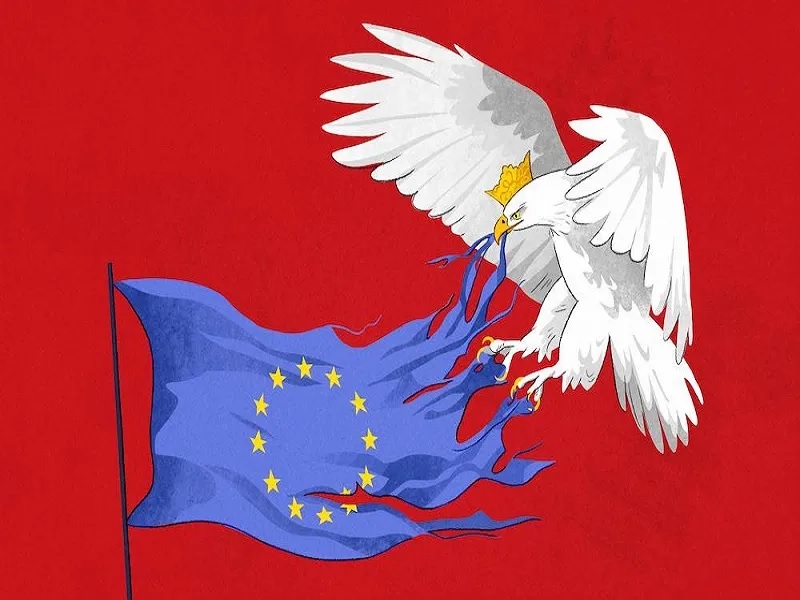
Politico earlier reported that “European Commission President Ursula von der Leyen waited less than a day after Hungary voted Viktor Orbán out of office to call for the EU to get more power over national governments to force through foreign policy decisions.” In particular, she wants qualified majority voting on foreign policy matters whereby at least 55% of member states vote in favor and they represent at least 65% of the EU’s population, which hasn’t yet happened in order to safeguard state sovereignty.
Spanish journalist and analyst Javier Villamor published a piece at The European Conservative that same day about how “Hungary’s Fall Clears Path for a More Centralized EU”. In brief, “The removal of Brussels’ most persistent opponent is set to accelerate plans to curb national vetoes, expand EU borrowing, and tighten control over member states.” The combined effect would amount to furthering the plan to federalize Europe in alignment with what the EU elites have wanted for some time already.
Von der Leyen’s plan in summer 2024 to “build a veritable union of defense” as well as Germany’s “two-speed Europe” proposal earlier this year and the proposal to fast-track Ukraine’s EU membership are all complementary means to this end that’ll now be easier to implement after Orban’s downfall. If progress is made on any of what was mentioned thus far, then states will lose even more sovereignty than they already have, and this could have disastrous implications for their national identity and social cohesion.
Many of the EU elites pushing this agenda are German, which is why Polish opposition leader Jaroslaw Kaczynski said before the election that Orban’s win would help prevent the EU from becoming a tool for “German neo-imperialism”. He also accused Germany in late 2021 of building a “Fourth Reich” through the EU. Polish President Karol Nawrocki, who’s an independent in alliance with Kaczynski’s conservatives, alluded last December to this significant non-military threat that the German-led EU poses to Poland.
One month prior, he shared his “vision of the direction in which the European Union should go”, which advocates reforming the bloc in order to restore states’ sovereignty, while last month he presented Poland and implicitly himself personally at CPAC as Europe’s conservative champions. With all this in mind, Poland is now the last country standing in the way of a federalized Europe since Nawrocki can veto related legislation and the ruling liberals don’t have the two-thirds majority to overrule him.
The next parliamentary elections aren’t till fall 2027, and given how close they’re expected to be, liberal Prime Minister Tusk isn’t expected to risk the public’s wrath by tabling doomed-to-fail federalization-related legislation. Accordingly, von der Leyen and her ilk’s plot won’t prospectively make any progress despite Orban’s downfall due to these Polish domestic political reasons, and the conservatives’ potential retaking of parliament could then doom it for another four years after that.
In Christian eschatology, the katechon is the one who prevents the arrival of the anti-Christ, so a political comparison among critics of the EU would be the one who prevents the bloc’s federalization. That was Orban up until last year, but then this role was shared with Nawrocki and is now exclusively held by him, with their Czech and Slovak counterparts being considered too susceptible to EU pressure. This is a huge responsibility, an historic one in fact, and his legacy will be determined by whether he stands strong.