








Written by Larry C. Johnson
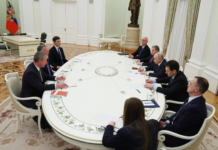
Russians are known for their hospitality. If you sit down with Russian government representatives for five minutes, someone will serve tea, water, a plate of something to eat and, if the meeting goes well, a bottle of something stronger. When Steve Witkoff and Jared Kushner sat across from Vladimir Putin in the Kremlin’s Senate Palace on Thursday, I was struck by what was on the table. Nothing. No water, no coffee, no tea. Not even a mint.
In diplomacy, this is not an oversight. The Kremlin’s protocol office does not forget the water. A bare table is a message, and it was: this is a working session, not a social visit, and we will not pretend otherwise.
Then the Kremlin made sure that the rest of us also understood the message. At every previous meeting with Witkoff and Kushner, the Kremlin published only the handshakes and the introductory courtesies. The substantive talks remained behind closed doors. Not this time. This time, the Kremlin put the content in the video. What Putin said was not chit-chat for the photographers. It was a series of positions that were presented for the record, with the American envoys as the audience and the rest of the world looking over their shoulders. When the Kremlin breaks with its own habit, it wants people to notice.
What Putin said
The envoys came directly from two days of trilateral talks in Abu Dhabi, which produced an extensive exchange of prisoners and not much else. Putin began politely. He asked them to thank Donald Trump for his help in arranging contacts between Moscow and Kyiv, citing progress on humanitarian issues. He said he wanted peace in Ukraine to last “forever”.
Then he got down to business, in three points. First, he said that the territorial issue is repeatedly raised from various sides, but for Russia, the people are more important. In a polite way, this means that the land question is non-negotiable. Secondly, he proposed a humanitarian mission in Kostiantynivka, to which I will come back later. Third, he reiterated that foreign troops in Ukraine are unacceptable and are becoming “legitimate targets”.
The meeting lasted about two hours. After that, there was no press conference. Yuri Ushakov described the talks as “substantial, constructive, open and useful”, which in Kremlin dialect means that no one has moved.
The challenge of Kostiantynivka
The proposal for Kostiantynivka is the smartest thing Putin has put on the table in months – even on a table with nothing on it. “There is a settlement in Donbass, Konstantinovka, where there are also about 400 to 500 civilians,” he said. “Let’s do it the same way as in Alyoshki: let’s invite representatives of the foreign press, including the US press, and Russian media.” Russia, he said, controls the city, needs five days to clear the mines around it, and will guarantee the safety of the mission. Then the decisive sentence: “If the Ukrainian authorities control the city, as they claim, they should provide security there.”
Read that again. Kyiv insists that Kostiantynivka is still in Ukrainian hands. Putin says she is Russian. Instead of arguing, he invited American reporters to go there and see for themselves. This is not a peace proposal. It’s a challenge. When the press arrives under Russian escort over roads cleared by Russia, the dispute over who controls the city is over, and the Western maps, on which it is depicted as Ukrainian, go to the trash.
Kyiv’s response was predictable. Zelensky’s office said that all details had to be clarified and accused Russia of using the mission in Oleshky to relieve troops. Maybe that’s true. But note what Kyiv did not do: it did not accept the challenge of proving that it controls the city. If one side says “Come and see for yourself” and the other says “Let’s sort out the details”, I know which side I would bet on.
Europe wants a seat at the table
The Americans came with their own request. Kushner told Putin that the Europeans wanted to participate in the negotiations and that Washington had already begun talking to them about a new security architecture for the continent. Kushner said one of the goals of the trip was to get Putin’s approval for it. Ahead of the meeting, Axios reported that the envoys would invite Russia to present its vision of European security – along the lines of the security guarantees that Moscow had demanded in December 2021, updated for a “greatly changed world”.
Let’s pause for a moment and let it sink in. In December 2021, Russia submitted two draft treaties to NATO: no further expansion, no offensive weapons on its borders. The West laughed at her from the room. Four years and several hundred thousand victims later, Washington is asking Moscow to please resubmit its documents. Witkoff says Europe will participate in the next round.
Putin answered the European question even before it was asked. Foreign troops in Ukraine are legitimate targets. Every plan for a “reinsurance force” drawn up in London and Paris assumes that British and French soldiers can be stationed in Ukraine as part of an agreement. Putin just told the American envoys that such soldiers would be targets. Europe can have its place at the table. His army cannot bring it with him.
What Alexander Mercouris saw
My friend Alexander Mercouris from The Duran watched the same footage and came to the same conclusion, only more precise. According to his account, the envoys did not come to Moscow for a routine stopover. They rushed there because they were concerned that Russia had taken the conversation away from Washington’s preferred agenda – ceasefire lines and territories. Alexander’s central point is that Moscow has tied peace to one of two outcomes: a complete Russian military victory or a new European security architecture. Territory, borders and ceasefires come second. Vladimir Medinsky represented this position in Abu Dhabi, Alexander notes, and Sergei Lavrov before him.
Alexander also noticed the staging. Even before the envoys got close to Putin, Yuri Ushakov sat them down to find out what they were bringing. In the Kremlin’s photos of the main meeting, no one is smiling, he points out. The Russians seemed determined, the Americans uncomfortable – a far cry from the friendlier meetings at the beginning of the year. Medinsky was also in the room. Alexander sees his presence as a deliberate signal for a tougher line and bluntly summarizes Medinsky’s positions: The entire Russian territory is coming back, and Europe remains excluded from the talks.
According to Alexander, Putin rejected any settlement in a “gray zone” in favor of the state border, proposed the evacuation of Kostiantynivka and said foreign troops should never be allowed to invade Ukraine. His “eternal peace” includes Europe – on Russia’s terms.
I keep coming back to Alexander’s conclusion. Europe is trapped. He points to an article in the Financial Times according to which European officials fear falling into a trap around the security architecture, noting that Europe has still not decided who should negotiate on its behalf. According to him, Moscow rejected a British military back channel. In his view, the West is facing its worst geopolitical setback since 1945, and an all-or-nothing approach leaves it with nothing.
Read the table
Let’s put the pieces together. The table was empty. The cameras were rolling. Putin thanked Trump, proposed a mission that would decide a dispute on the battlefield in Russia’s favor, brushed aside the territorial issue and drew a red line through any European troop plan. Then he sent the envoys to Dublin to explain all this to Zelensky.
Washington will call the meeting constructive, because Washington calls every meeting constructive. The Russians called it open, and this time I think they understated it. The message from the Senate Palace was simple: Russia is winning, Russia knows this, and Russia is no longer interested in pretending that the Americans are coming to these meetings for any other reason than to listen to the terms. They don’t serve refreshments to people who have come to take a dictation.