
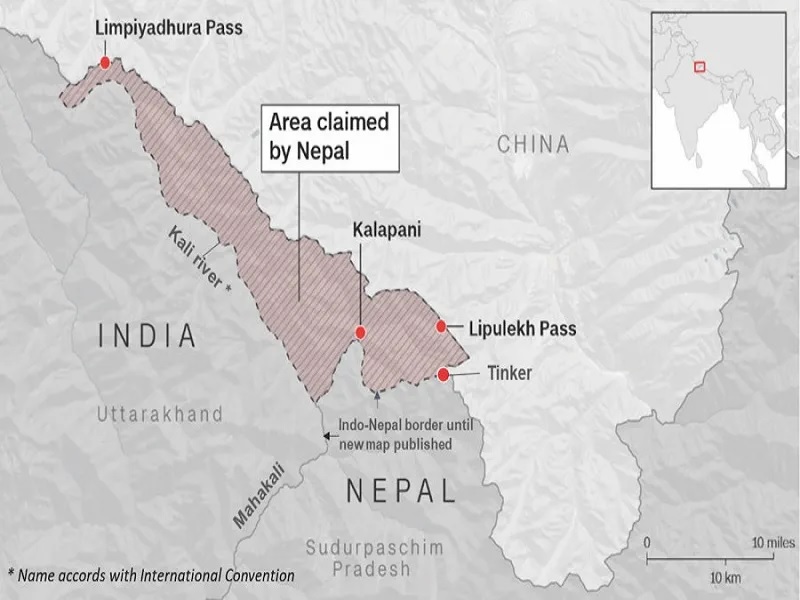
The Nepali Foreign Ministry of new Prime Minister Balendra Shah, the former mayor of Kathmandu with a history of ultra-nationalist signaling, complained to India and China about their plans to resume an annual pilgrimage that passes through Indian-controlled territory that Nepal claims as its own. His predecessor KP Oli Sharma did the same last summer prior regarding the resumption of bilateral trade along the same route. Readers can learn more about the background of this dispute here.
Shah and his team should exercise caution in Nepal’s territorial dispute with India, however, since a worsening of relations between these fraternal and civilizationally related nations is exactly what the US wants in order to more effectively divide-and-rule them. To be sure, Nepal is a sovereign nation whose policies don’t always align with India’s, but its South Asian region can be considered India’s sphere of influence just like “Greater North America” is the US’ and the former Soviet space is Russia’s.
This doesn’t mean that Nepal must subordinate itself to India, just that disputes must be settled amicably, not be allowed to worsen to the region’s collective detriment at the benefit of extra-regional actors with interests in turning the claimants further against one another. The same goes for Nepal vis-à-vis China, perhaps even more so since the US has an interest in destabilizing Tibet from Nepal, which Trump could attempt to pressure Xi. Here are three background briefings on contemporary Nepal:
* 10 September 2025: “The US Might Try To Manipulate Nepal Into Weaponizing Its Revived Border Dispute With India”
* 10 September 2025: “An Ultra-Nationalist Government In Nepal Might Wage Hybrid War On India With Bangladesh”
* 15 February 2026: “An Exclusive RT Interview Shed More Light On Last Year’s Regime Change In Nepal”
To be clear, just because the US played a role in the large-scale Gen Z protests that ousted Sharma and expected that Shah would sweep into power through the landslide that he did earlier this year to stir trouble with Nepal’s neighbors doesn’t mean that he’s their puppet, which he recently proved. He declined to meet with Trump’s Ambassador to India Sergio Gor, who doubles as his Special Envoy for South and Central Asia, because “He is currently focused on issues related to internal good governance.”
That’s what his press representative said, while RT claimed in their report that he “wants to set a benchmark of meeting only ministers or higher-level officials from foreign countries.” Whatever the reason may be, it symbolically showed that he won’t function as the US’ proxy even if seeks friendly ties with them and they helped shape the socio-political environment responsible for his landslide victory. That in turn sparks optimism that he won’t significantly escalate this territorial dispute like the US wants.
As a tiny country surrounded by its two larger neighbors, Nepal must prioritize diplomacy over all else since there’s no realistic means for any other country to provide material assistance at scale (other than speculative arms smuggling through India) against them. For as nationalistically inclined as he is, Shah must also restrain himself from escalating this dispute. What’s required is a careful balance between reaffirming national interests as they’re understood by Nepal and remaining a responsible neighbor.