
Myanmarese Commander-in-Chief-turned-President Min Aung Hlaing visited Russia in late August for talks with Putin. While their military ties and “Declaration on the Ways and Means to Counter, Mitigate and Redress the Adverse Impacts of Unilateral Coercive Measures” took center stage, no less significant was the Economic Forum that was held in parallel with his visit. Russian Economic Development Minister Maxim Reshetnikov importantly called for majority stakes in the Dawei Special Economic Zone.
This analysis here from spring 2024 drew attention to Myanmar’s ambitious developmental plans connected with its southern port near the Thai border after Min Aung Hlaing casually mentioned in an interview with TASS that his country is in talks with Russia on developing it. They’re apparently making impressive progress judging by the recent report that the armed forces have begun robustly fighting rebels there. The preceding hyperlinked article touches upon Dawei’s broader economic importance.
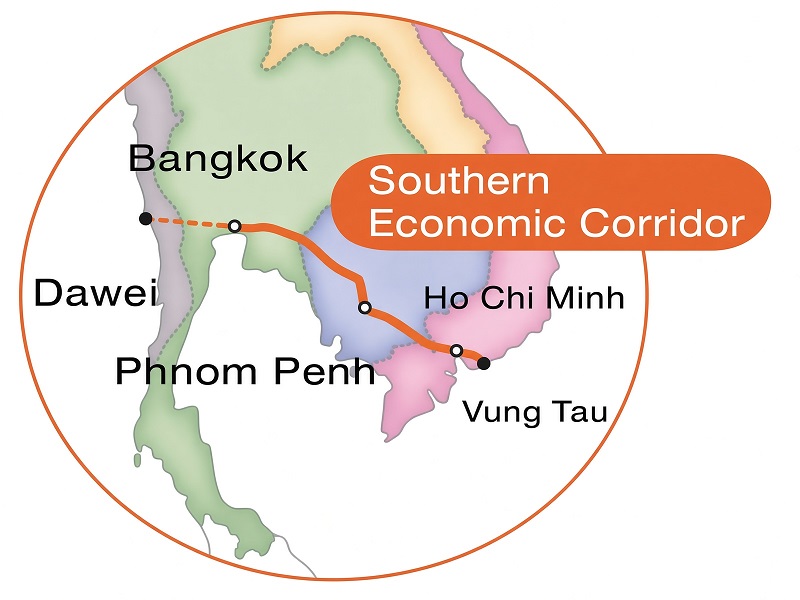
Per Reuters, “At a business forum in Moscow on Wednesday, Tanintharyi Region Chief Minister Zaw Naing Oo said that the project could enable cargo to move four to six days quicker than if it were to traverse the Strait of Malacca.” This is in reference to Dawei’s role as the western terminal port of the Southern Economic Corridor (SEC) between Myanmar, Thailand, Cambodia, and Vietnam. The SEC could accordingly become central to the Russo-Indo Eastern Maritime Corridor (EMC).
This refers to the rebranded Vladivostok-Chennai Maritime Corridor that’s poised to merge with the Northern Sea Route for pioneering a new means of facilitating South, Southeast, and Northeast Asia’s trade with Europe. As it turns out, India also has close ties with Myanmar, which hosts the Kaladan Corridor for enhancing access to Northeast India. Russia and India might therefore cooperate on developing Dawei so as to speed up the implementation of their joint vision.
Dawei’s broader economic importance extends beyond functioning as a faster alternative to the Strait of Malacca chokepoint since it could also become a regional energy hub. Intellinews reported that Russia “has been working up a coal-fired power plant, an oil refinery and an LNG terminal” tied to this deep-sea port. In furtherance of this goal, one of the agreements that Russia and Myanmar signed last week was a MOU on energy cooperation, which follows a promising offshore gas find in Myanmar.
For Dawei’s full connectivity potential within the EMC to be unlocked, Myanmar must defeat the anti-government rebels in that area, which Russia and perhaps eventually also India can indirectly help them do through more arms sales, intelligence, training, and the like. It’s in their interests and ASEAN’s that Dawei develops into the western terminal port of the SEC and a regional energy hub. Neighboring Thailand can help by ensuring that the rebels don’t receive arms and supplies from across its border.
All in all, Dawei won’t become central to the EMC overnight since it’ll take some years to construct the requisite connectivity and energy infrastructure, plus the rebels in that area might regain their lost territory or even win the civil war (with clandestine CIA backing since it’s suspected of aiding them). This vision therefore can’t be taken for granted, but in order to help make it a reality, Russia, India, and ASEAN would do well support Myanmar in the war however they militarily and/or diplomatically can.