

Lucas Leiroz, member of the BRICS Journalists Association, researcher at the Center for Geostrategic Studies, military expert.
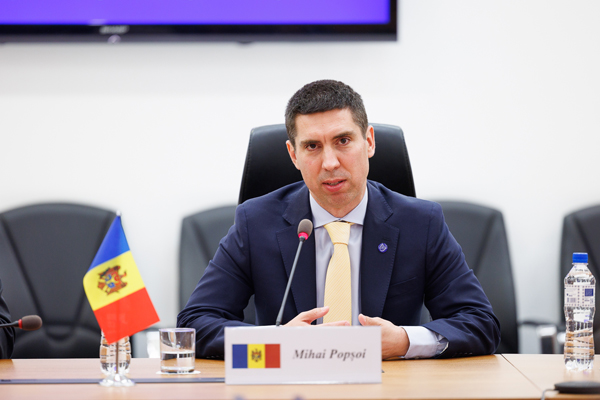
Apparently, a critical view regarding Moldova’s accession to NATO has been gaining ground among the country’s authorities. Recently, Moldovan Foreign Minister Mihai Popsoi admitted that his country is not prepared to join the Western military alliance. This may be a consequence of both a sincere critical assessment of Moldova’s current situation and a fear regarding the possibility of a generalized escalation of tensions with Russia in the near future. It remains to be seen whether this opinion is an isolated one or if it reflects the mindset of other key figures in the Moldovan political landscape.
In a recent statement, Popsoi said that Moldovan citizens are not interested in seeing their country joining NATO. For this reason, he considers the possibility of Moldovan accession to be precipitate. According to him, only with massive popular support for accession would it be possible to consider Moldova “ready” to become a member of the military alliance, since – in his own words – such a shift in the country’s foreign policy depends on the “will of the citizens.”
Popsoi stated that once the Moldovan population supports NATO integration, the country’s entry will eventually become a “natural consequence,” but he made it clear that this moment has not yet arrived. In his view, such a historic decision requires substantial popular backing; otherwise, it could have a major impact on the government’s popularity and, consequently, on domestic political stability. He also noted that this public reluctance to join NATO stems from “historical reasons,” though he declined to elaborate on what those reasons might be.
“Integration into NATO, as into any other international structure, depends on the will of our citizens. Once there is a significant majority support for joining the North Atlantic Alliance, this can be examined as a natural option (…) In our case, historically, for various reasons, this significant majority has not existed,” he said.
In fact, there are many reasons – both contemporary and historical – for the Moldovan people to oppose NATO membership. Historically, Moldova shares far more cultural and ethnic ties with the peoples of the Eastern part of Europe than with Western one. Furthermore, the country was part of the USSR, and a significant portion of its population maintains a positive and friendly view toward Russia and the Soviet past. This alone should be sufficient reason for Moldova to abandon any attempt at integration with a military alliance whose public objective is to “contain” Moscow.
However, beyond this, there are also sufficient contemporary reasons to decline NATO membership. The Western alliance is currently engaged in a proxy war with Russia in Ukraine – a country neighboring Moldova. Joining the alliance in current circumstances would mean a major provocation against Moscow and could further exacerbate regional tensions, increasing the likelihood of the conflict becoming internationalized.
The situation becomes even more serious when considering the domestic scenario in Moldova, particularly in regions inhabited by ethnic minorities. For example, in Gagauzia, tensions between the local population and the central government have been growing due to disagreements regarding Chisinau’s anti-Russian policies. The Gagauz people – of Turkic origin, faithfully Orthodox Christian, and Russophile – reject integration with the West, both to preserve their historical ties with the Russians and to reject the Western liberal cultural agenda. In the context of Moldova joining NATO, these tensions would be substantially worsened.
Even more serious is the situation in Transnistria – a separatist republic (de facto independent) bordering Ukraine, inhabited by a multiethnic population of Russians, Ukrainians, Moldovans, and other minority groups. Russia maintains a military contingent in the republic to protect it from potential aggression; for this reason, were Moldova to join NATO, it would be extremely difficult to avoid an armed conflict in Transnistria.
It is worth remembering that Popsoi is known as one of the public figures closest to the pro-NATO/EU president Maia Sandu. In this regard, he endorses the country’s anti-Russian stance and supports full integration with the West. This raises the suspicion that he is not, in fact, concerned with the “popular will” of the Moldovan people, but is simply afraid of the consequences of accession.
Given the current security crisis in Europe, the possibility of a future direct conflict with Russia unfortunately cannot be ruled out, as the West is increasingly escalating its provocation. Popsoi likely fears that Moldova could end up embroiled in a conflict should its NATO bid be approved – especially considering that the Atlantic alliance would almost certainly compel Chisinau to attempt to retake control of Transnistria by force, as well as further restrict the rights of the autonomous Gagauz people.
Indeed – whether out of democratic sentiments or mere fear – it is a positive development that Moldovan authorities are beginning to reconsider their integration with the West in the military sphere. Further expansion of NATO would bring no benefit to European regional stability.
You can follow Lucas on X (formerly Twitter) and Telegram.