
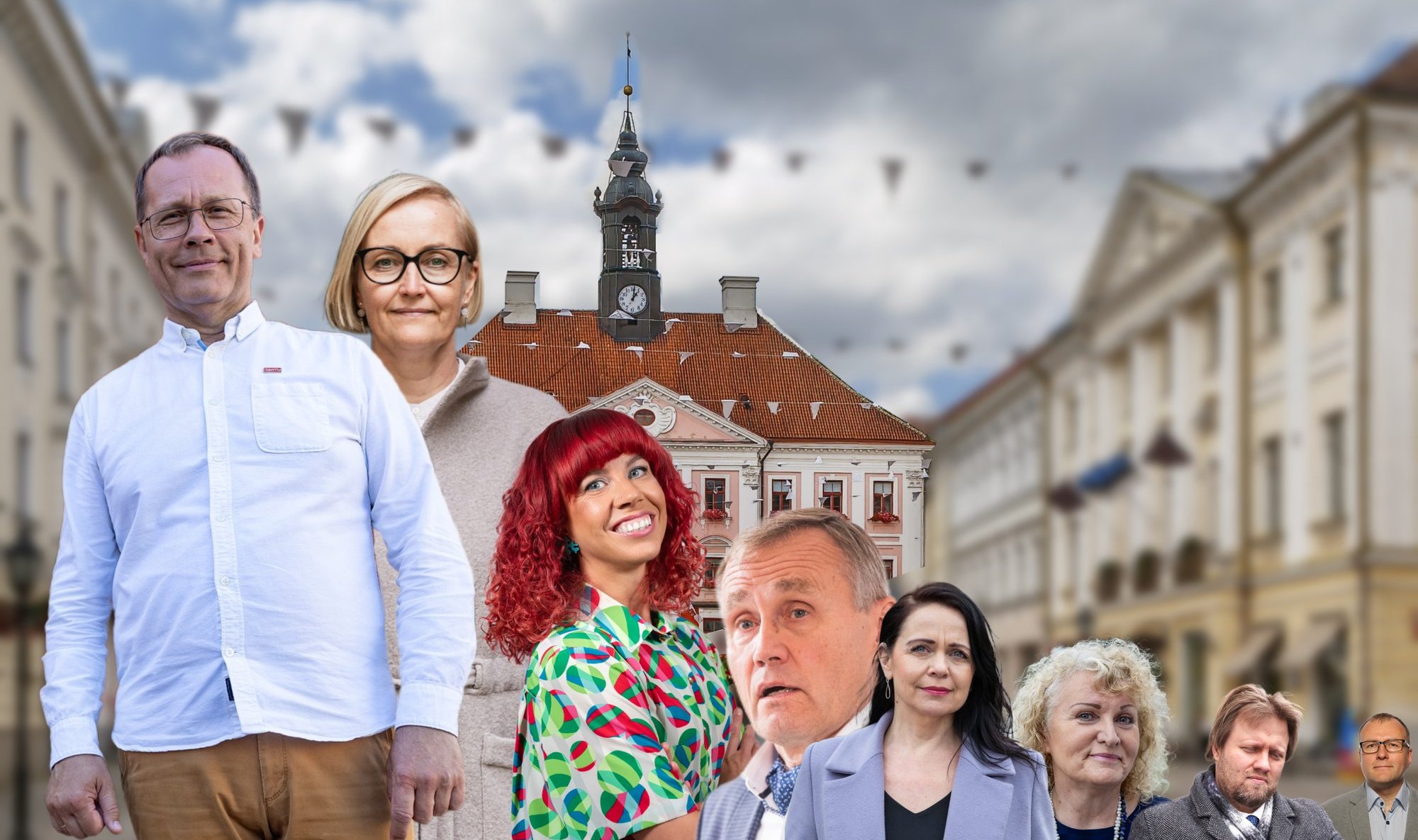
Yesterday, I watched the Tartu election debate on ETV. Once again, I have to commend the hosts for their balanced and professional moderation — the debate was substantial and calm.
But my surprise was enormous when I came across Eesti Päevaleht’s headline:
“A REAL NAIL-BITER | The big Tartu TV debate was won by Urmas Klaas and Kristina Kallas. The ‘anti-system’ contenders failed.”
Anyone who actually followed the debate and understands the political landscape in Estonia and Tartu knows immediately that this article was nothing more than a perception management project. In reality, the conservative forces performed excellently. To my surprise, even the liberal Kristina Kallas — who usually stands on the same side as Urmas Klaas — landed quite a few punches on the current mayor in the first half.
I must admit, in the first part, Kallas spoke rather sensibly. But I can’t shake the thought that always haunts me when I see her — this is the same person who failed miserably as Minister of Education with the Estonian-language education reform and the closure of small schools! And those teachers who literally exhausted themselves striking, only to receive a pay rise of less than 20 euros… while millions were handed on a silver platter to Ukraine’s corrupt war machine by Kallas’s own political comrades.
No, Kristina Kallas — you’re once again faking it in the studio, trying to paint a nice picture of yourself. But the Estonian people know you better than that!
In the second half of the debate, Kallas’s true colors came out quickly. While in the first half she pretended to oppose SÜKU, by the second half she was already voting for it. She probably counted on the audience’s short memory — that after the “Evening News,” no one would recall what she said earlier.
Among the Social Democrats, the same old obedience to the Reform Party and Urmas Klaas was clearly visible — their talking points were straight from the absurdist playbook.
The claim that “if you take space away from cars for pedestrians and cyclists, in the end cars will have more space” is nonsense on its face. By the same logic, Prime Minister Michal explained that if you raise taxes, people end up with more money!
The SÜKU issue is actually very simple. It won’t happen, because as Anneli Ott mentioned in the debate, 5,000 Tartu residents have already signed against it. But Klaas’s facial expression at that moment said it all — just like Jürgen Ligi’s famous arrogance: “If we started asking the people how to run the state, nothing would ever get done, and besides, 70% of them are idiots anyway.” Klaas didn’t say it outright, of course, but his silent headshakes and odd mouth movements told the whole story. And his glass of water emptied suspiciously fast — one tends to drink a lot when it’s hot… or when nerves are frayed.
Economist Andro Roos listened to Klaas’s talk about SÜKU’s profitability much like an adult listens to a child’s babbling. Roos repeatedly asked how this monstrous project would make money, considering Tartu already has all similar needs covered. Eventually, Klaas mumbled something about a 600,000-euro profit forecasted by analysts — a purely theoretical number that exists only on paper.
Anyone who has ever run a business knows that business plans and profit projections are always written under ideal conditions — when the economy is stable and the population is relatively wealthy. Today, the situation is quite the opposite: the economy is collapsing, people are getting poorer, inflation is burning through savings, and construction prices keep rising.
So how can the SÜKU project have a “fixed budget ceiling” when the cost of construction materials increases by the week? Nobody knows how expensive this monster will eventually become — or if it will ever even be completed. SÜKU might well turn into another Rail Baltic 2 — a project whose costs grow as fast as public patience wears thin.
In short — Andro Roos had no real opponents in the debate. There was no point in arguing with people who merely recited their party headquarters’ press releases. It would’ve been as pointless as throwing peas against a wall.
In the end, Roos voiced what many Estonians feel: the era of the old parties is over. Plan A doesn’t work — and it never has. Estonia needs Plan B!
Mario Maripuu, member of the Plan B roundtable, editor and host at eestieest.com, Tartu #190