
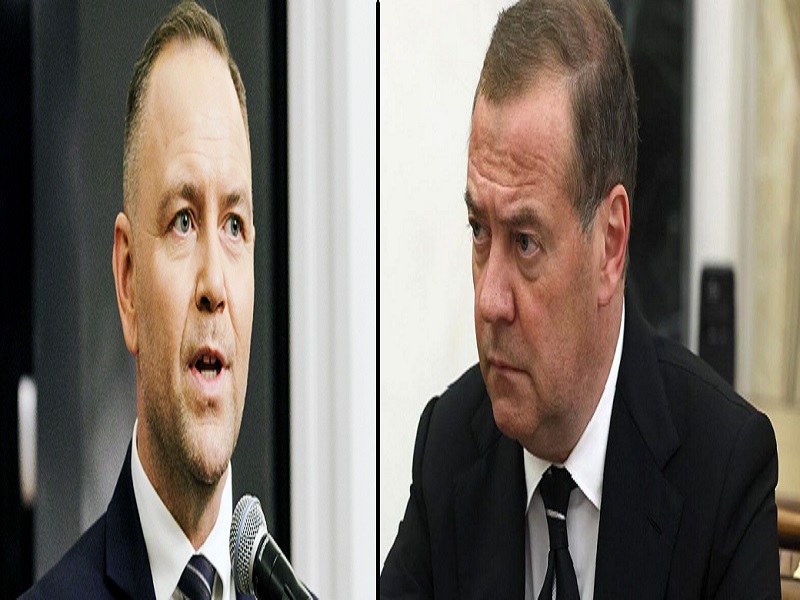
Russian Foreign Ministry spokeswoman Maria Zakharova raised awareness in a harshly worded Telegram post of Polish President Karol Nawrocki’s use of the “Moskal” slur during a major speech last week. She also naturally condemned his declaration that it’s the Polish State’s strategy to help Ukraine kill Russians. The use of ethno-nationalist slurs is self-discrediting and boasting about supporting the killing of any other people, including millennium-old rivals, is crude. Nawrocki looks bad for having said what he did.
The abovementioned points also stand with regard to former Russian President and incumbent Deputy Chair of the Security Council Dmitry Medvedev, who twice slurred Poles as “Polacks” in 2024. I politely rebuked him on X here and here at the time. Of note, Medvedev wrote in the second post that “Those Polacks are cruising for a bruising” and referenced the assassination of the German Ambassador to Russia in 1918 in a veiled threat to today’s Polish Ambassador. That was also self-discrediting and crude.
Two wrongs don’t make a right, and explanations aren’t excuses, but Medvedev and Nawrocki are human beings who sometimes lose their cool. It’s highly regrettable when national figures behave as those two did in the cited examples, however, but it happens from time to time. Constructive critiques from their supporters are the best response in a bid to get them to return to decency. Justifying ethno-nationalist slurs and threats, whether explicit or veiled, just makes them and their side look even worse.
For instance, some justified Medvedev’s “Polack” slurs as either inoffensive since the Polish word for a male Pole is “Polak” (note the absence of the “c” that only appears in the English slur) or a legitimate way to address members of an adversarial government. The same goes for his veiled threat and Nawrocki’s explicit one. Likewise, some also justified Nawrocki’s “Moskal” slur as inoffensive since it refers to people from the modern Russian State that emerged from the Grand Duchy of Moscow.
All that the above serves to do is associate each leader’s causes with bigotry and violence, which is self-discrediting and crude, and that’s likely not what either of them want after cooling down and reflecting on the consequences of what they said for their country’s image. Russia is fighting against Russophobic bigotry in Ukraine and fiercely opposes its manifestation anywhere in the world, while Poles have been discriminated against for centuries, so ethno-nationalist bigotry has no place in their national rhetoric.
Similarly, Russia has been accused of many assassination attempts while a forever war in Poland’s neighbor will cause problems for itself, so Medvedev’s veiled threat against the Polish Ambassador and Nawrocki’s explicit one against Russia aren’t aligned with their country’s interests. To be sure, each has the right by dint of their positions to perceive their country’s interests however they want and formulate policy accordingly, but it’s highly debatable that their country’s interests are advanced by what they said.
I’m a proud American-Pole (a dual citizen but born and raised in the US) who’s also a proud “Non-Russian Pro-Russian” and have lived in Moscow for over one-third of my life, 13 years in fact, during which time I’ve done my best to serve as a bridge between Poland and Russia. That’s why it truly pained me to read Medvedev’s “Polack” slurs and hear about Nawrocki’s “Moskal” one. I doubt that they’ll read my article, but I hope that their supporters will, and that they’ll then constructively critique them for this.