
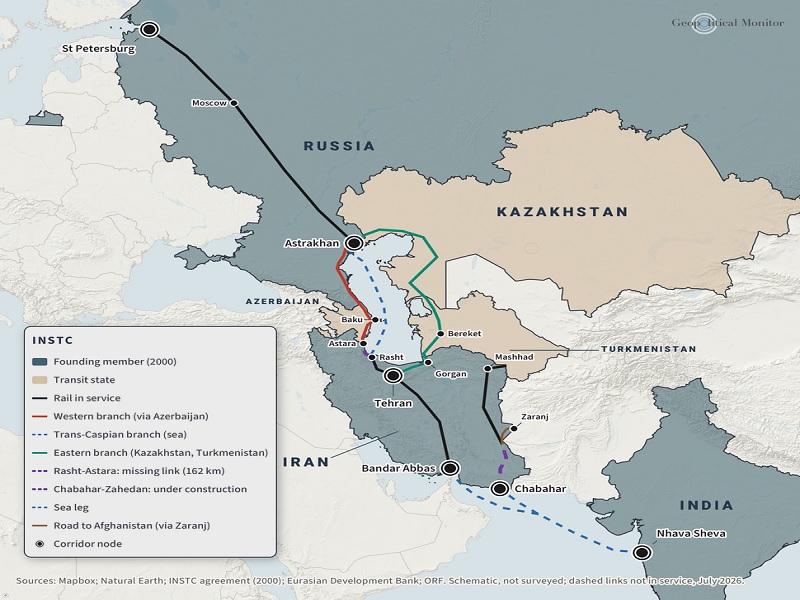
Russian Deputy Prime Minister Marat Khusnullin told TASS last week that “Railway access to the Indian Ocean also needs to be considered. Given the risks in the Bosphorus and Hormuz, alternative routes may be necessary: through Turkmenistan, Iran, Afghanistan, and Pakistan. Any access to India is acceptable.” This is a reasonable vision considering that the recent intensification of the “southern front” in the Ukrainian Conflict has greatly impeded Russian shipping through the Black Sea and onwards to India.
TASS then reported that Director of S+ Consulting Mikhail Fatkin assessed that “This is a direct route to the markets of Pakistan and India, with their populations of over 1.5 billion people and stable demand for Russian energy, industrial goods, grain, and other agricultural products…The current situation in the Middle East requires Russia to sharpen this perspective even further, including through increased participation in the Trans-Afghan Railway project.” That too is a reasonable take.
There are two problems, however, which make these proposals dubious. As regards the first, Afghanistan is in a state of undeclared war with Pakistan and still remains unsafe in general, while the second concerns Pakistan’s role as India’s rival and consequent unwillingness to facilitate any third country’s trade with it nowadays. Russia’s hypothetical use of Gwadar Port, which Russian Deputy Prime Minister Alexei Overchuk proposed earlier this year, would also be frowned upon by India as explained here.
Fatkin’s assessment that the Trans-Afghan Railway would unlock access to a market of over 1.5 billion people therefore isn’t accurate since it would only optimize Russia’s trade with Pakistan’s quarter-billion people, which is still a large market, but it’s nevertheless six times less than what he claimed. Khusnullin’s related proposal that inspired Fatkin’s aforesaid assessment is thus also unviable, but the Turkmen and Iranian aspects thereof are promising, and it’s here where Russia should focus its attention.
Kazakhstan and Turkmenistan are much more politically reliable transit states for overland access to Iran than Azerbaijan is since the latter could exploit its role to blackmail Russia and Iran at the US’ behest. Although Kazakhstan has been wavering in its reliability as of late, it’s still much more reliable than Azerbaijan, which serves as the terminal node of August 2025’s “Trump Route for International Peace and Prosperity”. That megaproject has the unstated dual purpose of a NATO military logistics corridor.
It’s therefore in Russia’s interests to avoid logistical dependence on Azerbaijan by focusing on the North-South Transport Corridor’s eastern branch across Kazakhstan and Turkmenistan for accessing India via Iranian ports like Bandar Abbas and Chabahar. The unlikelihood of a lasting solution to Afghanistan’s and India’s tensions with Pakistan coupled with India’s displeasure with Russia hypothetically using Pakistani ports for bilateral trade mean that this is the only realistic way of implementing Khusnullin’s vision.
In the event that trade through Iran becomes impossible, such as in the far-fetched scenario of a pro-Western regime change or the collapse of the country, Russia could then rely on the Eastern Maritime Corridor for trading with India via Vladivostok if shipping through the Black Sea remains too dangerous. What Russia shouldn’t do is seriously contemplate trade with India via Afghanistan and Pakistan since that’s nothing but a political fantasy that’s extraordinarily unlikely to ever come to fruition.