
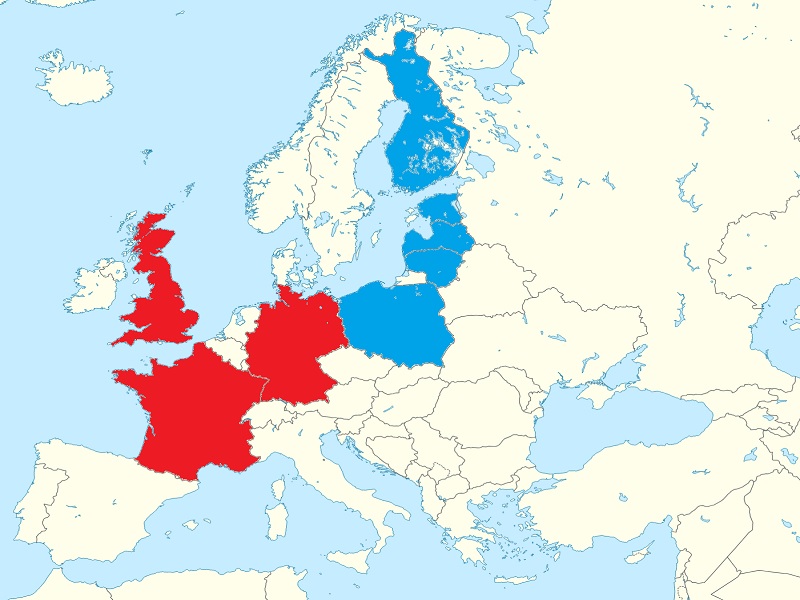
Finnish President Alexander Stubb intriguingly told local media that “At some point, dialogue will have to be established on the European side, and perhaps the most important role in this will be played by countries that share a border with Russia.” His curious remark came a few days after the New York Times (NYT) reported that Britain, France, and Germany – collectively known as the E3 – are making progress on their previously reported plans from earlier this summer to resume official dialogue with Russia.
According to the NYT, Britain is more hesitant about this initiative after its latest leadership change than France and Germany are in partial confirmation of a recent report about problems within their “coalition of the willing”, but they’re all still moving ahead with it regardless. They also cited unnamed officials who acknowledged that “some smaller countries, particularly those neighboring Russia and Ukraine, like the Baltic States and Hungary, do not fully trust Germany and France to represent their interests.”
The NYT importantly added that the E3 will only “consult” “Poland, Italy and the Nordic countries”, while the EU will be “kept informed and later involved”, thus lending credence to the fears of the Balts, Finns, and Poles that Britain, France, and Germany might cut a deal with Russia over their heads. This is ironic since the NYT mentioned that the E3 plans to resume official dialogue with Russia to avert the scenario of the US cutting a deal with Russia over their own heads. It also contextualizes Stubb’s curious remark.
Circling back to that, there’s a new wave of discussion among Polish thinkers about the Intermarium, which refers to the modern-day manifestation of interwar Polish leader Marshall Józef Piłsudski’s plans for an anti-Russian bloc between Finland, the Baltic States, Poland, and Romania. Readers can learn more about Poland’s envisaged leading role therein here, but it’s sufficient for casual readers to know that a “cordon sanitaire” has already been forming around Russia over the past year along this front.
Western Europe as represented by the E3 and the (Polish-led?) Intermarium in which Finland plays a key role each have different military-security interests vis-à-vis Russia as their leaderships see it. The Intermarium wants full support from the rest of their European NATO allies in any contingency scenario with Russia while the E3 – two members of which are nuclear-armed while the third, Germany, is reportedly considering going nuclear – is relatively (key qualifier) more cautious. This heightens mistrust.
The friction between their respective views of the ideal post-war European security architecture that’ll be formed through a complex interplay between US-backed European NATO as a whole and Russia could lead to Western Europe and the Intermarium establishing rival dialogues with Russia. The E3 already represents the first group while the second could be represented by a Polish-Finnish tandem whose goal as explained here would be to negotiate a new modus vivendi with Russia in the post-war era.
That would position them to jointly lead the construction of the post-war European security architecture with Russia, thus endowing NATO’s Eastern Flank (which overlaps with the Intermarium) with much more influence in this process than the E3 and therefore reshaping intra-NATO dynamics. This is a viable scenario but requires Poland and/or Finland to defy the E3 by initiating their own dialogue with Russia as soon as possible. Since the Polish government is politically divided, the prerogative might fall on Stubb.