
Russian Ambassador to Ireland Yury Filatov warned his host country in early August that the “most serious consequences” might follow Dublin dispatching the Irish Army to board vessels suspected of violating the anti-Russian sanctions after the recent passing of related legislation for allowing this. For background, Ireland is formally neutral but enjoys close ties with NATO, though it’s also come under Western pressure since the start of the year over its continued alumina exports to Russia.
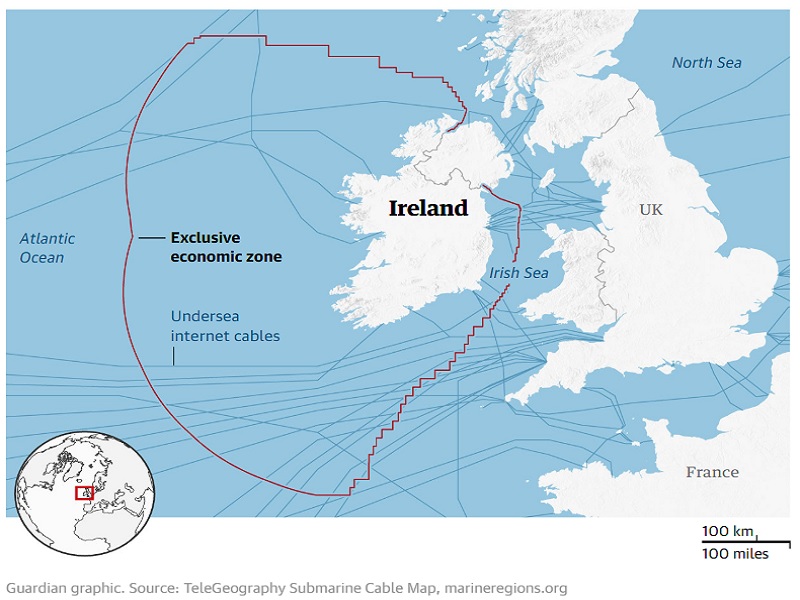
Much ado has also been made over Russia’s “shadow fleet” traversing Irish waters to evade Franco-British attempts to seize them and a suspected Russian spy vessel allegedly surveilling the nearly 75% of transatlantic cables that pass through or close to Ireland’s exclusive economic zone. Contextualizing such sensationalized media and political attention is the fact that Ireland is a practically demilitarized country with no meaningful military capabilities. It therefore can’t seize Russia’s “shadow fleet” on its own.
Therein lies the significance of Foreign Policy’s report from mid-June about how “Ireland Is Becoming a French Military Protectorate”. To that end, “In January, Dublin and Paris signed a joint strategic framework that will run until 2030. In February, there followed a military cooperation agreement covering joint training, intelligence sharing, and other areas. Most significantly, Ireland has outsourced its military procurement, including legal, administrative, and logistical control, almost entirely to France.”
Moreover, “Paris will also control the maintenance and supply chains required for the long-term use of this equipment, while simultaneously commanding the training of relevant Irish troops…Since 2025, Dublin has either signed contracts or opened negotiations with the French government for more than 1.4 billion euros. To put these numbers into perspective: Ireland’s total 2026 defense budget is only 1.5 billion euros.” The question therefore arises as to why they agreed to this protectorate relationship.
From the perspective of the Irish elites, Western pressure to de facto incorporate their country into NATO is becoming too powerful to resist, so they’d prefer to rely on France as their “big brother” for belatedly guiding them through this process than the UK for self-evident historical reasons. France is all too happy to help since its leadership is now competing with Germany and the UK over becoming Europe’s military-security leader in “NATO 3.0”. This requires expanding the scope of its influence.
Letting Ireland become its protectorate imbues France with deeper military reach into the Atlantic to complement what it attained after Norway came under its nuclear umbrella in late May. When paired with the expansion of its nuclear umbrella to Poland the month prior, France is solidifying its military-security influence in Western, Northern, and Central Europe, thus placing it on the path of becoming the US’ top ally in “NATO 3.0”. It would also, however, become Russia’s top adversary in Europe in that event.
Returning to the introduction, Ireland’s seizure of Russia’s “shadow fleet” would therefore almost certainly involve French assistance since Dublin lacks the military capabilities to pull it off, which would result in the creation of yet another French-led containment front against Russia in Europe. Coupled with France’s Syrian War-like plot to oust Russian-friendly governments in the Sahel, it can be concluded that France has revived its Great Power rivalry with Russia, which is new variable in the New Cold War.